III. The ESPDResponse XML document
Data Model overview
The UML Diagram below provides a simplified view of the ESPDResponse document. Notice that the classes herein represented belong to different data-packages. Hence each class name is preceded by different prefixes representing their corresponding namespaces: "espd::", "ccv::", "cev::", "cac::" (see '' Table 1. Schemas, namespaces and prefixes used by the ESPDResponse''). [1]
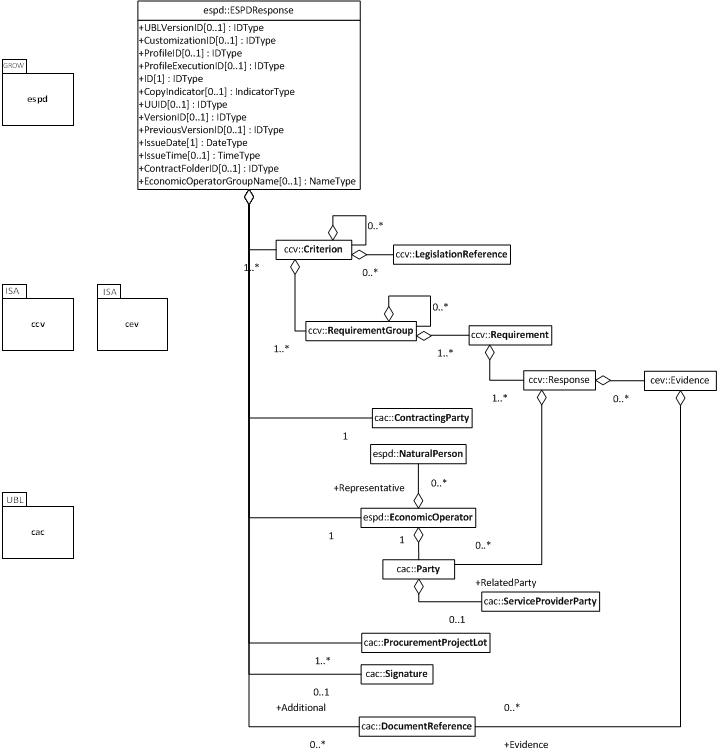
As you can see in the diagram more than 50% of the classes were already defined in UBL-2.1 (cac-prefixed classes). Moreover, many of the "root" elements in the espd:ESPDRequest class reuse UBL-2.1 Common Basic Components. This document does not represent nor describe in its entirety the entities modelled in UBL that are re-used in the ESPD. Any detail on the model, schemata, and any other artefact relating to UBL-2.1 can be freely downloaded here: http://docs.oasis-open.org/ubl/os-UBL-2.1/UBL-2.1.html. Nonetheless those parts of the UBL components that are commonly used in the ESPD documents are herein sufficiently identified and commented.
This other figure below shows a graphical view of the XSD Schema implementation corresponding to the above UML diagram.
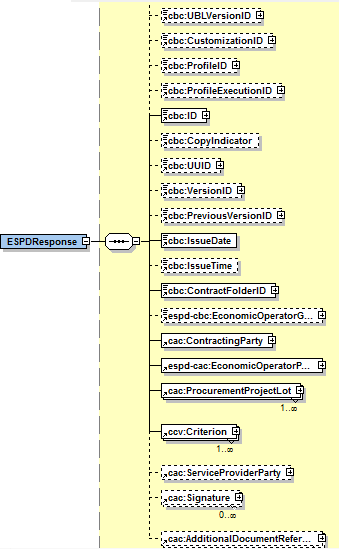
According to the UML Diagram an ESPDResponse XML document is represented by the class espd:ESPDResponse.
This ''root'' class aggregates other classes (which in turn aggregate sub-classes).
The list below summarises the use of each of these classes. Further on, in this document,
each class is analysed and illustrated in more detail:
-
The
cac:ContractingParty, defined in UBL-2.1, is used to specify data relating the Contracting Authority, Body or Entity. All ESPD Requests MUST provide some basic data about the Contracting Body. -
The
espd:EconomicOperatorclass is defined by COM as a placeholder for all the data related to the Economic Operator. This class aggregates an espd:RepresentativeNaturalPerson class intended to gather the data of the legal representatives of the EO. It also reuses the UBL-2.1 cac:Party class. -
The
cac:ProcurementProjectLotclass was also defined in UBL-2.1 to hold data about the Lots in which a Procurement Project has been divided. The ESPD Request XML documents MUST use this class to specify whether the Procurement Project has lots or not and to identify them. Although the ESPD-EDM model was designed to support multiple lots, the current version of the ESPDService, however, still does not fully uses this feature and permits only to describe them. -
The
ccv:Criterionclass belongs to the Core Criterion Vocabulary data-package, thus the ccv: prefix.[2] . It is a compulsory element of multiple cardinality allowing for the specification of both the exclusion and selection criteria in an ESPD Request. -
cac:ServiceProviderPartyis a specialisation of the cac:Party class, both defined in UBL-2.1. It is used to inform about the party responsible of the system that provided the data included in the document; e.g. a pre-qualification system, a procurement platform, etc. The absence of this element indicates that the data has been provided by the Economic Operator itself. -
cac:Signatureclass is used to include an electronic signature in the document. In general, the presence of an electronic signature aims at ensuring authenticity, integrity and non-repudiation. Different methods of signing an electronic document exist, and some of them do not need embedding the signature in the document. The cardinality 0..1 of this class in theespd:ESPDRequestdocument allows the use of other electronic signature methods that do not imply the use of this class in an ESPD Request XML document. Therefore, the absence implies that authentic, integrity, etc. are solved by other means. -
cac:AdditionalDocumentReferenceis used to include external references to information that can be accessed from a URL. In contracts above the threshold this element is used by the CA in the ESPDRequest to refer to the Contract Notice published in TeD. Other documents or information accessible through a URL that might be considered relevant MAY be specified by the Contracting Authority (in the ESPDRequest) or by the EO (in the ESPDResponse) through the use of multiple instances of this element.
The next sections deal with the specific details of each one of these classes and provide guidelines, rules and examples on how to produce XML documents that are conformant with the ESPD Service ESPDResponse XML document and for contracts above the threshold.
|
All the reference data artefacts in a bunch file
The text and tables below (about the classes, properties and attributes of the ESPD-EDM model) make reference to code lists, which use is compulsory in many cases. These references provide links to the specific code lists therein referred to. The links allow for the downloading of a PDF file with the metadata about the list and the values and descriptions of each code. Click on the links to download and examine the code list you are interested in. The ESPD Service uses Schematron and the OASIS Genericode 1.0 specification for the validation of externalised codes. If you need the Genericode files you can download them altogether, jointly with the code lists PDF files, from this zip volume. |
Root properties
The ESPDResponse main class represents the entire ESPDResponse documents. All the data (root properties) of the document "hang" directly from the class or are other classes associated to it.
As for all documents designed upon the UBL-2.1 Naming and Design Rules (NDR), this main class uses several UBL-2.1 common basic components. Although most of them are optional the ESPD Service expects the following ones:
| Property | Description | Example | Mandatory? | Rules & comments |
|---|---|---|---|---|
cbc:UBLVersionID |
Identifies the earliest version of the UBL 2 schema for this document type that defines all of the elements that might be encountered in the current instance |
|
OPTIONAL (0..1) |
|
cbc:CustomizationID |
Identifies a user-defined customization of UBL for a specific use. |
|
OPTIONAL (0..1) |
|
cbc:CopyIndicator |
Indicates whether this document is a copy (true) or not (false) |
|
OPTIONAL (0..1) |
|
cbc:VersionID |
Indicates the current version of this ESPDResponse XSD Schema |
|
OPTIONAL (0..1) |
|
cbc:IssueDate |
The date, assigned by the sender, on which this document was issued |
|
MANDATORY (1..1) |
|
cbc:IssueTime |
The time, assigned by the sender, at which this document was issued |
|
OPTIONAL (0..1) |
|
cbc:ID |
An identifier for this document, assigned by the sender |
|
MANDATORY (1..1) |
|
cbc:ContractFolderID |
An identifier, assigned by the sender, for the process file (i.e., record) to which this document belongs |
|
MANDATORY (1..1) |
|
Associated classes |
||||
ext:UBLExtensions |
A container for all ad-hoc (non standard) extensions present in the document. |
OPTIONAL (0..1) |
|
|
cac:ContractingParty |
The contracting authority or contracting entity who is buying supplies, services or public works using a tendering procedure as described in the applicable directive (Directives 2014/24/EU, 2014/25/EU). |
MANDATORY (1..1) |
|
|
espd-cac: EconomicOperatorParty |
Any natural or legal person or public entity or group of such persons and/or entities, including any temporary association of undertakings, which offers the execution of works and/or a work, the supply of products or the provision of services on the market. Information about the party submitting the qualification. |
MANDATORY (1..1) |
|
|
cac:ProcurementProjectLot |
One of the parts of a procurement project that is being subdivided to allow the contracting party to award different lots to different economic operators under different contracts |
MANDATORY (1..n) |
|
|
ccv:Criterion |
A condition that the economic has to meet in order to not be excluded and be selected as a candidate for awarding in a procurement procedure. |
MANDATORY (1..n) |
|
|
cac: ServiceProviderParty |
The organisation that provided the data about the procurement project, the Contracting Authority and/or the Economic Operator |
OPTIONAL (0..1) |
|
|
cac:Signature |
The signature of the Economic Operator or of its representative |
OPTIONAL (0..n) |
|
|
cac: AdditionalDocumentReference |
A reference to an additional document |
OPTIONAL (0..n) |
|
|
Additionally to the above properties, the ESPDResponse XSD Schema defines other root properties that the class ESPDResponse does not uses currently. If you use them in your own XML documents the ESPD Service will skip them (i.e. no exception would be thrown).
| Property | Description | Example | Mandatory? | Rules & comments |
|---|---|---|---|---|
espd-cbc: Economic Operator GroupName |
The name of the Consortium or group to which the Economic Operator belongs for a specific procurement project |
|
OPTIONAL (0..1) |
Comments: This property is not used (yet) by the ESPD Service. Future releases will take it into account |
cbc:PreviousVersionID |
Indicates the version immediately previous to the earliest version of this ESPDResponse XSD Schema |
|
OPTIONAL (0..1) |
|
cbc:ProfileID |
Identifies a user-defined profile of the customization of UBL being used |
|
OPTIONAL (0..1) |
Comment: Example source http://www.datypic.com/sc/ubl21/e-cbc_ProfileID.html |
cbc:ProfileExecutionID |
Identifies an instance of executing a profile, to associate all transactions in a collaboration |
|
OPTIONAL (0..1) |
Comment: Example source http://www.datypic.com/sc/ubl21/e-cbc_ProfileExecutionID.html |
cbc:UUID |
A universally unique identifier for an instance of this document |
|
OPTIONAL (0..1) |
Comment: Example source http://www.datypic.com/sc/ubl21/e-cbc_UUID.html |
UBLExtensions element
The UBL 2 Naming and Design Rules (NDR) establish that the first element of a
UBL-conformant XML document should be ext:UBLExtensions element. If used the
UBLExtensions MUST instantiate one or more UBLExtension sub-elements.
The current version of the ESPDResponse documents does not UBLExtensions, but you could use it for your own internal purposes. If specified in an XML document the ESPD Service would skip it.
According to the UBL 2 Guidelines for Customization the UBLExtension element found at the beginning of all UBL documents allows communities of interest to specify additional information entities as part of a UBL standard document. The UBLExtension element is not one of UBL’s information entities. It is a structural device that allows arbitrary extensions to a UBL document type without affecting UBL conformance.
There are two situations where UBLExtension may be considered appropriate:
-
Where the requirement is to incorporate alien content in a standard UBL document type that cannot be contained as an Attachment.
-
Where a customizing organization wishes to extend information entities in a standard UBL document type and still have their documents be validated by the standard UBL schema.
Contracting Party
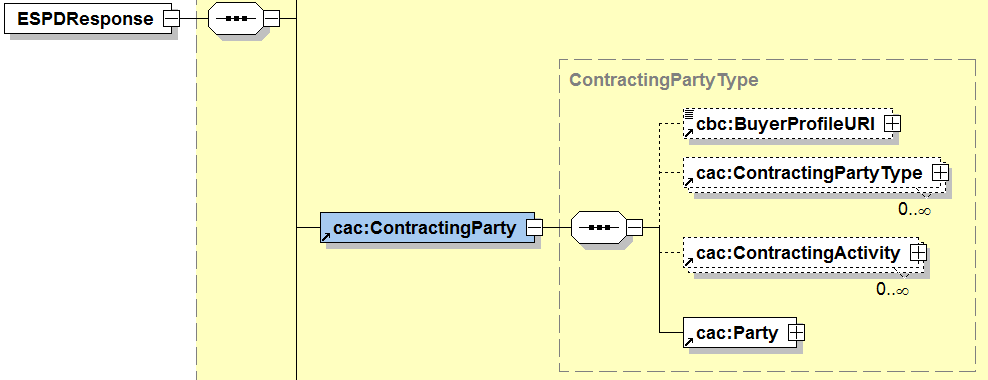
The class cac:ContractingParty was defined in UBL-2.1 (hence the prefix cac:).
This UBL class is a specialisation of the very rich UBL-2.1 aggregate component cac:Party.
The ESPDResponse only uses a reduced subset of its data, although the XSD Schema imports it in
all of its richness (so you could use it for your own purposes beyond the ones expected by the
ESPD Service). See the UBL-2.1 specification for all
the details about the cac:Party Common Aggregate Component.
Class cac:ContractingParty
The table below lists the attributes and associated classes expected in an XML conformant to the ESPD Service.
"A class representing the contracting authority or contracting entity who is buying supplies, services or public works using a tendering procedure as described in the applicable directive (Directives 2014/24/EU, 2014/25/EU)" [3] |
||||
Elements |
Description |
Example |
Mandatory? |
Rules & comments |
cac:PartyName |
The name of the contracting body |
|
MANDATORY |
|
cac:Country |
The country of the contracting body |
|
MANDATORY - (Although in the XSD Schema the cardinality is 0..n) |
|
| 1 | The name of the Contracting Body is mandatory but has been removed from this example to simplify the example |
| 2 | the country of Contracting Body is mandatory but has been removed from this example to simplify the example |
A complete example about the cac:Party elements of the cac:ContractingParty expected by the ESPD
Service follows:
cac:Party to identify the contracting body<cac:ContractingParty>
<cac:Party>
<cac:PartyName>
<cbc:Name>Executive Agency for Small and Medium-sized Enterprises (EASME)</cbc:Name>
</cac:PartyName>
<cac:PostalAddress>
<cac:Country>
<cbc:IdentificationCode listID="CountryCodeIdentifier" listAgencyID="EU-COM-GROW" listName="CountryCodeIdentifier" listVersionID="1.0.2">BE</cbc:IdentificationCode>
</cac:Country>
</cac:PostalAddress>
<cac:Contact/>
</cac:Party>
</cac:ContractingParty>Economic Operator
The ESPDResponse was explicitly designed to hold data about one single Economic Operator.
Thus, the ESPDResponse Exchange Data Model associates a class EconomicOperatorParty as
a placeholder for the data related to only one Economic Operator (EO) that
tenders solely to a procurement project, to one of the EOs that tender as part of a group
(e.g. a Consortium), or to one possible sub-contractor of the EO.
Consortia grouping more than one EO need to draft and submit as many ESPDResponses as Economic Operators and sub-contractors participate in the tender. Revisit the "Figure 7: espd::ESPDRequest UML class diagram" and check that its association to the epsd::EconomicOperatorParty class is restricted to 1. This element is therefore mandatory.
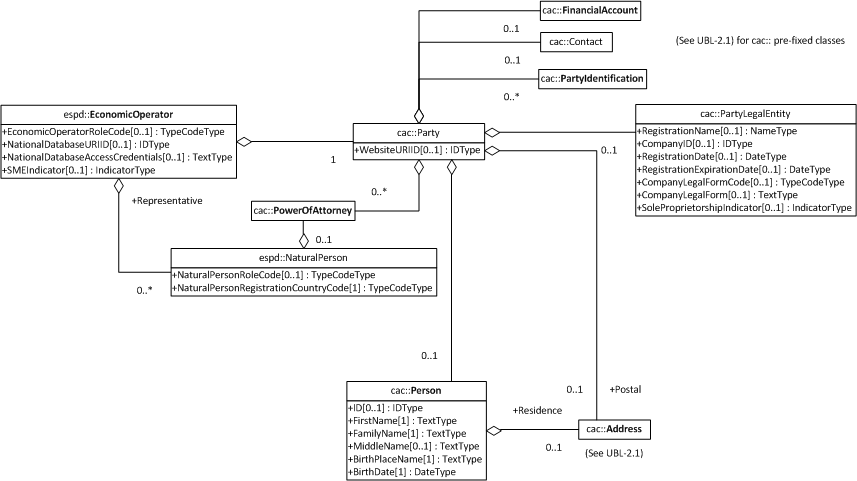
The UML diagram below shows the details about the class EconomicOperatorParty:
This other figure below shows the equivalent (abbreviated) XSD schema:
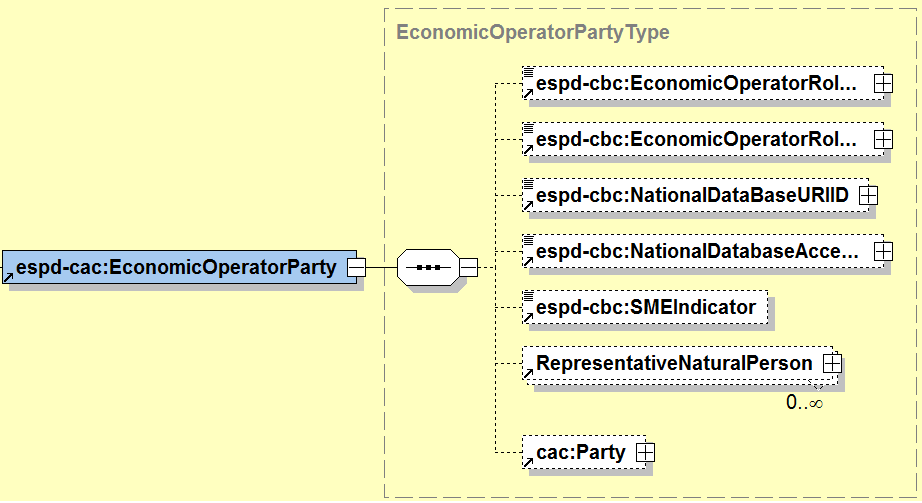
EconomicOperatorParty
The table below lists the attributes and associated classes expected in an XML conformant to the ESPD Service.
Beware that this class associates the very rich UBL-2.1 aggregate component cac:Party.
Similarly to what happens with the cac:ContractingParty, the ESPDResponse espd:EconomicOperatorParty
only uses a reduced subset of the component cac:Party.
"A class representing any natural or legal person or public entity or group of such persons and/or entities, including any temporary association of undertakings, which offers the execution of works and/or a work, the supply of products or the provision of services on the market in the context for which the tender where the ESPDResponse is submitted"[4] |
||||
Property |
Description |
Example |
Mandatory? |
Rules & comments |
espd-cbc:EconomicOperatorRoleCode |
The code for the role of the economic operator when bidding from a consortium |
|
OPTIONAL (0..1) - Currently not used in the ESPD Service |
|
espd-cbc: EconomicOperatorRoleDescription |
A short description for the role of the economic operator when bidding from a consortium |
|
OPTIONAL (0..1) |
|
espd-cbc: NationalDataBaseURIID |
Unrestricted and full direct access to tools and devices used for electronic communication is possible at this URL. |
OPTIONAL (0..1) |
|
|
espd-cbc: NationalDatabaseAccessCredentials |
Credentials (e.g. username and password) to access the national database |
OPTIONAL (0..1) |
|
|
espd-cbc: SMEIndicator |
Indicates whether the Economic Operator is an SME or not |
OPTIONAL (0..1) |
|
|
Associated classes |
||||
RepresentativeNaturalPerson |
Information about individuals who in one way or the other represent the economic operator |
OPTIONAL (0..n) |
Comment: Belongs to the ESPD spacename (espd-cac:) |
|
cac:Party |
The UBL-2.1 class used to hold data about the party that, in this case, is the Economic Operator |
OPTIONAL (0..n) |
|
|
RepresentativeNaturalPerson
UBL-2.1 defines a component PowerOfAttorney with that is a good container for the main data about a representativefootnote[cac:PowerOfAttorney also aggregates the cac:AgentParty, where many data about the person can be provided.]. However the ESPD stakeholders identified some data requirements that the UBL-2.1 component does not cater for; namely the role of the person (e.g. type of representation) and the country where this person is registered (i.e. in a civil base register).
The XSD diagram and table below show the details about the class EconomicOperatorParty:
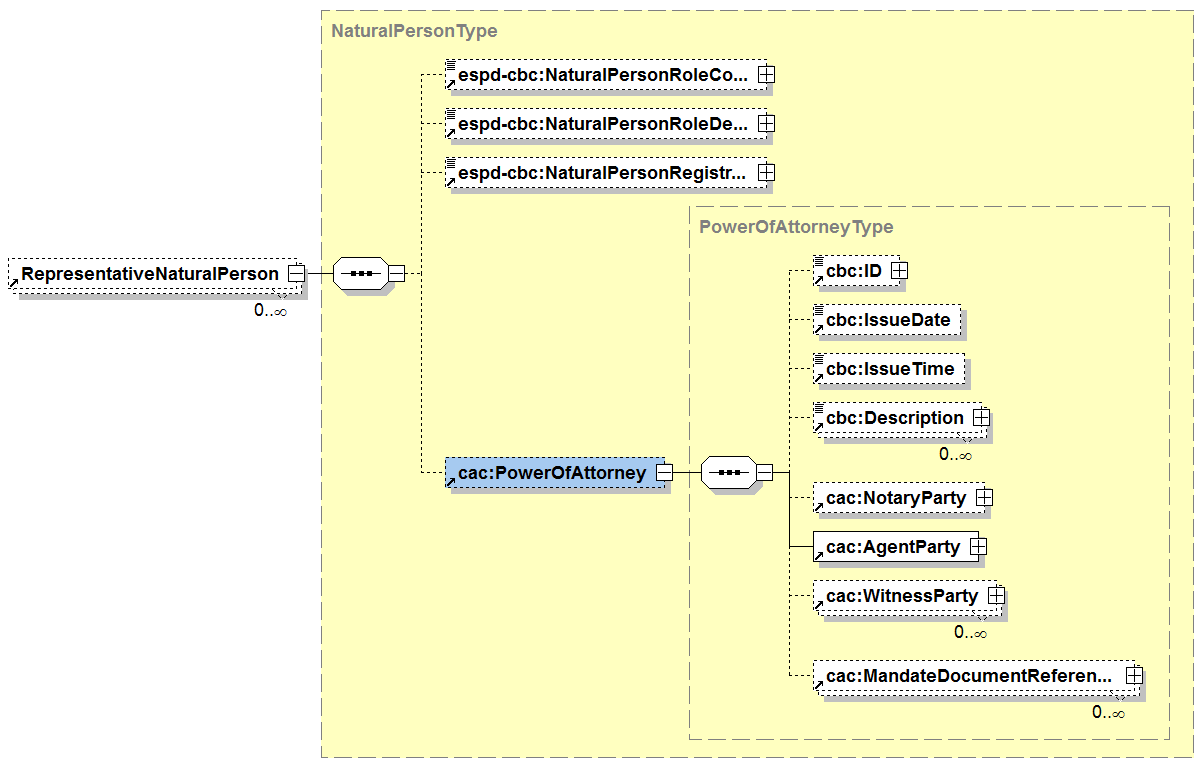
"A class representing an individual who in one way or the other represents the economic operator" |
||||
Property |
Description |
Example |
Mandatory? |
Rules & comments |
espd-cbc: NaturalPersonRoleCode |
OPTIONAL (0..1) - Currently not used (yet) in the ESPD Service |
|||
espd-cbc: NaturalPersonRoleDescription |
A short description for the role of the Economic Operator’s representative |
OPTIONAL (0..1) |
|
|
espd-cbc: NaturalPersonRegistrationCountryCode |
Country of registration of the natural person |
OPTIONAL (0..1) |
|
|
Associated classes |
||||
espd-cbc: NaturalPersonRegistrationCountryCode |
Country of registration of the natural person |
OPTIONAL (0..1) |
|
|
cac:PowerOfAttorney |
A power of attorney associated with this natural person |
OPTIONAL (0..n) |
Comment: UBL-2.1 component (cac:) |
|
Power of attorney
The ESPD reuses only a small part of the class cac:PowerOfAttorney defined in UBL-2.1, only the component AgentParty and within it the subcomponent Person:
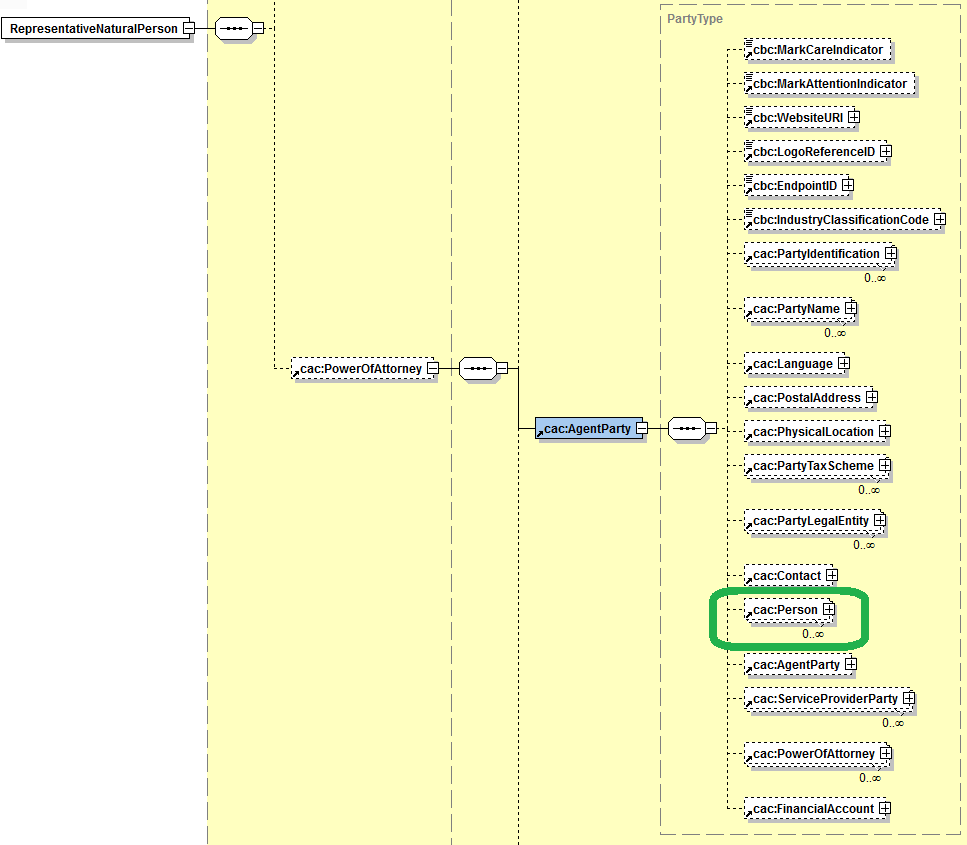
From the subcomponent Person, also a rich UBL structure, the ESPD is interested in a small set of elements, namely the name, birth data, and contact data of the representative, as shown in this example:
<cac:PowerOfAttorney>
  <cac:AgentParty>
    <cac:Person>
	  <cbc:FirstName>Bruce</cbc:FirstName>
	  <cbc:FamilyName>Wayne</cbc:FamilyName>
	  <cbc:BirthDate>1983-03-02</cbc:BirthDate>
	  <cbc:BirthplaceName>USA</cbc:BirthplaceName>
	  <cac:Contact>
	    <cbc:Telephone>01 234 56 78</cbc:Telephone>
		<cbc:ElectronicMail>Bruce.wayne@enterprises.com</cbc:ElectronicMail>
	  </cac:Contact>
	  <cac:ResidenceAddress>
	    <cbc:Postbox>1000</cbc:Postbox>
		<cbc:StreetName>Rue Melsens 3</cbc:StreetName>
		<cbc:CityName>Brussels</cbc:CityName>
		<cac:Country>
		  <cbc:IdentificationCode listID="CountryCodeIdentifier" listAgencyID="EU-COM-GROW" listName="CountryCodeIdentifier" listVersionID="1.0.2">BE</cbc:IdentificationCode>
		</cac:Country>
	  </cac:ResidenceAddress>
	</cac:Person>
  </cac:AgentParty>
</cac:PowerOfAttorney>
The Party component of the Economic Operator
For the Economic Operator (EO) it is the UBL class cac:Party that holds the more important part of the data.
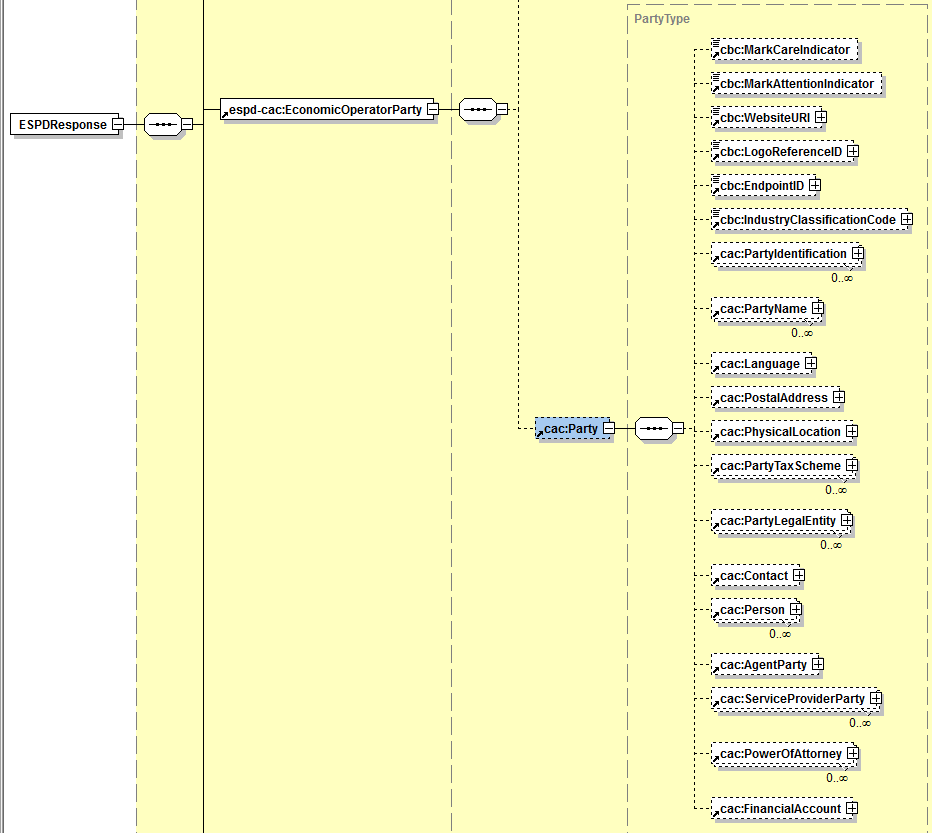
The ESPD Service uses the class cac:Party to identify the Economic Operator. Although this UBL-2.1 class defines
many properties and associated classes, the ESPD Service uses only a reduced set of them: the EO’s identification, name,
address and contact, as shown below:
Element |
Description |
Example |
Mandatory? |
Rules & comments |
cac:PartyIdentification |
Unique identification number for the Economic Operator |
|
MANDATORY - (Although in the XSD Schema the cardinality is 0..n) |
|
cac:PartyName |
The official name of the Economic Operator, as registered in a Business Register |
|
MANDATORY - (Although in the XSD Schema the cardinality is 0..n) |
|
cac:PostalAddress |
The address of the Economic Operator, as registered in a Business Register |
|
OPTIONAL |
|
cac:Country |
The country code of where the EO is registered in a Business Register |
|
MANDATORY - (Although in the XSD Schema the cardinality is 0..1) |
`Rule: The country code MUST always be specified. Compulsory use of the code list CountryCodeIdentifier |
cac:Contact |
The contact data of a person related to the EO |
|
OPTIONAL |
`Comment: The ESPD Service expects the name, telephone and e-mail |
| 1 | The data provider SHOULD specify who is the issuer of the EO’s ID |
| 2 | The schemeID attribute specifies if it is a VAT number or another national number. The
possible values are: VAT_Number and National_Number. |
A complete example about the EO’s Party elements expected by the ESPD Service follows:
cac:Party to identify the Economic Operator<espd-cac:EconomicOperatorParty>
<espd-cbc:SMEIndicator>false</espd-cbc:SMEIndicator>
<espd-cac:RepresentativeNaturalPerson/>
<cac:Party>
<cac:PartyIdentification>
<cbc:ID>B20779081</cbc:ID>
</cac:PartyIdentification>
<cac:PartyName>
<cbc:Name>Wayne Enterprises</cbc:Name>
</cac:PartyName>
<cac:PostalAddress>
<cbc:Postbox>1000</cbc:Postbox>
<cbc:StreetName>Rue Melsens 3</cbc:StreetName>
<cbc:CityName>Brussels</cbc:CityName>
<cac:Country>
<cbc:IdentificationCode listID="CountryCodeIdentifier" listAgencyID="EU-COM-GROW" listName="CountryCodeIdentifier" listVersionID="1.0.2">BE</cbc:IdentificationCode>
</cac:Country>
</cac:PostalAddress>
<cac:Contact>
  <cbc:Name>Bruce Wayne</cbc:Name>
  <cbc:Telephone>01 234 56 78</cbc:Telephone>
  <cbc:ElectronicMail>wayne@enterprises.com</cbc:ElectronicMail>
</cac:Contact>
</cac:Party>
</espd-cac:EconomicOperatorParty>Procurement Project Lot
The class cac:ProcurementProjectLot was defined in UBL-2.1 to refer to the
possible lots into which a procurement project has been subdivided (see complete
definition provided by UBL in the table below).
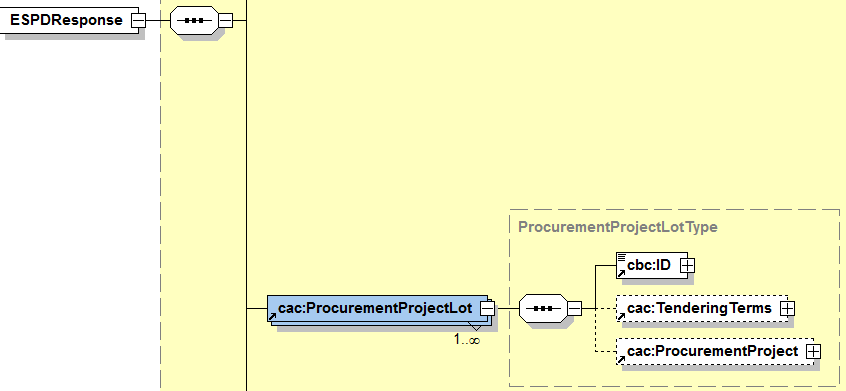
"One of the parts of a procurement project that is being subdivided to allow the contracting party to award different lots to different economic operators under different contracts"[5] |
||||
Elements |
Description |
Example |
Mandatory? |
Rules & comments |
cbc:ID |
An identifier for the lots |
|
MANDATORY |
|
| 1 | For the time being the ESPD Service does not handle multiple lots. |
Criterion
Criteria are at the core of the ESPD. The two main groups of Criteria relevant for the ESPD are the ones required in the Directive, Exclusion and Selection criteria. This section gives a detailed view on how to specify each of those criteria. Its content is aligned to the Annex to the Regulation 2016/7 establishing the standard form for the European Single Procurement Document.
Additionally to the Exclusion and Selection Criteria, the ESPD EDM treat some data related to the Economic Operator also as criteria. This is covered further on under Section "Other Criteria".
Core Criterion and Core Evidence Data Models and Vocabularies
This document differentiates between Data Model (referring to the UML conceptual diagrams) and Vocabulary (referring to the XSD schemas). Thus the CCV and CEV abbreviations refer to the Core Criterion and Core Evidence XSD Schemata that implement the conceptual Data Models (represented as UML diagrams).
The UML diagram below shows in detail the classes of the Core Criterion and Core Evidence Data Models used in the ESPDResponse XML document.
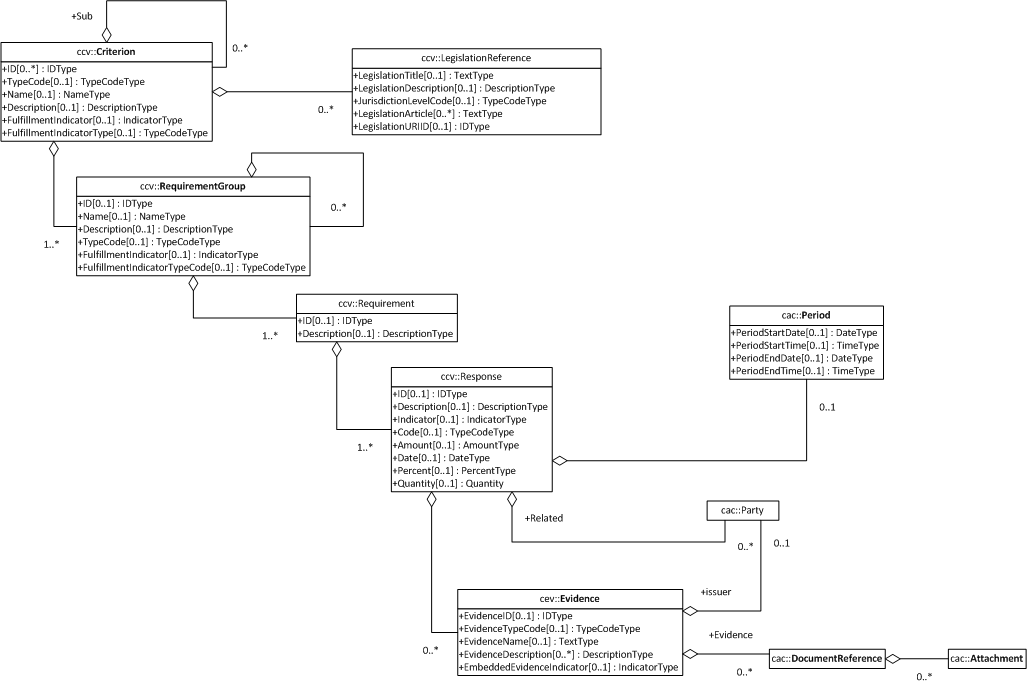
As far as the ESPD Service is concerned the above UML diagram SHOULD be interpreted as follows:
-
One Criterion contains one or more Groups of Requirements
-
One Criterion MAY have sub-Criteria
-
One Criterion MAY be linked to a specific Legislation
-
One Group of Requirements contains one or More Requirements
-
One or more Response MUST be provided (by the EO) for each Requirement
-
The Response MUST be of one, and only one, type of data
-
The type of data in a Response can be either an Indicator (a boolean value), a Code (representing a concept), an Amount (an economic value expressed as a specific currency type), a Date, a Percent, a Quantity or a Period
-
One Response MAY refer to one or more Evidences
-
The Response MAY also refer to a Party that is somehow related to the Response
-
An Evidence MAY refer to the issuer of that Evidence
-
The Evidence MAY refer to an attached DocumentReference, i.e. to a URL pointing at a document; the document could also be embedded into the cev:Evidence element, although the ESPD Service does not use this UBL feature
In the ESPD documents a Criterion takes the form of a ''question or statement about a specific subject that may lead to the exclusion or selection of an Economic Operator in a Procurement Project''. An example of Criterion in the ESPD would be a question like this:
"Has the economic operator itself or any person who is a member of its administrative, management or supervisory body or has powers of representation, decision or control therein been the subject of a conviction by final judgement for participation in a criminal organisation, by a conviction rendered at the most five years ago or in which an exclusion period set out directly in the conviction continues to be applicable?"
''Requirements'', in turn, relates to the way the Economic Operator has to answer one specific Criterion. In the case of the exclusion Criterion above mentioned, the Contracting Authority requires the Economic Operator (EO) to answer ''yes or no'', and in the case of an affirmative answer the EO is required to provide some more specific data about the conviction.
| In principle, practically all the elements in the UML class and the XSD Schema are optional. However this does not mean that an ESPD conformant Service will accept that certain data are not provided (or all of them for that matter). The compulsoriness of the ESPD Service documents elements is not controlled solely by the XSD Schema. Instead the cardinality of the elements is also validated based on ''rules''. These rules are assertions about the restrictions that affect an element, an attribute or the relationship between classes.[6]. In the tables below, describing each class, the optionality or compulsoriness is indicated in respect of the ESPD Service needs, and regardless of the XSD cardinality. |
The next figure shows the "collapsed" (i.e. abbreviated) XSD Schema corresponding to the Criterion element:
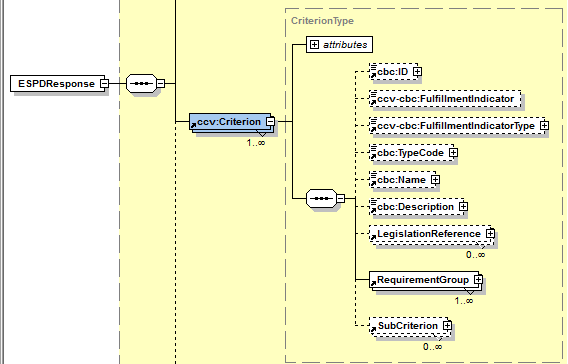
The tables below list and describe each class of the Core Criterion Vocabulary and Core Evidence Vocabulary used in the ESPDResponse XML document. They also provide the rules specific to each class, properties and elements within the class, as mentioned above. When implementing XML instances of the ESPDRequest schema these rules MUST be thoroughly respected if the XML instance is intended to be ESPD Service-conformant.
Remember that the prefixes (ccv:, cbc: cac:, etc.) are representatives of the namespaces used in the XSD Schema (see "Table 1. Schemas, namespaces and prefixes used by the ESPDResponse").
| Except for the ccv:Response element, the rest of the data is already present in the ESPDRequest XML Document. The ESPDResponse copies the ESPDRequest and extends it with the Response of the EO. |
"A class to associate a condition that the economic has to fulfil in order to not be excluded and be selected as a candidate for awarding in a procurement procedure" |
||||
Attributes |
||||
pi |
Processing Instruction. Reserved for non-standard processing of the class; e.g. for hiding or showing elements in a user interface |
OPTIONAL (0..1) |
|
|
Properties |
||||
cbc:ID |
A language-independent token, e.g., a number, that allows to identify a criterion uniquely as well as allows to reference the criterion in other documents |
|
MANDATORY (1..1) |
|
ccv-cbc: FulfillmentIndicator |
Indicates whether the economic operator states that it fulfills the specific criterion (true) or not (false) |
OPTIONAL (0..1) - Currently not used by the ESPD Service |
||
ccv-cbc: FulfillmentIndicatorType |
Codifies the type of indicator used to state whether the Criterion is met or not |
OPTIONAL (0..1) - Currently not used by the ESPD Service |
||
cbc:TypeCode |
Code specifying the type of Criterion |
|
MANDATORY (1..1) |
|
cbc:Name |
A short and descriptive name for a criterion |
|
MANDATORY (1..1) |
|
cbc:Description |
An extended description of the criterion |
|
MANDATORY (1..1) |
|
Associated classes |
||||
LegislationReference |
The specific piece(s) of Legislation(s) where the criterion is defined or mentioned |
MANDATORY (1..n) |
|
|
SubCriterion |
Specialised criterion derived from a higher classified Criterion |
OPTIONAL (0..n) |
|
|
Legislation Reference
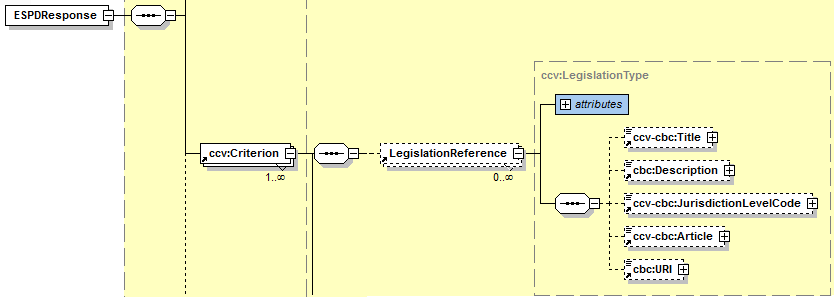
"The specific piece(s) of Legislation(s) where the criterion is defined or mentioned" |
||||
Attributes |
||||
langID |
Language of the textual data provided for this reference to a legislation |
|
OPTIONAL (0..1) |
|
Properties |
||||
ccv-cbc: LegislationTitle |
Title of the legislation as published in an official gazette or portal |
|
MANDATORY (1..1) |
|
Cbc:Description |
Reminder label or short description of the Legislation |
|
OPTIONAL (0..1) |
|
ccv-cbc: JurisdictionLevelCode |
Jurisdictional level of a particular Legislation |
|
MANDATORY (0..1) |
|
ccv-cbc:Article |
Textual description of the article of the Legislation; e.g. ''Article 61'' |
|
MANDATORY (1..1) |
|
ccv-cbc:URIID |
URI that points at the text of a particular Legislation |
|
MANDATORY (1..1) |
|
Requirement Group
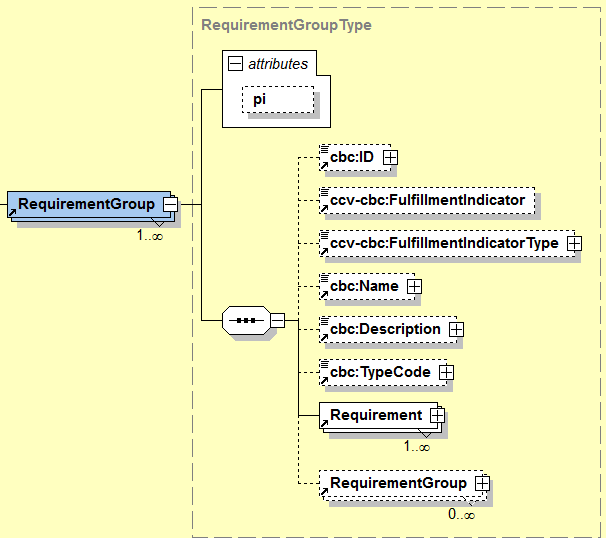
"A group of requirements with a specific structure relating to one Criterion" |
||||
Attributes |
||||
pi |
Processing Instruction. Reserved for non-standard processing of the class; e.g. for hiding or showing elements in a user interface |
OPTIONAL (0..1) |
|
|
Properties |
||||
cbc:ID |
A language-independent token, e.g., a number, that allows to identify a group of requirements uniquely |
|
MANDATORY (1..1) |
|
cbc:Name |
A short and descriptive name for a group of requirements |
OPTIONAL (0..1) |
|
|
cbc:Description |
An extended description of the group of requirements |
OPTIONAL (0..1) |
|
|
cbc:TypeCode |
Code to specify the type of the group |
OPTIONAL (0..1) |
|
|
Associated classes |
||||
Requirement |
Request by the Contracting Authority oriented to determine how the Economic Operator meets a concrete aspect of the Criterion |
MANDATORY (1..n) |
||
RequirementGroup |
Subgroup(s) of nested Requirements catering for the construction of data flows including decision fork points |
(See the example about a complete Criterion below= |
MANDATORY (1..n) |
|
| A CriterionRequirementGroup MAY contain sub-groups of criteria. This nested structure allows the ESPD to represent complex decision structures and capture faithfully the data represented in highly structured user interfaces (like the one implemented in the ESPD Service). This is clearly illustrated in the next sections. |
Requirement
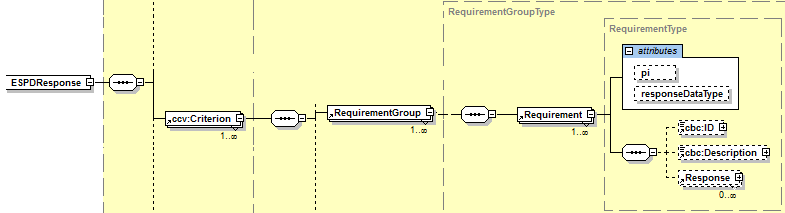
"A class to associate a specific requirement that must be fulfilled through a response by the Economic Operator (EO)" |
||||
Attributes |
||||
pi |
Processing Instruction. Reserved for non-standard processing of the class |
OPTIONAL (0..1) |
|
|
responseDataType |
Type of response expected for this requirement; e.g. Indicator, Date, Description, etc. |
MANDATORY (1..1) |
|
|
Properties |
||||
cbc:ID |
A language-independent token, e.g., a number, that allows to identify a Requirement |
|
MANDATORY (1..1) |
|
cbc:Description |
Short textual description of the requirement |
OPTIONAL (0..1) |
|
|
Response
The ccv:Response class is used by the economic operator to answer a specific Requirement issued by
the contracting body.
|
Providing the expected data type
The XSD Schema defines multiple types of data for the response (Indicator, Amount, Date, etc.), only one response data MUST be provided. And the data provided in the response MUST match the one specified in the attribute of the class ccv:Requirement. The economic operator MUST use the code list ResponseDataType and make sure that the data provided is of the same type that the one expected by the contracting authority (See the column ''Type of value expected by the current version of the ESPD Service''). |
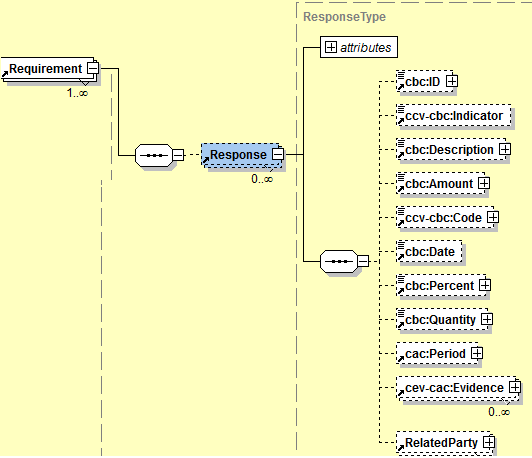
"A class to associate the answer provided by the Economic Operator (EO) to a specific Requirement" |
||||
Attributes |
||||
pi |
Processing Instruction. Reserved for non-standard processing of the class; |
OPTIONAL (0..1) |
|
|
Properties |
||||
cbc:ID |
A language-independent token, e.g., a number, that allows to identify a Response |
OPTIONAL (0..1) |
|
|
ccv-cbc:Indicator |
Indicates a positive or a negative answer provided by the economic operator as an answer to a question in the Requirement |
|
OPTIONAL (0..1) |
`Comment: The only possible values are False and True |
cbc:Description |
A textual description of a criterion response that describes how an economic operators fulfills an specific criterion |
OPTIONAL (0..1) |
||
cbc:Amount |
Declared amount that fulfills this criterion |
|
OPTIONAL (0..1) |
|
ccv-cbc:Code |
A code pointing at a definition of a concept as the answer to the Requirement |
OPTIONAL (0..1) |
`Comment: The current ESPD Service does not use this property, but consider for example a Requirement asking for a country code: in that case this would be the right placeholder for the expected data |
|
cbc:Date |
Declared date that fulfills this criterion |
|
OPTIONAL (0..1) |
`Rule: The date format MUST be 'YYYY-MM-DD', where 'Y' stands for 'Year', 'M' for 'Month', and 'D' for 'Day' |
cbc:Percent |
Declared percentage that fulfills this criterion |
|
OPTIONAL (0..1) |
|
cbc:Quantity |
Declared quantity that fullfills the criterion |
|
OPTIONAL (0..1) |
|
Associated classes |
||||
cac:Period |
Declared period that fulfills the Criterion |
|
OPTIONAL (0..1) |
|
cev-cac:Evidence |
One or more references to a source where a documentary proof can be obtained to demonstrate that one stated response does actually fulfill the Requirement from a Criterion |
OPTIONAL (0..n) |
|
|
RelatedParty |
A party that may be affected by the response provided by the economic operator |
OPTIONAL (0..1) |
|
|
| 1 | "…" indicates that some mandatory elements (ID and Description) have been removed from the example to shorten it |
| 2 | Notice the use of the attribute unitCode |
| 3 | Notice the absence of the attribute unitCode |
|
About the different types of Quantities
Up to three different types of Quantities can be specified: (1) QUANTITY_INTEGER, a number representing a quantity in a specific unit of measure. The unit has to be specified (e.g. number of workers); (2) QUANTITY_YEAR, a non-negative integer (i.e. a natural number) representing a year. The unit has to be specified as YEAR, and (3) QUANTITY, a number representing a generic quantity with no unit specified (e.g. a ratio). Beware that in the case of QUANTITY_INTEGER and QUANTITY_YEAR the attribute unitCode MUST be always specified (See code list ResponseDataType). 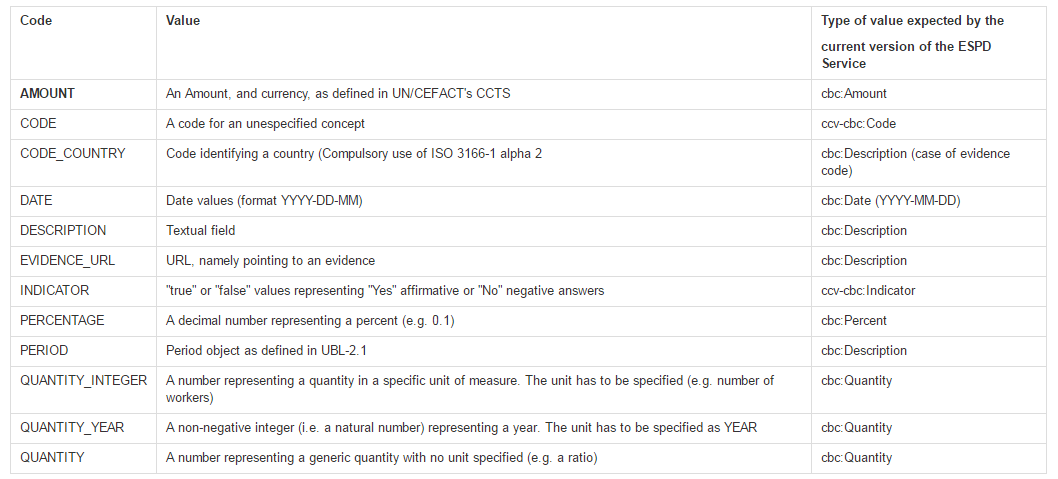
Figure XXX: The ResponseDataType code list
|
Evidence
The ccv:Evidence class is used by the economic operator to refer to a trusted source of proofs that
supports the stated response to a criterion requirement.
In the ESPD Exchange Data Model (ESPD EDM) the Evidence class is part of the Response to a Requirement, as shown in the XSD diagram below:
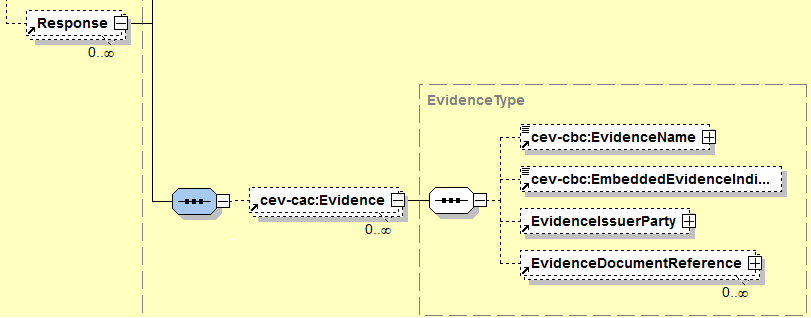
"A class used by the economic operator to refer to a trusted source of proofs that supports the stated response to a criterion requirement" |
||||
Properties |
||||
cev-cbc:EvidenceName |
The name of an evidence |
OPTIONAL (0..1) |
|
|
cev-cbc: EmbeddedEvidenceIndicator |
Indicates whether the Evidence is embedded in the XML document (True) |
OPTIONAL (0..1) |
|
|
Associated classes |
||||
EvidenceIssuerParty |
A UBL-2.1 Party class to refer to the (trusted) Party responsible for issuing the Evidence |
OPTIONAL (0..1) |
|
|
EvidenceDocumentReference |
A UBL-2.1 DocumentReference class to hold the data about the reference to the Evidence |
(See example below) |
OPTIONAL (0..1) |
|
<ccv:Requirement responseDataType="EVIDENCE_URL">
 <cbc:ID schemeID="CriterionRelatedIDs" schemeAgencyID="EU-COM-GROW" schemeVersionID="1.0">03bb1954-13ae-47d8-8ef8-b7fe0f22d700</cbc:ID>
  <cbc:Description>URL</cbc:Description>
   <ccv:Response>
    <cev:Evidence>
     <cev:EvidenceDocumentReference>
      <cbc:ID>6a5818a9-7908-44d0-9847-086b4b7a1444</cbc:ID>
       <cac:Attachment>
        <cac:ExternalReference>
         <cbc:URI>http://www.eurodb.be/scriptsPublic/arianeweb.dll/e/m_mkt_rech</cbc:URI>
        </cac:ExternalReference>
       </cac:Attachment>
      </cev:EvidenceDocumentReference>
     </cev:Evidence>
    </ccv:Response>
</ccv:Requirement>
Service Provider
The Service Provider refers to the party who provided the data included in the ESPDRequest XML document. For this purpose the ESPD EDM reuses
the UBL-2.1 class cac:ServiceProvider, which ''is a'' cac:Party class. (see the UBL-2.1 specification for details about this class).
Similarly to the ''Service Provider'' the ESPD EDM defines a Signature that reuses the UBL-2.1 cac:Signature class to hold an
electronic signature. For the time being the ESPD does not use this UBL component neither.
Additional Document Reference
The ESPD EDM reuses this UBL-2.1 component to allow both the contracting body (in the ESPDRequest) and the economic operator (in the ESPDResponse) to include references to documents that they might consider relevant including in the XML instances of both types of documents.
The class used for this, cac:AdditionalDocumentReference ''is a'' cac:DocumentReference class defined in the UBL-2.1
Common Aggregate Components library (see the folder xsd/common/UBL-CommonAggregateComponents-2.1.xsd file of the
UBL-2.1 specification)
Although this class has a rich data structure the ESPD Service at most expects the following data from it:
-
The document ID;
-
The issue date and time;
-
The document type code;
-
A title for the document; and
-
A description of its content and/or intended purpose; and
-
The URL where to access its content.
This example below illustrates how these fields from the cac:AdditionalDocumentReference are used in the ESPDRequest XML document. Beware that this is a special case (see General rule 1, below), as it refers to the Contract Notice published in the Publications Office’s TeD Service:
 <cac:AdditionalDocumentReference>
      <cbc:ID schemeID="ISO/IEC 9834-8:2008 - 4UUID" schemeAgencyID="EU-COM-GROW" schemeAgencyName="DG GROW (European Commission)" schemeVersionID="1.1">2015/S 252-461137</cbc:ID>(1)
      <cbc:DocumentTypeCode listID="ReferencesTypeCodes" listAgencyID="EU-COM-GROW" listVersionID="1.0">TED_CN</cbc:DocumentTypeCode>(2)
      <cac:Attachment>
         <cac:ExternalReference>
            <cbc:FileName>Belgium-Brussels: European Resource Efficiency Excellence Centre</cbc:FileName>(3)
            <cbc:Description>The objective of this contract is to set up a virtual European Resource Efficiency Excellence Centre. The Centre will provide information and support to European SMEs, business intermediaries, resource efficiencypractitioners and other interested parties such as regional authorities.</cbc:Description>(4)
         </cac:ExternalReference>
      </cac:Attachment>
</cac:AdditionalDocumentReference>| 1 | Unique ID for this document (the TeD Contract Notice reference number) |
| 2 | The COM’s code for this type of content |
| 3 | A title for the document |
| 4 | A description of the content and intended use of this document |
|
|
General rule 1: All ESPD XML Documents MUST refer to the Contract Notice (CN) published in TeD
All ESPDResponse XML instances (and the ESPDRequest instances, too, for that matter) MUST always include an Additional Document Reference indicating the TeD reference number of the Contract Notice the ESPDResponse is related to. This reference number MUST be specified in the field `cbc:ID`of the element cac:AdditionalDocumentReference component, and MUST follow the scheme defined by the Publications Office: [][][][]/S [][][]-[][][][][][] (e.g. 2015/S 252-461137). |
////
xsd folder inside the UBL-2.1 distribution package)