VIII. The ESPD Response document
VIII.1 Business requirements specification
The ESPD-EDM V2.1.1 models the business and information requirements in alignment with the works developed by e-Sens, which uses the identifier Trdm092 to refer to the business requirements regarding the ESPD Response transaction. See formal information requirements related to the ESPD Response transaction in the document BIS 41 - European Single Procurement Document (Version 2.0.0), by e-Sens.
BUSINESS REQUIREMENT |
The ESPD Response document must include all the criteria that are present in the ESPD Request. For certain *selection criteria the economic operator can add additional properties to the criteria so it can include in the ESPD Response more responses than the minimum required by the contracting authority. |
This last requirement has a technical reason: each response of an economic operator needs to be linked to one, and only one, property of a criterion (this is explained and illustrated in the sections below). Therefore for those cases when the contracting authority requires a minimum number of data but gives the flexibility to the economic operator for adding more the economic operator (the software it uses) will have to add properties to the criterion.
Examples: the CA requires a minimum of 3 references to works similar to the ones being procured, but the EO decides to add 5. The ESPD REquest will contain a criterion "For works contracts: performance of works of the specified type" with the structure prepared for three references. The ESPD Response will add two more structures to contain the additional references to that criterion. The ESPD will add (at the end of the file) five responses related to the same criterion, each response will point at five different properties of the criterion. This is described and illustrated in more detail in the section "Providing additional responses" below.
VIII.2 ESPD Response XSD Schema
For the ESPD Response, the ESPD-EDM V2.1.1 uses the UBL-2.2 document named QualificationApplicationResponse.xsd XSD Schema. This schema can be found under the folder dist/xsdrt/maindoc (or the equivalent documented xsd folder).
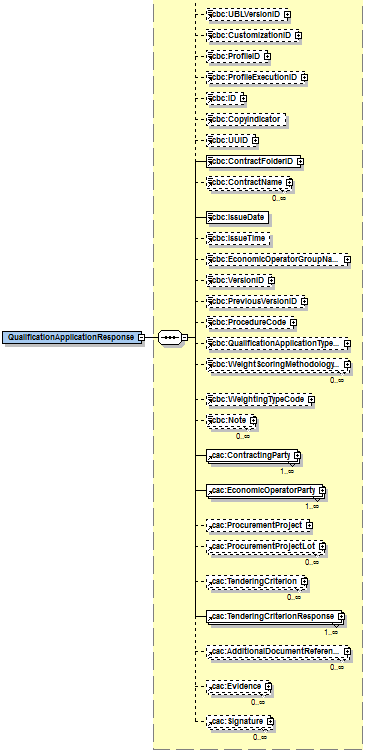
The figure below shows the XSD Schema defined by UBL-2.2 for this document, which replaces the Schema for the “ESPD Response” document used in the previous versions of the ESPD-EDM. The figure below shows a diagram representing the UBL-2.2 XSD Schema. Only the first level components of the schema are shown. The inner sub-elements and sub-classes are covered in detail in the following sub-sections of this document. The ESPD Response share many elements with the ESPD Request. For those elements that have already been described in the ESPD Request please see the sections above in this document where those elements were explained.
Notice that, in the UBL-2.2 Schema there are only four mandatory elements: cbc:IssueDate, ContractFolderID, cac:ContractingParty (the contracting authority) and cac:EconomicOperatorParty (the economic operator).
|
This section about the ESPD Response does not cover those information elements that were already described in the ESPD Request, unless a characteristic related to the ESPD Response needs to be clarified. Thus for details about elements like |
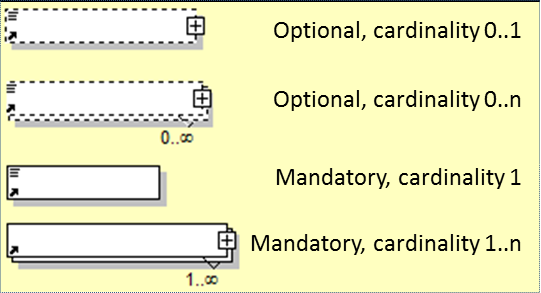
LEGEND: The figure below enumerates the four different types of optionality and cardinality for the elements of the UBL-2.2 Schema:
VIII.3 ESPD Response cardinalities
As you can see the UBL-2.2 Schema is quite flexible as, except for a few cases practically all the elements are optional.
The ESPD-EDM model, however, adds a few more restrictions regarding the cardinalities. These can be seen in the diagram below, which presents the ESPD-EDM V2.1.1 structure for the ESPD Response with its own cardinality restrictions. Notice that ESPD-EDM does not change anything else from the UBL-2.2 Schema.
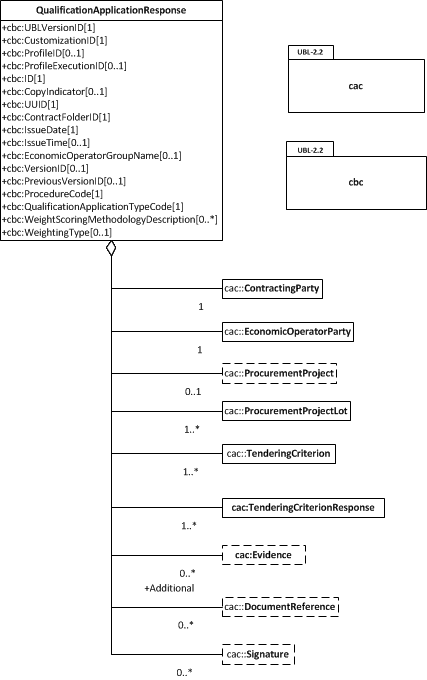
If you compare both figures you will observe that:
-
The cardinalities of the root common basic components, such as
cbc:ID,cbc:UUID,cbc:TendererRole,cbc:QualificationApplicationTypeCode,ProcedureCode, and other are different for the ESPD than for UBL-2.2; -
Similarly, the cardinalities of aggregate components like
cac:ContractingParty,cac:ProcurementProjectLotandcac:TenderingCriterionare different to the UBL-2.2 ones.
The cardinality constraints added by the ESPD are not defined in the XSD Schema. In order to control these constraints the ESPD-EDM uses ISO Schematron assertions. The ESPD-EDM V2.1.1 distribution package provides Schematron schemata and CVA files [1] for the validation of the XML instances (folder dist/val).
The European Commission (EC) ISA2 Programme provides an Interoperability Testbed where Stakeholders can freely test these validation artefacts.
VIII.4 Root elements
The table below lists the elements that are expected in the ESPD Response V2.1.1 and provides details on the cardinalities and usage of those elements.
| Document name: | QualificationApplicationResponse |
|---|---|
Definition: |
"A structured electronic business document for providing qualification information in a simplified way through an ESPD when responding to a Call for Tender." (source: ESPD Response transaction (Trdm092)). Preliminary evidence certificates in the form of a self-declaration submitted by the economic operator during the tendering phase. On awarding, the winning party has to supply the real attestations and certificates. |
Business rule(s): |
None |
File: |
dist/xsdrt/maindoc/UBL-QualificationApplicationResponse-2.2.xsd |
| Components | Type | Card | Description | Requirements |
|---|---|---|---|---|
cbc:UBLVersionID |
Identifier |
1 |
Identifies the earliest version of the UBL 2 schema for this document type that defines all of the elements that might be encountered in the current instance. |
Information Requirement: tbr92-020. Rule: Use the value "2.2". Use also "OASIS-UBL-TC" for the schemeAgencyID attribute. Rule scope: Common (BR-OTH-05, 2.BR-OTH-02) |
cbc:CustomizationID |
Identifier |
1 |
Identifies a user-defined customization of UBL for a specific use. |
Information Requirement: tbr92-019. Rule: For the ESPD we use the value “urn:www.cenbii.eu:transaction:biitrdm092:ver3.0”. Compulsory use of the value "CEN-BII" for the schemeAgencyID attribute. Rule scope: Common (BR-OTH-02, BR-OTH-06) |
cbc:ProfileID |
Identifier |
0..1 |
An identification of the specification containing the total set of rules regarding semantic content, cardinalities and business rules to which the data contained in the instance document conforms. The identification may include the version of the specification as well as any customizations applied. |
Information Requirement: tbr92-019. Rule: Use the value "41". Use also "CEN-BII" for the scheme AgencyID attribute. Rule scope: Common (BR-OTH-07, BR-OTH-02) |
cbc:ID |
Identifier |
1 |
An identifier for this document, normally generated by the system that creates the ESPD document, or the organisation responsible for the document (e.g. the buyer, e.g. a contracting authority, or the supplier, e.g. an economic operator). The identifier enables positive referencing the document instance for various purposes including referencing between transactions that are part of the same process. |
Information Requirement: tbr92-019. Rule: Compulsory use of schemeAgencyID attribute. Use it to identify the organisation responsible for the document. Rule scope: Common (BR-OTH-02) |
cbc:CopyIndicator |
Indicator |
0..1 |
Indicates whether this document is a copy (true) or not (false). |
Information Requirement: tbr92-019. Rule: It is a good practice to use the CopyIndicator component if the same document is forwarded several times to the same or to different destinations. Use it in combination with the UUID identifier: copies of an ESPD document should be identified with distinct UUIDs. |
cbc:UUID |
Identifier |
0..1 |
A universally unique identifier that can be used to reference this ESPD document instance. |
Information Requirement: tbr92-019. Rule: Other documents, e.g. the tender, might refer to the ESPD Response using this identifier (thus its compulsoriness). Copies of a document must be identified with a different UUID. Compulsory use of schemeAgencyID attribute. |
cbc:ContractFolderID |
Identifier |
1 |
An identifier that is specified by the buyer and used as a reference number for all documents in the procurement process. It is also known as procurement project identifier, procurement reference number or contract folder identifier. A reference to the procurement procedure to which a Qualification request document and the delivered response documents are associated. |
Information Requirement: tbr92-013. Rule: Try always to use the reference number issued by the contracting authority. This number in combination with a registered contracting authority ID (e.g. the VAT number) results in a universally unique identifier of the procurement procedure. Rule scope: BASIC (BR-REG-20), EXTENDED (BR-SC-30) |
cbc:IssueDate |
Date |
1 |
Date when the document was issued by the contracting authority. |
Information Requirement: tbr92-019. Rule: Format "YYYY-MM-DD". |
cbc:IssueTime |
Time |
0..1 |
Time when the document was issued by the contracting authority. |
Information Requirement: tbr92-019. Rule: Format "hh:mm:ss". |
cbc:EconomicOperatorGroupName |
Code |
0..1 |
The name of the group that presents a tender to which this economic operator belongs (e.g. the name of a consortium, a joint venture, etc.). |
Information Requirement: tbr92-008. Rule: The leader of the group must take care of ensuring that the name of the group is identical in all the ESPDs of the tender. Rule scope: EXTENDED (BR-LEAD-10-S10) |
cbc:VersionID |
Identifier |
0..1 |
The version identifying the content of this document. |
Information Requirement: tbr92-020. Rule: Changes in content should entail the modification of the version identifier and a reference to the previous version. |
cbc:PreviousVersionID |
Identifier |
0..1 |
The version identifying the previous modification of the content of this document. |
Information Requirement: tbr92-020. Rule: None |
cbc:ProcedureCode |
Identifier |
0..1 |
The type of the procurement administrative procedure according to the EU Directives. |
Information Requirement: Rule: Compulsory use of attributes listID, listAgencyName and listVersionID. Compulsory use of the code list ProcedureType (values: Rule scope: EXTENDED (BR-OTH-01, BR-OTH-01#1, BR-OTH-03) |
cbc:QualificationApplicationTypeCode |
Code |
1 |
The type of European Single Procurement Document (ESPD). |
Information Requirement: tbr92-019. Rule: Compulsory use of the codelist QualificationApplicationType (values 'BASIC`, Rule scope: EXTENDED (BR-OTH-01, BR-OTH-01#2, BR-OTH-03) |
cbc:WeightScoringMethodologyNote |
Text |
0..n |
Free-form text to describing information about Weight Scoring Methodology. |
Information Requirement: tbr070-016 Rule: Used for transparency motives. Provide a text explaining clearly the method that will be used to select those selection criteria that will be weighted. Rule scope: Common (BR-2P-10) |
cbc:WeightingTypeCode |
Code |
0..1 |
A code specifying the type of the Weighting. |
Information Requirement: tbr070-016 Rule: Compulsory use of the code list Rule scope: Common (BR-2P-10) |
cac:ContractingParty |
Associated class |
1 |
The contracting authority or contracting entity who is buying supplies, services or public works using a tendering procedure as described in the applicable directive (Directives 2014/24/EU, 2014/25/EU). |
Information Requirement: tbr92-011. Rule: UBL-2.2 defines multiple cardinality ContractingParties presumably to allow joint procurements. However the ESPD only expects data about one buyer. The decision was made that in case of joint procurement the data collected in the ESPD would be about the leader of the joint procurement procedure. |
cac:EconomicOperator |
Associated class |
0..1 |
Any natural or legal person or public entity which offers the execution of works and/or a work, the supply of products or the provision of services on the market. Information about the party submitting the qualification. |
Information Requirement: tbr92-001. Rule: The ESPD Response only refers to one, and only one, economic operator. Rule scope: Common (BR-RESP-10) |
cac:ProcurementProject |
Associated class |
0..1 |
An overall definition of the procurement procedure. |
Information Requirement: tbr92-013. Rule: Use this component to identify and describe the procurement administrative procedure. If the procurement procedure is divided into lots use the |
cac:ProcurementProjectLot |
Associated class |
0..1 |
One of the procurement project lots into which this contract can be divided. |
Information Requirement: tbr92-014. Rule: If there is only one single procurement project lot specified, the ESPD refers then to a procurement procedure without lots. Rule scope: EXTENDED (BR-LOT-30) |
cac:TenderingCriterion |
Associated class |
1..n |
A tendering criterion describes a rule or a condition that is used by the contracting body to evaluate and compare tenders by economic operators and which will be used for the exclusion and the selection of candidates to the award decision. |
Information Requirement: tbr92-015,tbr92-016. Rule: (see examples further below in this document) |
cac:TenderingCriterionResponse |
Associated class |
1..n |
Response of the economic operator to the requirements and questions issued by the contracting authority in the ESPD Request. |
Information Requirement: br92-018, tbr92-007, tbr92-005, tbr92-006. Rule: (see examples further below in this document) |
cac:AdditionalDocumentReference |
Associated class |
0..n |
A reference to an additional document associated with this document. |
Information Requirement: tbr92-013. Rules: At least two instances of the AdditionalDocumentReference are expected: For procurement procedures above the threshold it is compulsory to make reference to the Contract Notice of the procedure published in TED*. See section "Reference to the Contract Notice" for a complete example. In the ESPD Response it is also compulsory to make reference to the ESPD Request document. Rule scope: Common (BR-COM-10) |
cac:Evidence |
Associated class |
0..n |
A reference to an online document available for free in a national or EU database. |
Information Requirement: tbr92-017, tbr92-007, tbr92-006. Rule: Used to point at an instance of the cac:Evidence. |
The figure below shows a global view of an ESPD Response XML instance (all nodes have been 'collapsed' to simplify the view):
XML example
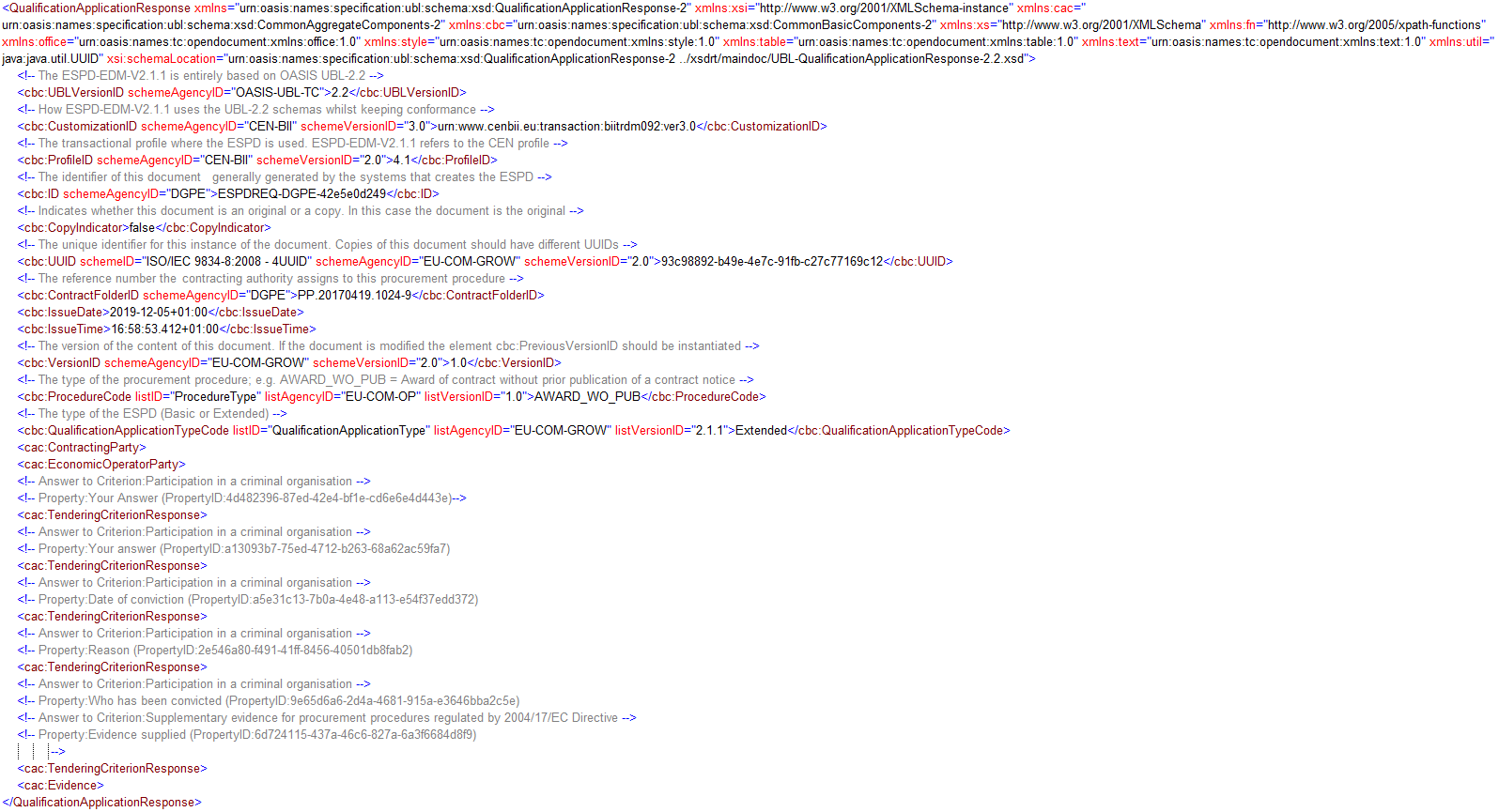
The XML snippet below shows how the beginning of an ESPD Response XML instance looks like. For a complete instance of an ESPD Response XML document see the the example files in the dist/xml folder: link:. or EXTENDED-ESPDResponse-2.1.1.xml.
<QualificationApplicationResponse xmlns="urn:oasis:names:specification:ubl:schema:xsd:QualificationApplicationResponse-2" xmlns:cac="urn:oasis:names:specification:ubl:schema:xsd:CommonAggregateComponents-2" xmlns:cbc="urn:oasis:names:specification:ubl:schema:xsd:CommonBasicComponents-2" xmlns:espd="urn:com:grow:espd:2.1.1" xmlns:fn="http://www.w3.org/2005/xpath-functions" xmlns:office="urn:oasis:names:tc:opendocument:xmlns:office:1.0" xmlns:style="urn:oasis:names:tc:opendocument:xmlns:style:1.0" xmlns:table="urn:oasis:names:tc:opendocument:xmlns:table:1.0" xmlns:text="urn:oasis:names:tc:opendocument:xmlns:text:1.0" xmlns:util="java:java.util.UUID" xmlns:xs="http://www.w3.org/2001/XMLSchema" xmlns:xsi="http://www.w3.org/2001/XMLSchema-instance" xsi:schemaLocation="urn:oasis:names:specification:ubl:schema:xsd:QualificationApplicationResponse-2 ../xsdrt/maindoc/UBL-QualificationApplicationResponse-2.2.xsd">
<?xml version="1.0" encoding="UTF-8"?>
	<!-- The ESPD-EDM-V2.1.1 is entirely based on OASIS UBL-2.2 -->
	<cbc:UBLVersionID schemeAgencyID="OASIS-UBL-TC">2.2</cbc:UBLVersionID>
	<!-- How ESPD-EDM-V2.1.1 uses the UBL-2.2 schemas whilst keeping conformance -->
	<cbc:CustomizationID schemeAgencyID="CEN-BII" schemeVersionID="3.0">>urn:www.cenbii.eu:transaction:biitrdm092:ver3.0</cbc:CustomizationID>
	<!-- The transactional profile where the ESPD is used. ESPD-EDM-V2.1.1 refers to the CEN profile -->
	<cbc:ProfileID schemeAgencyID="EU-COM-GROW" schemeVersionID="2.0">41</cbc:ProfileID>
	<!-- The identifier of this document provided by the contracting authority system -->
	<cbc:ID schemeAgencyID="DGPE">ESPDREQ-DGPE-46be0fdd00</cbc:ID>
	<!-- Indicator of whether this document is an original or a copy. In this case the document is the original -->
	<cbc:CopyIndicator>false</cbc:CopyIndicator>
	<!-- The unique identifier for this instance of the document. Copies of this document should have different UUIDs -->
	<cbc:UUID schemeID="ISO/IEC 9834-8:2008 - 4UUID" schemeAgencyID="EU-COM-GROW" schemeVersionID="2.0">901afdb9-8f7d-4c43-823b-725eeda3208d</cbc:UUID>
	<!-- The reference number the contracting authority assigns to this procurement procedure -->
	<cbc:ContractFolderID schemeAgencyID="DGPE">PP.20170419.1024-9</cbc:ContractFolderID>
	<cbc:IssueDate>2017-04-13</cbc:IssueDate>
	<cbc:IssueTime>19:09:11</cbc:IssueTime>
	<!-- The name of the group (Consortium, Joint Venture, etc.) if the tenderer is not a sole contractor -->
	<cbc:EconomicOperatorGroupName>ACME-Consortium</cbc:EconomicOperatorGroupName>
	<!-- The version of the content of this document. If the document is modified the element cbc:PreviousVersionID should be instantiated -->
	<cbc:VersionID schemeAgencyID="EU-COM-GROW" schemeVersionID="2.0">1.0</cbc:VersionID>
	<!-- The type of the procurement procedure; e.g. V = Award of contract without prior publication of a contract notice -->
	<cbc:ProcedureCode listID="ProcedureType" listAgencyID="EU-COM-OP" listVersionID="1.0">OPEN</cbc:ProcedureCode>
	<!-- The type of the ESPD (BASIC or EXTENDED) -->
	<cbc:QualificationApplicationTypeCode listID="QualificationApplicationType" listAgencyName="EU-COM-GROW" listVersionID="2.1.1">EXTENDED</cbc:QualificationApplicationTypeCode>

<!-- ... rest of document removed for brevity -->
VIII.5 Economic Operator
Related information requirements
See formal requirements related to the economic operators in the e-Sens site: from (tbr092-001, _tbr092-008).
REQUIREMENT |
One ESPD Response per economic operator. The ESPD-EDM-2.1.1, as all the previous versions of the ESPD, requires that every economic operator that participates in one tender provide its own ESDP Response document. This affects sole traders that rely on other entities for the execution of the contract (e.g. subcontractors) and groups of economic operators, e.g. a Joint Venture or a Consortium, and all the sub-contractors on which each economic operator of the group relies on to meet the selection criteria. |
Thus:
-
One tender submitted by a sole trader that relies on two sub-contractors will have to include three ESPD Requests, one for the sole trader and one per each of the sub-contracted entity.
-
One tender submitted by a Consortium composed of three economic operators, two of which rely on two sub-contracted entities and the third one relies on five sub-contracted entities, will have to include 3 + 2 + 5 (ten) ESPD Requests.
As you will see next, the information required about the economic operators varies depending on several factors:
-
Is the economic operator a sole trader or does it belong to a group?
-
If it belongs to a group, is the economic operator the leader of the group, a member or another entity (see the different types of 'roles' below);
-
Does the economic operator rely on other entities to fulfill the selection criteria?
-
Is the procurement procedure divided into lots?
One relevant aspect is the Role of the economic operator. The ESPD-EDM V2.1.1 defines four different roles for the EO. The information to be provided by each role varies:
-
Sole contractor / Lead entity: Sole entity or, in case of Consortium, Joint Venture or other types of groups, the leader of the group. In this case:
-
The sole contractor or leader will have to produce a complete ESDP;
-
The sole contractor or leader will also have to identify the rest of the procurers (in the case of a group);
-
The sole contractor or leader will have to identify the entities upon which it relies (and about those on which the entities it relies on rely).
-
The sole contractor or leader will have to identify the entities upon which it does not relies.
-
The sole contractor or leader will have to specify the subcontracted proportion of the group (in the selection criteria "Subcontracted Proportion" of the ESPD).
-
-
Group member: Member (not leader) of the Consortium, Joint Venture or other type of group. In this case:
-
The member of the group will have to produce a complete ESPD;
-
The member of the group does not have to identifier the rest of the procurers or entities.
-
-
Other entity (relied upon): Entity on which the main contractor, the group or another subcontractor relies in order to meet the selection criteria. In this case:
-
The entity will have to produce an ESPD
-
The entity will not have have to identify the rest of the procurers or entities. Beware that an entity could have again another entity which it relies on or a a sub-contractor: in this case those entities and sub-contractors the package of documents sumitted with the tender shall contain also an ESPD for each of them. This is for the sole contractor or the leader of the group to coordinate and identify all these entities in its own ESPD Response.
-
-
Other entity (not relied upon): Entity on which the main contractor, the group or another subcontractor does not rely in order to meet the selection criteria. In this case:
-
The entity will have to produce an ESPD
-
The entity does not have to provide information about the selection criteria
-
The entity does not have to provide information about the reduction of the number of qualified candidates [2].
-
Mock-ups (1/7): the simplest case
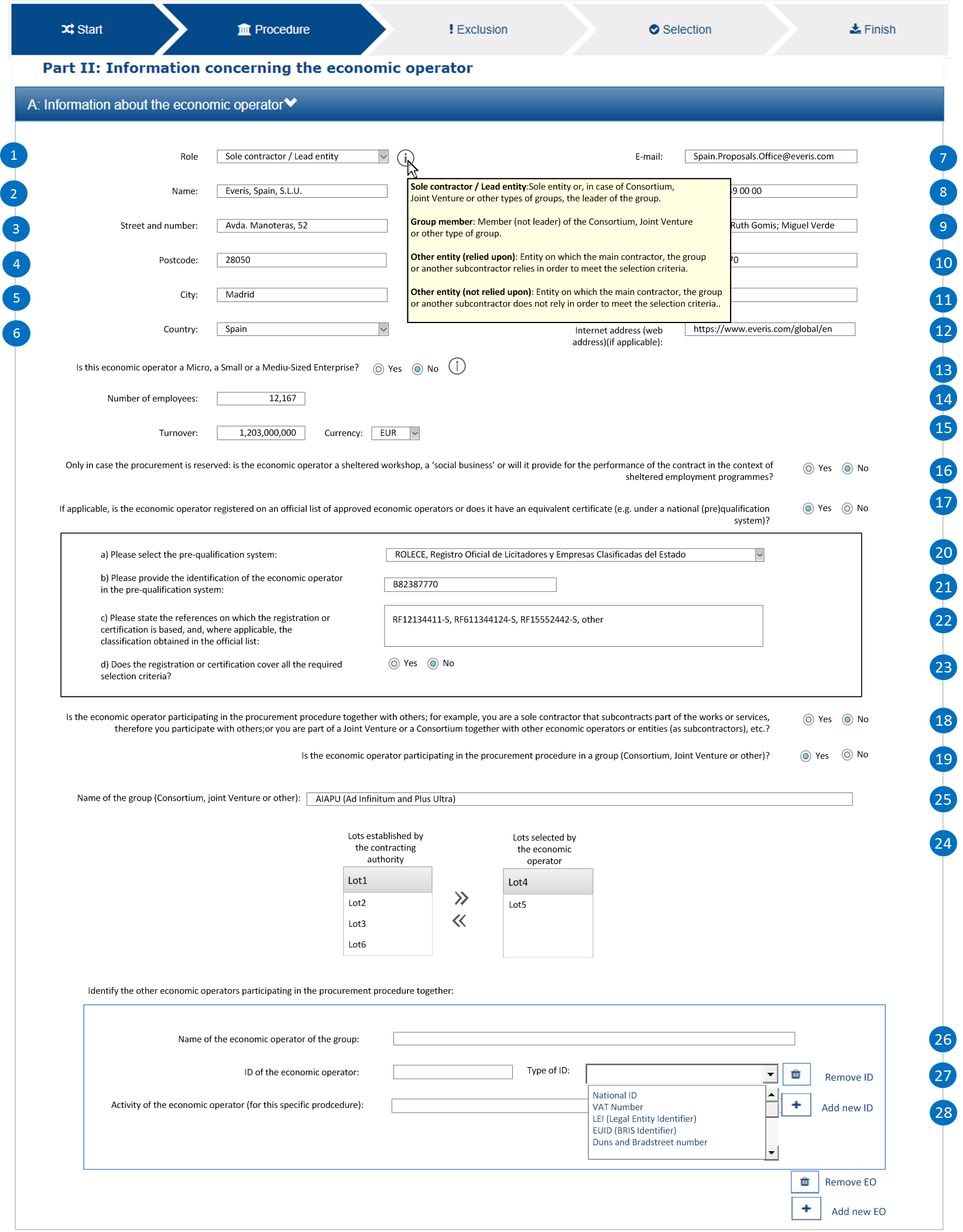
The mock-up below shows the set of data required about the economic operator when:
-
The economic operator (EO) is a sole contractor
-
The EO does not rely on other entities
-
The procurement procedure is not divided into lots
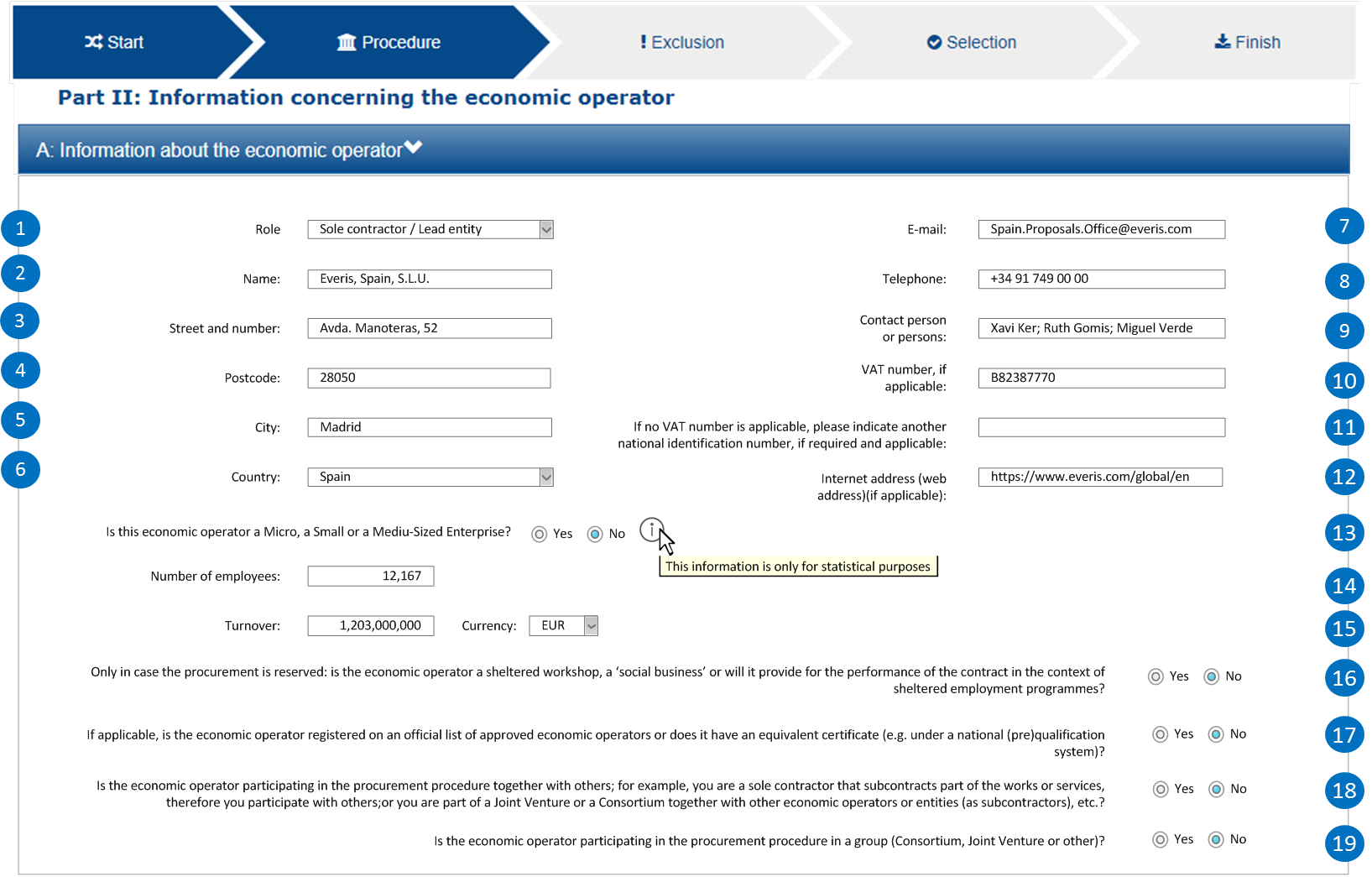
Notice the following:
-
Sole contractor. We know that this is a sole contractor because:
-
The role specified is 'Sole contractor / Lead entity' (first field of the mock-up); and (circle #1)
-
The EO states that it does not participate together with others; and (circle #18)
-
The EO states that it does not participate in a group (last field of the mock-up); (circle #19)
-
-
Not an SME. The EO is a large company (circle #13). The definition of what is an SME is provided in the EU recommendation 2003/361[3]. Based on this definition, software applications should be able to verify whether the statement of the EO is correct or not and issue a warning in the case the economic operator introduced data that contradicts the definition (e.g. the EO selected 'Yes' and states that it has 12,000 employees).
-
No lots. The software application GUI should not show any information about Lots if the procurement procedure is not divided into Lots. This information is available in the ESPD Request.
Mock-ups (2/7): EO registered in a Pre-Qualification System
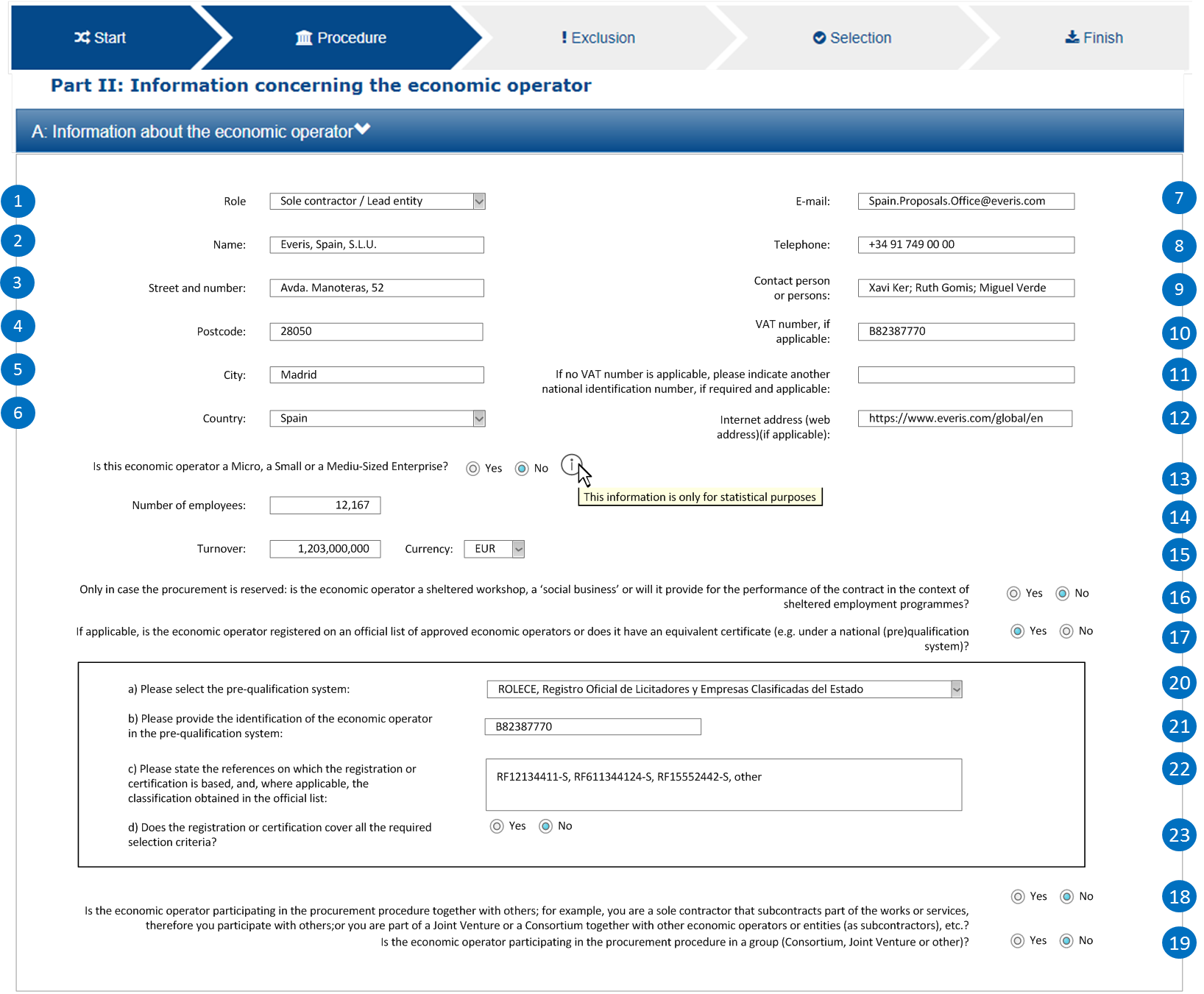
One of the questions asked is whether the economic operator is registered on an official list (e.g. on a national Pre-Qualification System, circle #17). In the case the EO answers yes, the software application should ask the EO for this other data about which the evaluators may be interested in.
The pre-qualification system the EO is registered on will be kept (and retrieved from) from e-Certis. In case the EO is registered on several pre-qualification systems, it will need to choose the one that applies to this particular procurement procedure. The EO will also be required to provide the identification of the EO in the selected pre-qualification system.
Mock-ups (3/7): Lots (contracting authority perspective)
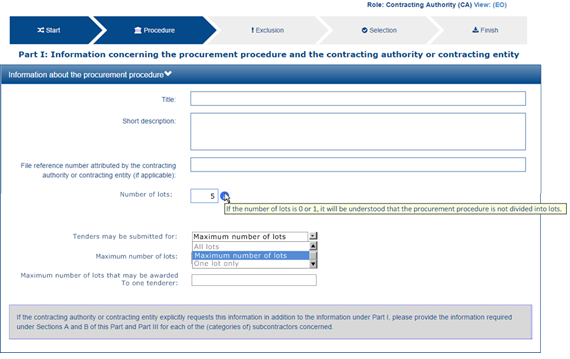
The economic operator should be able to specify to which Lots it tenders. Thus, if the procurement procedure is divided into Lots, the software application should show the list with all the Lots the contracted authority (CA) specified for the economic operator select one or more Lots. See the section III.11 Lots - Extended ESPD for details on how the CA specifies Lots. The mock-up below shows the requirements established by the contracting authorities about the Lots of the procurement procedure.
Mock-ups (4/7): Lots (economic operator perspective)
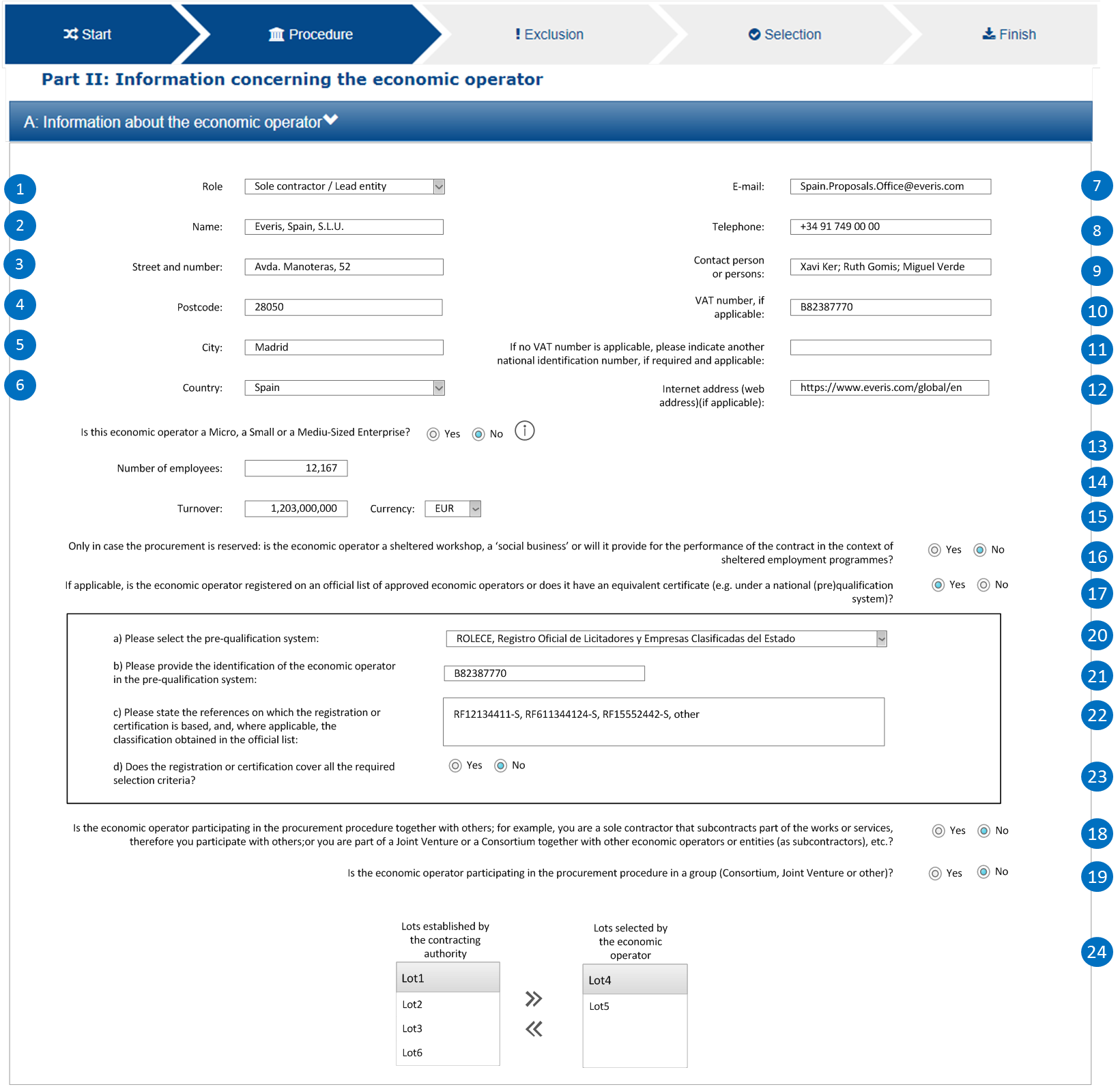
The economic operator should then be able to select the Lots it will tender to. However the software application should control that the requirements established by the contracting authority (CA) are respected (see mock-up 2 above). Thus, for example, if the CA established that the economic operator can only tender to one lot the application should block the economic operator from selecting more than one lot.
Mock-ups (5/7): Roles of the economic operator
Depending on its role the data that the economic operator (EO) will have to provide is different. The mock-up below represent the situation where the role is the Leader of a consortium. In this case:
-
The EO is the Leader of a Consortium it also had to select Yes to the question on whether it participates in a group. To this the software application reacts displaying a new field for the EO to provide the name of the Consortium (the rest of the members and entities related to this Consortium will have also to provide exactly the same name in their ESPDs).
-
As it is the Leader this EO will have to identify the rest of procurers and entities. The rest of members and entities participating in the tender shall not be requested to provide this information.
-
The Leader will also have to identify the entities it relies on and on those it does not rely on (this would also the case for the Sole Contractor). See the two next mock-ups below for the data to be provided on these two entities.
Mock-ups (6/7): Information about reliance on the capacities of the other entities
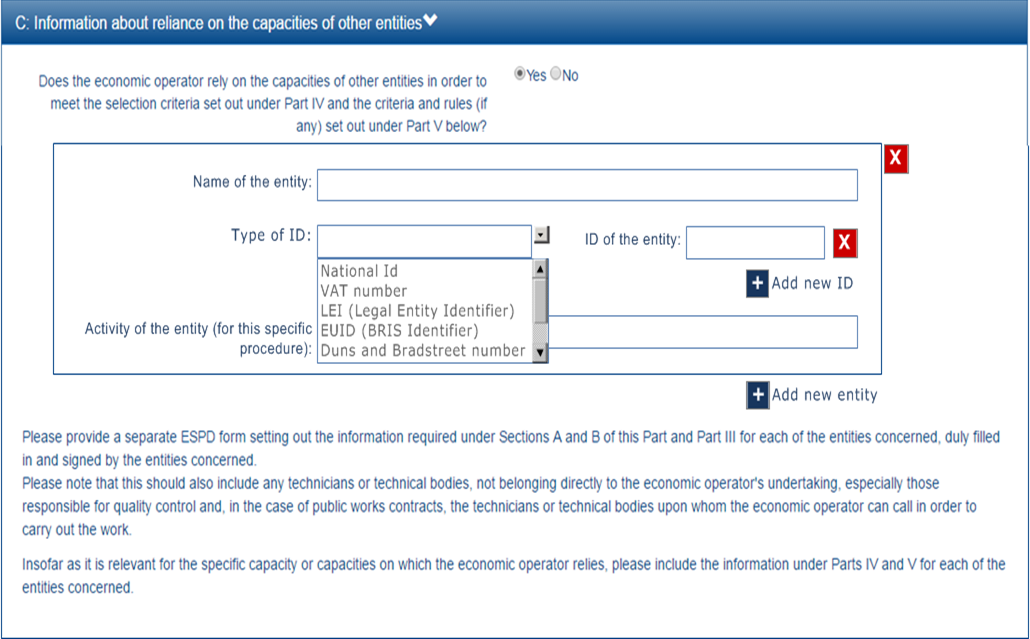
As explained above, the Sole contractor or the Leader of a group will have to provide information about the entities it relies on in order to meet the selection criteria. The mock-up below shows the set of data the ESPD-EDM V2.1.1 expects from this role. Remember that this information does not need to be supplied by the members of a group or other entities.
Mock-ups (7/7):
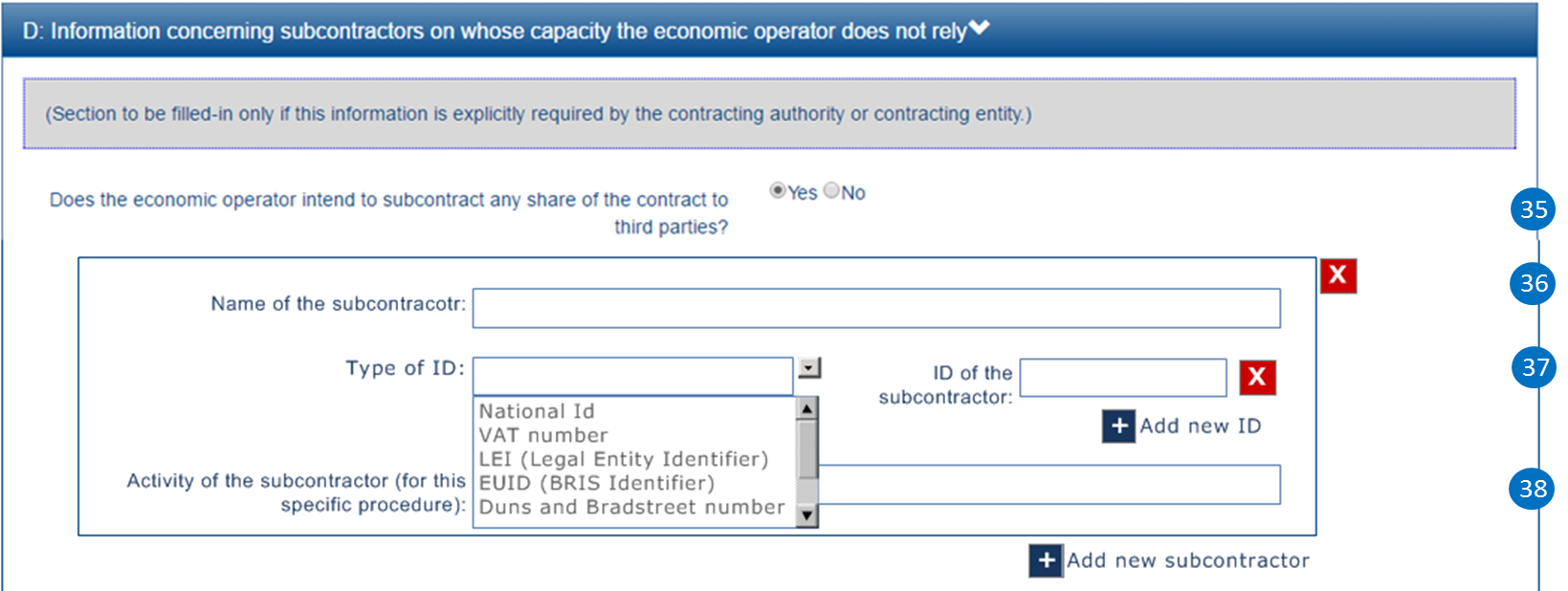
The Sole contractor or the Leader of a group will have also to provide information about subcontractors on whose capacity the economic operator does not rely. Remember that this information does not need to be supplied by the members of a group or other entities.
XSD Schema
The information that the economic operator (EO) has to provide is relatively abundant, especially if the EO is the lead entity of a group. UBL does provide a class cac:EconomicOperator with sufficient data elements to identify the economic operator, its role, its representatives, physical location, officially registered address and other.
Nonetheless some data requested in the ESPD are not modeled in UBL-2.2, namely those aiming at purposes going beyond the identification of the economic operator; e.g. data with statistical purposes (such as the number of employees and general turnover); or to ensure the transparency of the procurement procedure (the general methodology used for the weighting); or to link all the ESPDs that belong to one single tender (through the identification of the members of the group in the case of Joint Venture or Consortium and its sub-contracted entities).
Therefore in the ESPD-EDM-2.1.1 the information about the economic operator is spread in two different places:
-
The UBL-2.2
cac:EconomicOperatorPartycomponent; and -
Following the solution adopted for Version 1.0.2 of the ESPD-EDM, the ESPD-EDM V2.1.1 defines several criteria classified as CRITERION.OTHER.EO_DATA.* (where the * refers to different branches and leaves of a different structures about the economic operator (e.g. SHELTERED_WORKSHOP, REGISTERED_IN_OFFICIAL_LIST, TOGETHER_WITH_OTHERS, etc.). The XML instances use criteria components (UBL-2.2 cac:TenderingCriterion) to structure these data. The sub-sections below cover both data structures (the cac:EconomicOperatorParty one and the criteria containing the other data about economic operator.
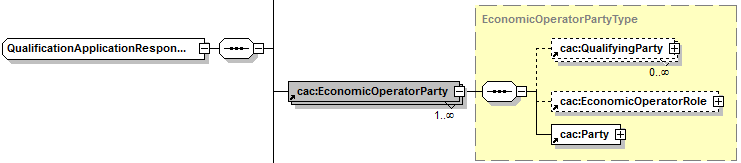
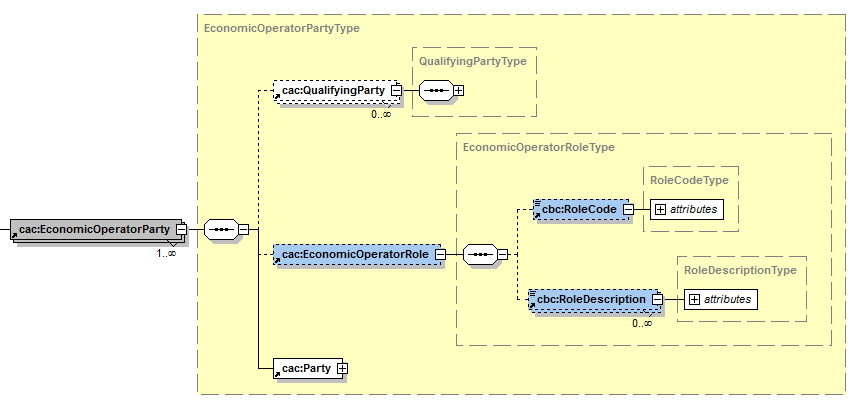
The UBL-2.2 cac:EconomicOperatorParty has three common aggregate components, the XSD Schema looks like this:
-
cac:QualifyingParty: is used to place the data about pre-qualification systems or registers that keep classification information about the economic operator (circle #13);
-
cac:EconomicOperatorRole: use to place the role of the economic operator (circle #1);
-
cac:Party: used to place the data to identify the EO and its contact (circles #2 to #12).
cac:QualifyingParty
The diagram below shows the XSD element that will hold the data required by the ESPD (see mock-up 1/7, too). Beware that:
-
The Identifier assigned by the register or (pre)qualification system of the economic operator is placed in the element
/cac:EconomicOperatorParty/cac:Party/cac:PartyIdentification(more details on this below and in the XML example); -
The Identifier and name of the register or (pre)qualification system (captured automatically from e-Certis) will be placed into the element
/cac:EconomicOperatorParty/cac:QualifyingParty/cac:Party; -
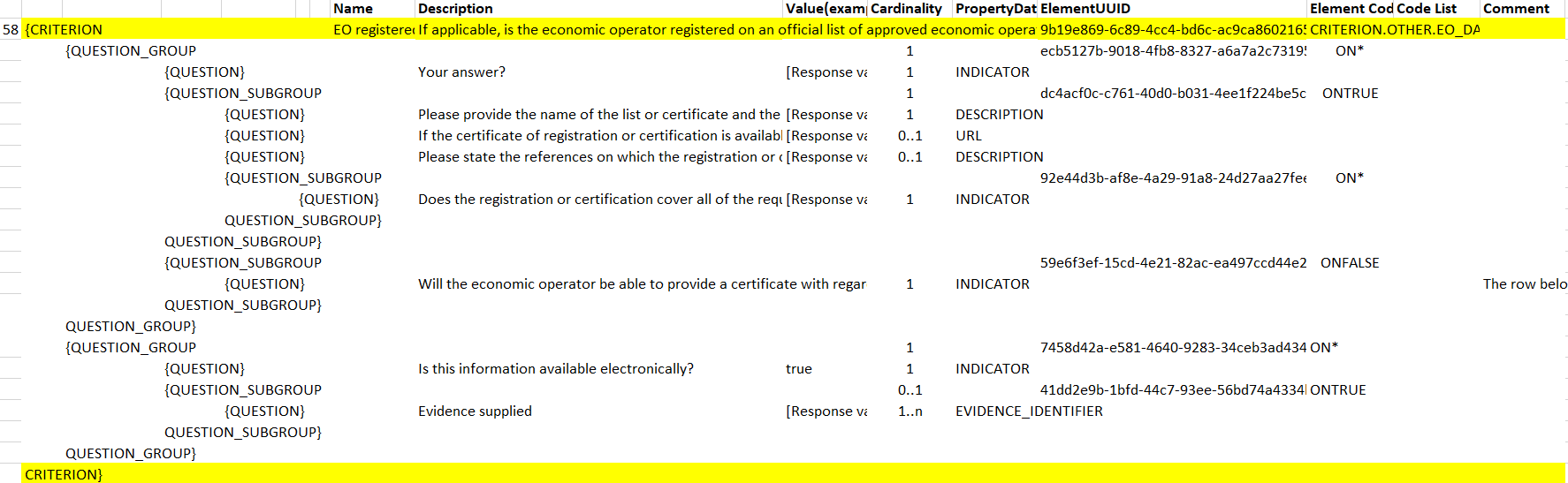
The references, the classification obtained in the official list and the answer to the QUESTION 'Does the registration or certification cover all the required selection criteria goes in a criterion of the type CRITERION.OTHER.EO_DATA.* (see below data structure
CRITERION.OTHER.EO_DATA.REGISTERED_IN_OFFICIAL_LISTand XML example).
|
Note for the future
Advanced software application can take leverage of the fact that the UBL-2.2 component |
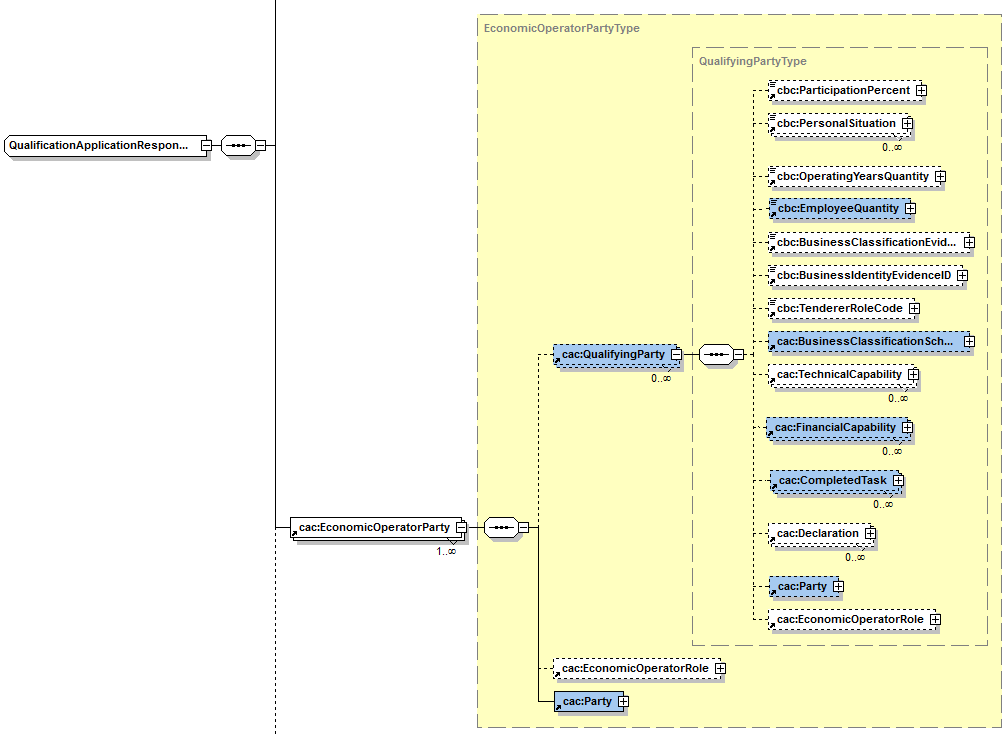
For the identification of the economic operator with the registration number assigned by the (pre)qualification system the cac:/EconomicOperatorParty/cac:Party/PartyIdentifier is used. Notice that this element has multiple cardinality, which is very convenient to identify parties with identifiers issued by different authorities. Each Identification element specifies which is the Agency -the (pre)qualification system, in this case- that issued the identifier (see XML example below to grasp how this is implemented).

The QUESTION(s) relating to the rest of information on the PQS are structured in the criterion CRITERION.OTHER.EO_DATA.REGISTERED_IN_OFFICIAL_LIST:
cac:EconomicOperatorRole
The UBL-2.2 element for the role of the economic operator is quite straightforward and typical in UBL: it provides a pair code + description (see Code List EORoleType for the codes and descriptions; see also the XML example below).
cac:Party
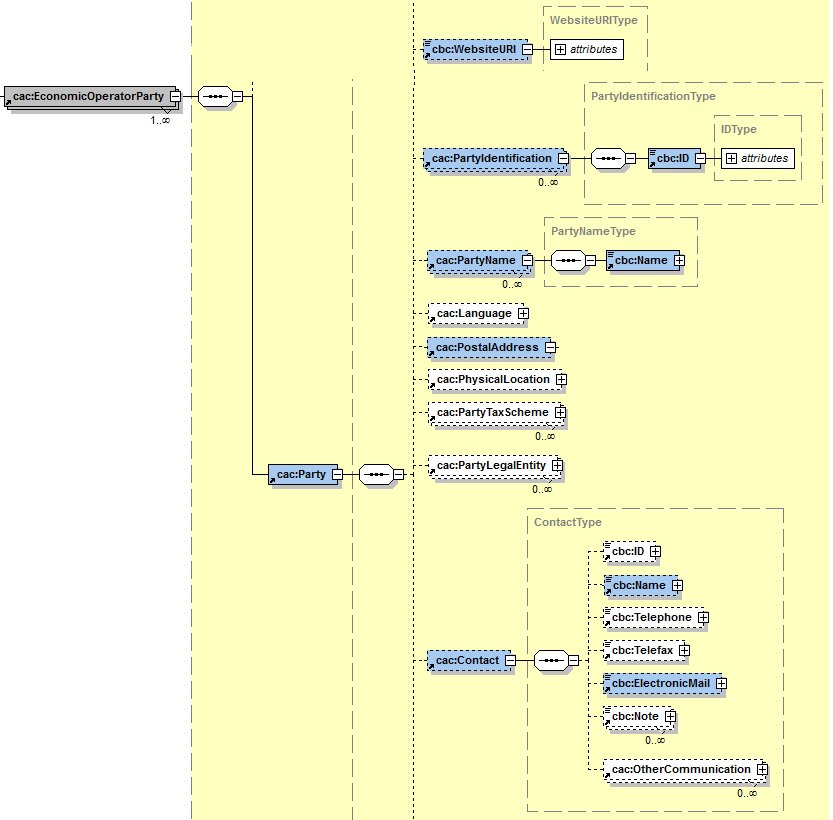
The XSD diagram below shows (in blue) the elements for which data are expected in the ESPD Response for the cac:Party element of the economic operator.
Expected elements
Class name: |
cac:EconomicOperatorParty |
Definition: |
The contracting authority or contracting entity who is buying supplies, services or public works using a tendering procedure as described in the applicable directive (e.g. Directives 2014/24/EU, 2014/25/EU). |
File: |
dist/common/xsdrt/UBL-CommonAggregateComponents-2.2.xsd |
Path: |
/QualificationApplicationRequest/cac:ContractingParty |
| Components | Type | Card | Description | Requirements |
|---|---|---|---|---|
cbc:BuyerProfileURI |
Identifier |
0..1 |
URL of the web section, in the contracting body web site, that contains information about the contracting body, the norms it applies when contracting, published calls for tenders, Prior Information Notices and Contract Notices as well as the related procurement documents, contract award notices, etc. |
Information Requirement: tbr070-001. Rule: Notices published at national level shall not contain information other than that contained in the notices dispatched to the Publications Office of the European Union or published on a buyer profile, but shall indicate the date of dispatch of the notice to the Publications Office of the European Union or its publication on the buyer profile (Directive 2014/24/EU, Art. 52.2). |
Class name: |
cac:Party |
Definition: |
Main data placeholder structure for, in this case, the contracting body. |
File: |
dist/common/xsdrt/UBL-CommonAggregateComponents-2.2.xsd |
Path: |
/QualificationApplicationRequest/cac:ContractingParty/cac:Party |
| Components | Type | Card | Description | Requirements |
|---|---|---|---|---|
cac:PartyIdentification/cbc:Identifier |
Identifier |
0..1 |
The national identifier of a contracting body as it is legally registered (e.g. VAT identification). |
Information Requirement: tbr070-001. Rule: More than one identifier can be specified. When possible use the VAT identification of the contracting body (see the VIES platform for a EU cross-border national VAT number verification system). |
cbc:WebsiteURI |
Identifier |
0..1 |
The website of the contracting body. |
Information Requirement: tbr070-006. Rule: For online services (e.g. Web Services, REST services, etc. use the component |
cbc:EndPointID |
Identifier |
0..1 |
Electronic address of the contracting body. |
Information Requirement: tbr070-001. Rule: Use it for online services (e.g. Web Services, REST services, ftp, etc.) |
cac:PartyName/cbc:Name |
Text |
1 |
The name of the contracting body as it is registered. |
Information Requirement: tbr070-001. Rule: Mandatory. Use the official name of the contracting body. The PartyName class has an associated basic element "cbc:Name". See XML example below. |
Class name: |
cac:PostalAddress |
Definition: |
Contractinng body address information. |
File: |
dist/common/xsdrt/UBL-CommonAggregateComponents-2.2.xsd |
Path: |
/QualificationApplicationRequest/cac:ContractingParty/cac:Party/cac:PostalAddress |
| Components | Type | Card | Description | Requirements |
|---|---|---|---|---|
cbc:PostBox |
Text |
0..1 |
A post office box number registered for postal delivery by a postal service provider. |
Information Requirement: tbr070-006. Rule: None. |
cbc:StreetName |
Text |
0..1 |
The main address line in an address. Usually the street name and number or post office box. |
Information Requirement: tbr070-006. Rule: None. |
cbc:CityName |
Text |
0..1 |
The common name of a city where the address is located. |
Information Requirement: tbr070-006. Rule: None. |
cbc:PostalZone |
Text |
0..1 |
The identifier for an addressable group of properties according to the relevant postal service, such as a ZIP code or Post Code. |
Information Requirement: tbr070-006. Rule: None. |
cac:Country/cbc:IdentificationCode |
Code |
1 |
A code that identifies the country. The lists of valid countries are registered with the ISO 3166-1 Maintenance agency, "Codes for the representation of names of countries and their subdivisions". It is recommended to use the Country Code ISO 3166-1 2A:2006 representation. |
Information Requirement: tbr070-006. Rule: The country of the contracting body must always be specified. Compulsory use of the code list CountryCodeIdentifier (ISO 3166-1 2A:2006). |
Class name: |
cac:Contact |
Definition: |
Used to provide contacting information for a party in general or a person. |
File: |
dist/common/xsdrt/UBL-CommonAggregateComponents-2.2.xsd |
Path: |
/QualificationApplicationRequest/cac:ContractingParty/cac:Party/cac:Contact |
| Components | Type | Card | Description | Requirements |
|---|---|---|---|---|
cbc:Name |
Text |
0..1 |
The name of the contact point. |
Information Requirement: tbr070-006. Rule: None. |
cbc:Telephone |
Text |
0..1 |
A phone number for the contact point. |
Information Requirement: tbr070-006. Rule: None. |
cbc:Telefax |
Text |
0..1 |
A fax number for the contact point. |
Information Requirement: tbr070-006. Rule: None. |
cbc:ElectronicMail |
Text |
0..1 |
An e-mail address for the contact point. |
Information Requirement: tbr070-006. Rule: None. |
VIII.6 Economic Operator
Related information requirements
See formal requirements related to the economic operators in the e-Sens site: (tbr092-001, _tbr092-008).
REQUIREMENT |
One ESPD Response per economic operator. The ESPD-EDM-2.1.1, as all the previous versions of the ESPD, requires that every economic operator that participates in one tender provide its own ESDP Response document. This affects sole traders that rely on other entities for the execution of the contract (e.g. subcontractors) and groups of economic operators, e.g. a Joint Venture or a Consortium, and all the sub-contractors on which each economic operator of the group relies on to meet the selection criteria. |
REQUIREMENT |
For the identification of the economic operators the UBL-2.2 element |
REQUIREMENT |
All economic operators belonging to a group (e.g. a Joint Venture, a Consortium, etc.) must specify the name of the group exactly with the same spelling (and respecting capital and lower cases, punctuation, and symbols) in each of their ESPD Responses. |
|
About the definition of economic operator
Beware that this ESPD-EDM V2.1.1 specification defines economic operator based on the one provided by the 2014 Directives, where an economic operator is "any natural or legal person or public entity, including any temporary association of undertakings, which offers the execution of works and/or a work, the supply of products or the provision of services on the market. Information about the party submitting the qualification". According to this definition one group of suppliers associated in a Joint Venture or in a Consortium, or any other type of undertaking is also an economic operator. However, due to the previous requirement establishing that each company participating in a tender must prepare its own ESPD Response document, the ESPD-EDM specification never uses the term "economic operator" to refer to a group of persons and/or companies but only to refer to each natural or legal person or public entity that participates in a tender. Therefore, in the context of the ESPD the definition of economic operator has been rephrased as "any natural or legal person or public entity, including any temporary association of undertakings, which offers the execution of works and/or a work, the supply of products or the provision of services on the market. Information about the party submitting the qualification". |
A couple of examples. According to the previous requirements:
-
One tender submitted by a sole trader that relies on two sub-contractors will have to include three ESPD Requests, one for the sole trader and one per each of the sub-contracted entity.
-
One tender submitted by a Consortium composed of three economic operators, two of which rely on two sub-contracted entities and the third one relies on five sub-contracted entities, will have to include 3 + 2 + 5 (ten) ESPD Requests.
Differences between Basic and Extended
-
Both, Basic and Extended models use the same elements from the UBL-2.2 XSD Schema. Differently to version 1.0.2.
-
The Basic ESPD expects the role as a text.The Extended ESPD allows for the specification of the role of the economic operator as a code. Depending on the role code the software applications can decide which sets of data show or hide in the GUI, validate or not, process or not.
-
The Basic ESPD expects the identification of members of a group as a text. In the Extended ESPD the members of the group are identified separately (name, ID and type of ID, and activity in the procedure).
-
In the Extended ESPD the information required about the entities upon which the economic operator relies on or not is richer and more structured than in the Basic ESPD.
-
The treatment of the data about the (pre)qualification of the economic operator varies; in the Extended ESPD is more structured and aims at making possible the implementation of the Once-Only-Principle, based on the premise that all the trusted (pre)qualification systems will be registered in e-Certis.
-
When specifying the Lots to which the Economic Operator wishes to tender, the Basic ESPD expects a DESCRIPTION, whilst the Extended expects a LOT_IDENTIFIER.
The information that the economic operator (EO) has to provide is relatively abundant, especially if the EO is the lead entity of a group. UBL does provide a class cac:EconomicOperator with sufficient data elements to identify the economic operator, its role, its representatives, physical location, officially registered address and other.
As the whole ESDP-EDM V2.1.1 is based entirely on the UBL-2.2 XSD (W3C) Schemas, these schemas are to be used for both the Basic and the Extended models of the ESPD.
Remember that the backwards compatibility between ESPD-EDM V2.1.1 and ESDP-EDM V1.0.2 is only ensured for the Basic ESPD.
Nonetheless some data requested in the ESPD are not modeled in UBL-2.2, namely those aiming at purposes going beyond the identification of the economic operator; e.g. data with statistical purposes; or to ensure the transparency of the procurement procedure; other.
Therefore in the ESPD-EDM-2.1.1, and for both the Basic and the Extended models, the information about the economic operator is spread in two different places:
-
The UBL-2.2 cac:EconomicOperatorParty component; and
-
In criteria data structures: following the solution adopted for Version 1.0.2 of the ESPD-EDM, the ESPD-EDM V2.1.1 defines several criteria classified as CRITERION.OTHER.EO_DATA.* (where the * refers to different branches and leaves of a different structures about the economic operator (e.g. SHELTERED_WORKSHOP, TOGETHER_WITH_OTHERS, etc.). The XML instances use criteria components (UBL-2.2 cac:TenderingCriterion) to structure these data. The sub-sections below cover both.
cac:EconomicOperatorParty
The UBL-2.2 cac:EconomicOperatorParty has three common aggregate components, the XSD Schema looks like this:
-
cac:QualifyingParty: is used to place data about the economic operator that is available from an official list, tenderer register or (pre)qualification system, such as official classification schemes, certificates, the number of employees, references used for the classification, etc. (circle #13);
-
cac:EconomicOperatorRole: use to place the role of the economic operator (circle #1);
-
cac:Party: used to place the data to identify the EO and its contact (circles #2 to #12).
cac:QualifyingParty
The diagram below shows the XSD element that will hold the data required by the ESPD (see mock-up 1/7, too). Beware that:
-
Identification of the economic operator: The Identifier assigned by the register or (pre)qualification system to the economic operator is placed in the element
/cac:EconomicOperatorParty/cac:QualifyingParty/cac:Party/cac:PartyIdentification(more details on this below and in the XML example); -
(Pre)qualification system: The Identifier and name of the (pre)qualification system is captured from e-Certis. The only datum that is necessary to keep in the XML is the identifier of the system provided by e-Certis. This identifier will be used as the value for the attribute
schemeAgencyID(always compulsory) of the element/cac:EconomicOperatorParty/cac:QualifyingParty/cac:Party/cac:PartyIdentification. This way:-
The (pre)qualification system is perfectly identified (and trusted, as it is registered in eCertis); and
-
The economic operator, identified with the number used in that (pre)qualification system, is linked inequivocally to that (pre)qualification system.
-
-
References and classification: The references linked to the classification of the EO are place in the component
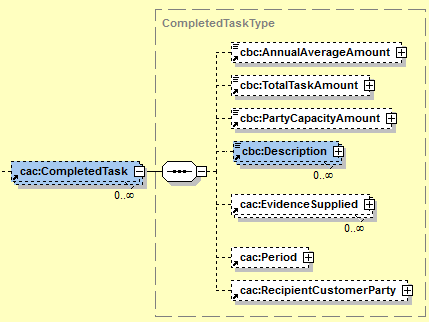
cac:QualifyingParty/cac:CompletedTask.-
For this V2.1.1 of the ESPD the only expected data about the reference is a short description identifying the task as described in the (pre)qualification system. However if you take a look at this common aggregate component you will observe that it caters for other relevant data.
-
Similarly, this V2.1.1, as the the v2.1.0 did, does not expect a complex representation of possible (optional) classification schemes. However the component
cac:BusinessClassificationScheme, associated to cac:QualifyingParty allows complex hierarchical classifications.
-
-
SME and number of employees: The number of employees determine the classification of the company as Micro, Small, Medium or Large company. The cac:QualifyingParty component provides two place-holders that are used by this ESPD-EDM (see also mock-ups above) [4]; see also footnote #6:
-
cac:QualifyingParty/cbc:EmployeeQuantity, for the number of employees; and
-
cac:QualifyingParty/cac:Party/cbc:IndustryClassificationCode to indicate whether the EO is a micro, small, medium or large company (or simply an SME). This code is defined in the Code List EOIndustryClassificationCode. See also sections "Expected Elements" and "XML example" for more details.
-
-
Turnover: For statistical purposes the ESPD-EDM asks this datum to reflect the financial capability of the economic operator (see mock-ups above). This datum is to be placed in
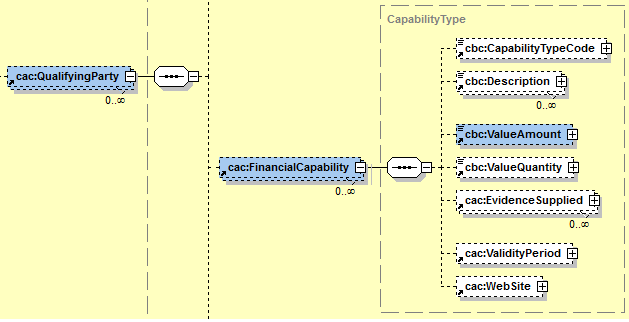
cac:QualifyingParty/cac:FinancialCapability/ValueAmount.
cac:EconomicOperatorRole
The UBL-2.2 element for the role of the economic operator is quite straightforward and typical in UBL: it provides a pair code + description (see Code List EORoleType for the codes and descriptions; see also the XML example below).
cac:Party
The XSD diagram below shows (in blue) the elements for which data are expected in the ESPD Response for the cac:Party element of the economic operator.
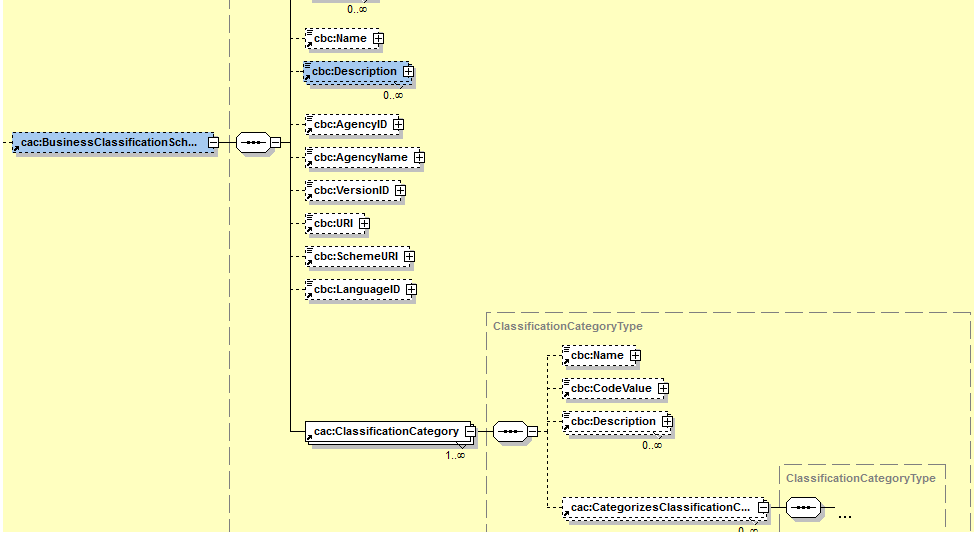
The figures below show the cac:QualifyingParty sub-components cac:BusinessClassificationScheme`and `FinancialCapability, and cac:CompletedTask in a bit more of detail. At present, the ESPD-EDM only uses one field, cbc:Description for the references and classifications and `cbc:Amount`for the Turnover.
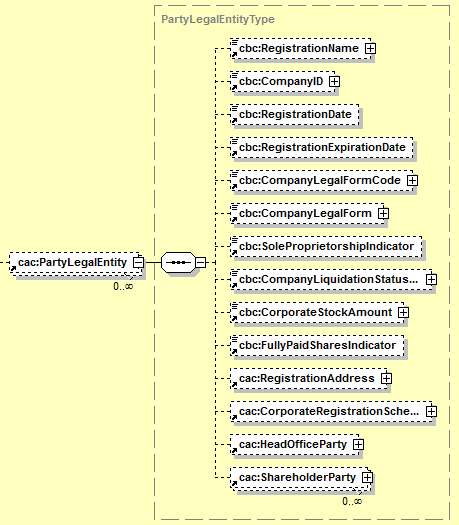
UBL-2.2 provides a component to hold very specifically the data to identify the economic operator as it officially registered in a Business Register. This XSD diagram below shows the elements of this component cac:LegalEntityParty. This ESPD-EDM specification recommends to use it as an alternative (or supplementary) way to identify the economic party.
Expected elements
Please, remember that the elements cac:ContractingAuthority, cac:ProcurementProject, cac:ProcurementProjectLot, and cac:AdditionalDocumentReference are expected in the ESPD Request, too. However, for the sake of brevity, and as they are taken from the ESPD Request and 'copied' in the ESPD Response, they have not been re-explained in this section about the ESPD Response. Therefore for details on those elements please refer to the section III. The ESPD Request document.
|
Remember that if the economic operator belongs to a group (i.e. it is not a sole contractor), the element |
Class name: |
cac:EconomicOperatorParty |
Definition: |
Any natural or legal person or public entity, including any temporary association of undertakings, which offers the execution of works and/or a work, the supply of products or the provision of services on the market. Information about the party submitting the qualification. |
Business rule(s): |
Common (BR-RESP-10) |
File: |
dist/common/xsdrt/UBL-CommonAggregateComponents-2.2.xsd |
Path: |
/QualificationApplicationResponse/cac:EconomicOperatorParty |
Context of use: |
The ESPD Response document. |
| Components | Type | Card | Description | Requirements |
|---|---|---|---|---|
cac:QualifyingParty |
Associated class |
1 |
The distinctive features or characteristics qualifying an economic operator to be a party in a tendering process (e.g., number of employees, number of operating units, type of business, technical and financial capabilities, completed projects). |
Information Requirement: tbr92-001 Rule: This element is compulsory in the ESPD-EDM V2.1.1 as it is the natural placeholder for several relevant data about the Economic Operator. Rule scope: Extended (BR-RESP-10-01) |
cac:EconomnicOperatorRole |
Associated class |
1 |
The function of the economic operator when bidding from a consortium (Sole contractor / Lead entity, member of a group, etc.). |
Information Requirement: Rule: This element is compulsory in the ESPD-EDM V2.1.1 because depending on it different sets of data will be required or not, shown or hidden, processed or skipped. |
cac:Party |
Associated class |
1 |
Main set of data used to identify and contact the economic operator, such as official identifiers, name, address, contact person, representatives, etc. |
Information Requirement: Rule: (See expected elements and rules below in the table about this Party). |
Class name: |
cac:QualifyingParty |
Definition: |
The distinctive features or characteristics qualifying an economic operator to be a party in a tendering process (e.g., number of employees, number of operating units, type of business, technical and financial capabilities, completed projects). |
Business rule(s): |
Extended (BR-RESP-10-01) |
File: |
dist/common/xsdrt/UBL-CommonAggregateComponents-2.2.xsd |
Path: |
/QualificationApplicationRequest/cac:EconomicOperatorParty/cac:QualifyingParty |
Context of use: |
Economic Operator in the ESPD Response document. |
| Components | Type | Card | Description | Requirements |
|---|---|---|---|---|
cbc:EmployeeQuantity |
Quantity |
0..1 |
The number of people employed by the economic operator participating in the tender. |
Information Requirement: tbr92-001 Rule: Integer value expected. |
cac:BusinessClassificationScheme/cbc:Description |
Text |
0..n |
The text describing one official classification assigned by an official list or (pre)qualification system to the economic operator. |
Information Requirement: tbr92-001 Rule: Only the 'Description' is expected, but the component cac:ClassificationScheme offers other rich possibilities (see the UBL-2.2 model in the distribution package or in the original source for more details). Rule: Integer value expected. |
cac:FinancialCapability/cbc:ValueAmount |
Amount |
0..1 |
A monetary amount as a measure of this capability. |
Information Requirement: tbr92-001 Rule: Use it to place here the general Turnover of the EO (for statistical purposes). Compulsory assignment of a value to the attribute currency. The default value should be set to 'EUR'. Compulsory use of the Code List CurrencyCode. Rule scope: Extended (BR-OTH-01#16, BR-OTH-03) |
cac:CompletedTask/cbc:Description |
Text |
0..1 |
Text describing the works, supplies or services executed, delivered or performed in a procurement project (normally used as a reference for the classification of the economic operator. |
Information Requirement: tbr92-001 Rule: Use it to place here the references that were used in the (pre)qualification system to get the specific classification related to those references. |
cac:Party/cac:PartyIdentifier/cbc:ID |
Identifier |
0..1 |
The identifier of the economic operator in an official list, register or (pre)qualification system. |
Information Requirement: tbr92-001 Rule: The attribute Rule scope: Extended ( BR-RESP-80-S10, BR-RESP-80-S20), Common (BR-RESP-50, BR-OTH-02) |
Class name: |
cac:EconomicOperatorRole |
Definition: |
The function of the economic operator when bidding from a consortium (Sole contractor / Lead entity, member of a group, etc.). |
File: |
dist/common/xsdrt/UBL-CommonAggregateComponents-2.2.xsd |
Path: |
/QualificationApplicationRequest/cac:EconomicOperatorParty/cac:EconomicOperatorRole |
Context of use: |
Economic Operator in the ESPD Response document. |
| Components | Type | Card | Description | Requirements |
|---|---|---|---|---|
cbc:RoleCode |
Code |
1 |
Identifies the role of the economic operator in the bid. |
Information Requirement: tbr92-008 Rule: Compulsory use of the Code List EORoleType. Rule scope: Extended (BR-RESP-10-03, BR-OTH-01, BR-OTH-01#15, BR-OTH-03) |
cbc:RoleDescription |
Text |
0..n |
The text describing the role of the economic operator in the bid. |
Information Requirement: tbr92-008 Rule: Software applications should retrieve and reuse the description from the Code List EORoleType. Rule scope: Common (BR-RESP-10-02) |
Class name: |
cac:Party |
Definition: |
Main set of data used to identify and contact the economic operator, such as official identifiers, name, address, contact person, representatives, etc. |
File: |
dist/common/xsdrt/UBL-CommonAggregateComponents-2.2.xsd |
Path: |
/QualificationApplicationResponse/cac:EconomicOperatorParty/cac:Party |
| Components | Type | Card | Description | Requirements |
|---|---|---|---|---|
cac:PartyIdentification/cbc:Identifier |
Identifier |
1 |
An identifier that identifies the economic operator, such as a the VAT number, the company registration number in a Business Register, other. |
Information Requirement: tbr92-001. Rule: More than one identifier can be specified. Compulsory use of the attribute Rule scope: Common (BR-OTH-02) |
cbc:EndPointID |
Identifier |
0..1 |
Electronic address of the contracting body. |
Information Requirement: tbr92-001. Rule: Use it for online services (e.g. Web Services, REST services, Delivery ID, ftp, etc. For the official web site of the Party use always the Rule scope: Common (BR-RESP-10-08) |
cac:PartyName/cbc:Name |
Text |
1 |
The name of the economic operator. |
Information Requirement: tbr92-001. Rule: Use the official name of the Party as officially registered. Be accurate in its spelling. |
cbc:IndustryClassificationCode |
Code |
1 |
Used to indicate whether the company is a micro, small, medium or large enterprise. |
Information Requirement: tbr92-004. Rule: Used only for statistical purposes. Compulsory use of parameters established by the EU Recommendation 2003/361 to determine whether the EO’s company is micro, small, medium or large. Beware that these parameters may change in the future. |
cbc:WebsiteURI |
Identifier |
0..1 |
The website of the economic operator. |
Information Requirement: tbr92-012. Rule: Use it for the official web site of the service provider. |
Class name: |
cac:PostalAddress |
Definition: |
Postal address information. |
Business rule(s): |
None |
File: |
dist/common/xsdrt/UBL-CommonAggregateComponents-2.2.xsd |
Path: |
/QualificationApplicationResponse/cac:EconomicOperator/cac:Party/cac:PostalAddress |
| Components | Type | Card | Description | Requirements |
|---|---|---|---|---|
cac:AddressLine/cbc:Line |
Text |
0..1 |
The main address line in an address. Usually the street name and number or post office box. |
Information Requirement: tbr92-012. Rule: None. |
cbc:CityName |
Text |
0..1 |
The common name of a city where the address is located. |
Information Requirement: tbr92-012. Rule: None. |
cbc:PostalZone |
Text |
0..1 |
The identifier for an addressable group of properties according to the relevant postal service, such as a ZIP code or Post Code. |
Information Requirement: tbr92-012. Rule: None. |
cac:Country/cbc:IdentificationCode |
Code |
1 |
A code that identifies the country. |
Information Requirement: tbr92-012. Rule: The country of the contracting body must always be specified. Compulsory use of the Code List CountryCodeIdentifier (ISO 3166-1 2A:2006). Rule scope: Common (BR-RESP-10-07, BR-OTH-01, BR-OTH-01#5, BR-OTH-03) |
cac:Country/cbc:Name |
Text |
0..1 |
The name of the country. |
Information Requirement: tbr92-012. Rule: None. |
Class name: |
cac:Contact |
Definition: |
Used to provide contacting information for a party in general or a person. |
Business rule(s): |
None |
File: |
dist/common/xsdrt/UBL-CommonAggregateComponents-2.2.xsd |
Path: |
/QualificationApplicationResponse/cac:EconomicOperatorParty/cac:Party/cac:Contact |
| Components | Type | Card | Description | Requirements |
|---|---|---|---|---|
cbc:Name |
Text |
0..1 |
The name of the contact point. |
Information Requirement: tbr92-012. Rule: None. |
cbc:Telephone |
Text |
0..1 |
A phone number for the contact point. |
Information Requirement: tbr92-012. Rule: None. |
cbc:Telefax |
Text |
0..1 |
A fax number for the contact point. |
Information Requirement: tbr92-012. Rule: None. |
cbc:ElectronicMail |
Text |
0..1 |
An e-mail address for the contact point. |
Information Requirement: tbr92-012. Rule: None. |
|
Please see also the section III.6 Service Provider (for the ESPD Request) for other details and comparison with the previous version 1.0.2 of the ESPD-EDM. |
Class name: |
cac:ServiceProviderParty/cac:Party |
Definition: |
Main information about the service provider. |
Business rule(s): |
None |
File: |
dist/common/xsdrt/UBL-CommonAggregateComponents-2.2.xsd |
Path: |
/QualificationApplicationResponse/cac:EconomicOperatorParty/cac:Party/cac:ServiceProviderParty/cac:Party |
| Components | Type | Card | Description | Requirements |
|---|---|---|---|---|
cbc:WebsiteURI |
Identifier |
0..1 |
The website of the service provider. |
Information Requirement: tbr070-021. Rule: Use it for the official web site of the service provider. Reserve the |
cbc:EndpointID |
Identifier |
0..1 |
Electronic address of the service provider. |
Information Requirement: tbr070-021. Rule: Use it for online services (e.g. Web Services, REST services, Delivery ID, ftp, etc. For the official web site of the Party use always the Rule scope: Common (BR-RESP-10-08) |
cac:PartyIdentification/cbc:ID |
Identifier |
1 |
The national identifier of a service provider as it is legally registered (e.g. VAT identification). |
Information Requirement: tbr070-021. Rule: An identifier for the service provider must always be provided. Compulsory use of the attribute Rule scope: Common (BR-RESP-10-11, BR-OTH-02) |
cac:PartyName/cbc:Name |
Text |
1 |
The name of the service provider. |
Information Requirement: tbr070-021. Rule: The name of the service provider must always be specified. Supply the official registered name of the service provider. Rule scope: Common (BR-RESP-10-09) |
cac:PostalAddress/cac:Country/cbc:IdentificationCode |
Identifier |
1 |
The code that identifies the country of the service provider. |
Information Requirement: tbr070-021. Rule: The country of the service provider must always be specified. Compulsory use of the Code List CountryCodeIdentifier (ISO 3166-1 2A:2006). Rule scope: Extended (BR-RESP-10-10, BR-OTH-01, BR-OTH-01#5, BR-OTH-03) |
Mock-ups and data structures
The mock-up below shows the set of data required about the economic operator for the Basic model of the ESPD:
Mock-up (1/8): Basic identification data:
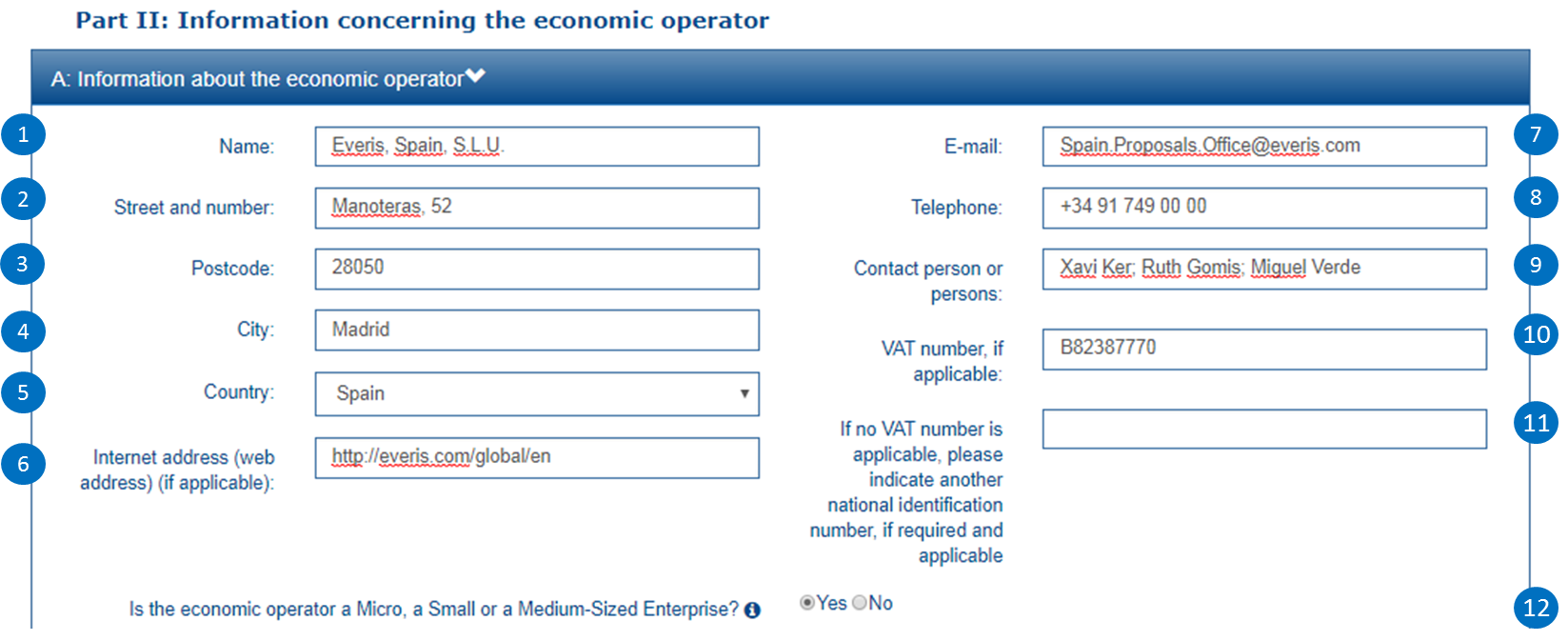
The following figures below show the data aimed at other purposes (namely statistical), that is structured using the UBL-2.2 cac:TenderingCriterion. See the XML example below to check how both, the cac:EconomicOperatorParty and these data structures are used.
Mockup (2/8): Sheltered workshop or social business in case of reserved procurement:

Data structure for a sheltered workshop or social business in case of reserved procurement:
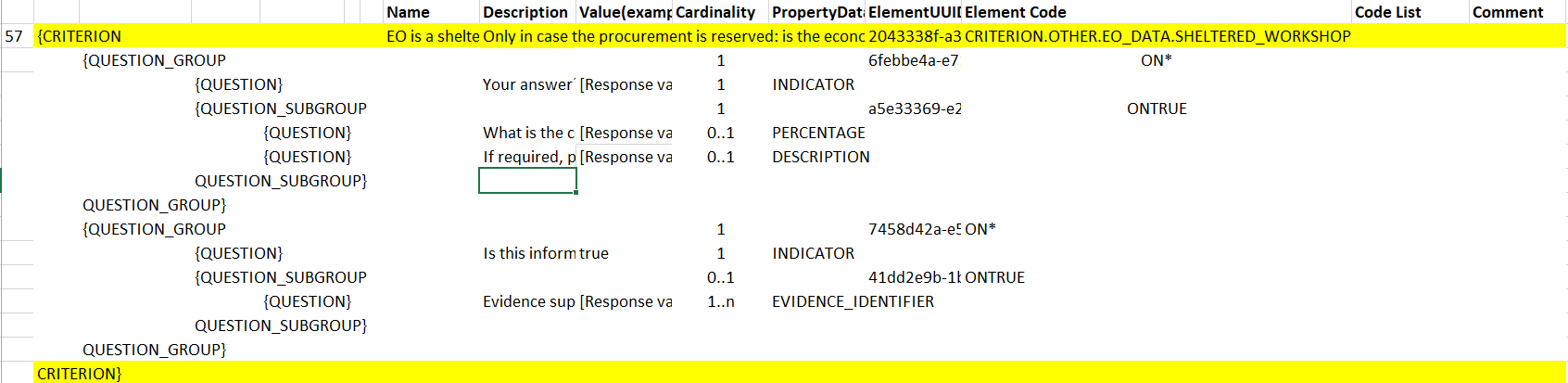
Mockup (3/8): Registration on an official list, tenderer register or (pre)qualification system:
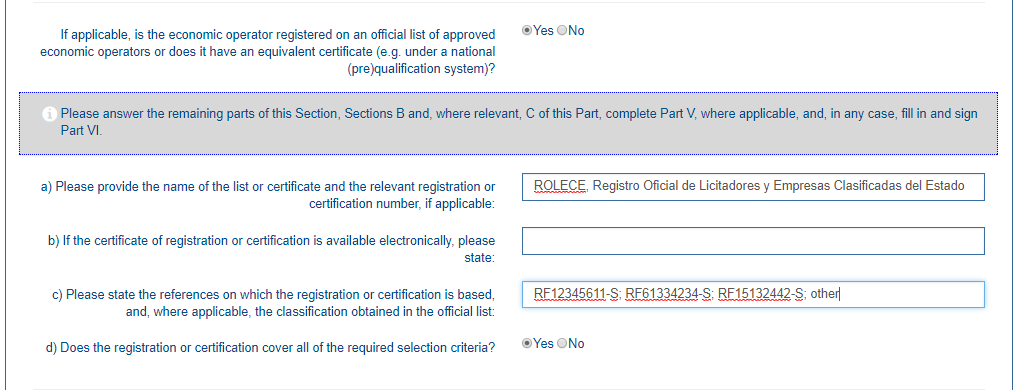
Data structure for the (pre)qualification of the economic operator by an official list or similar:
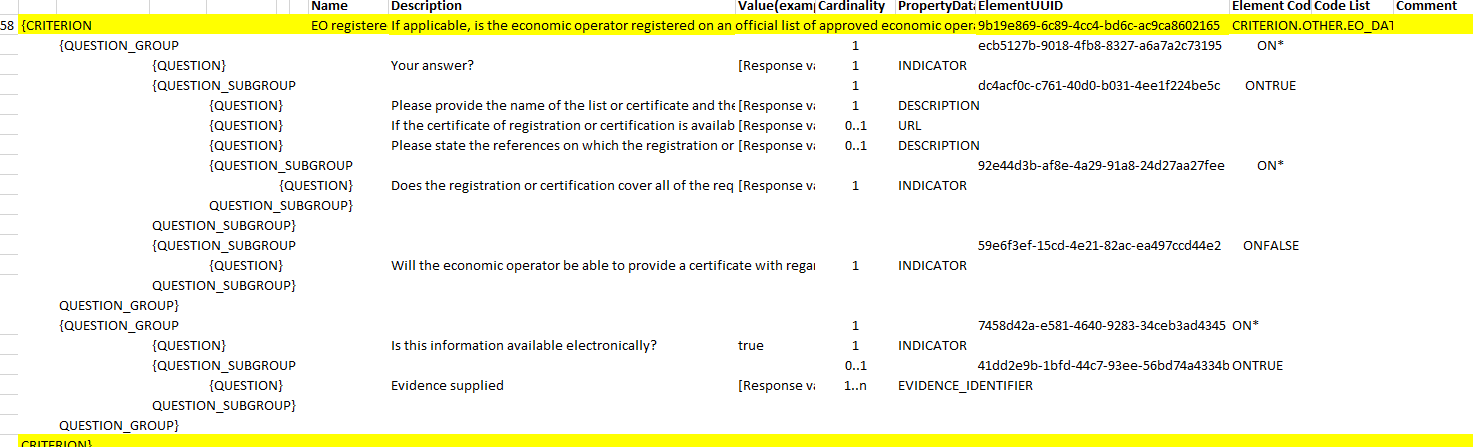
Mock-up (4/8): Role and other members of the group:
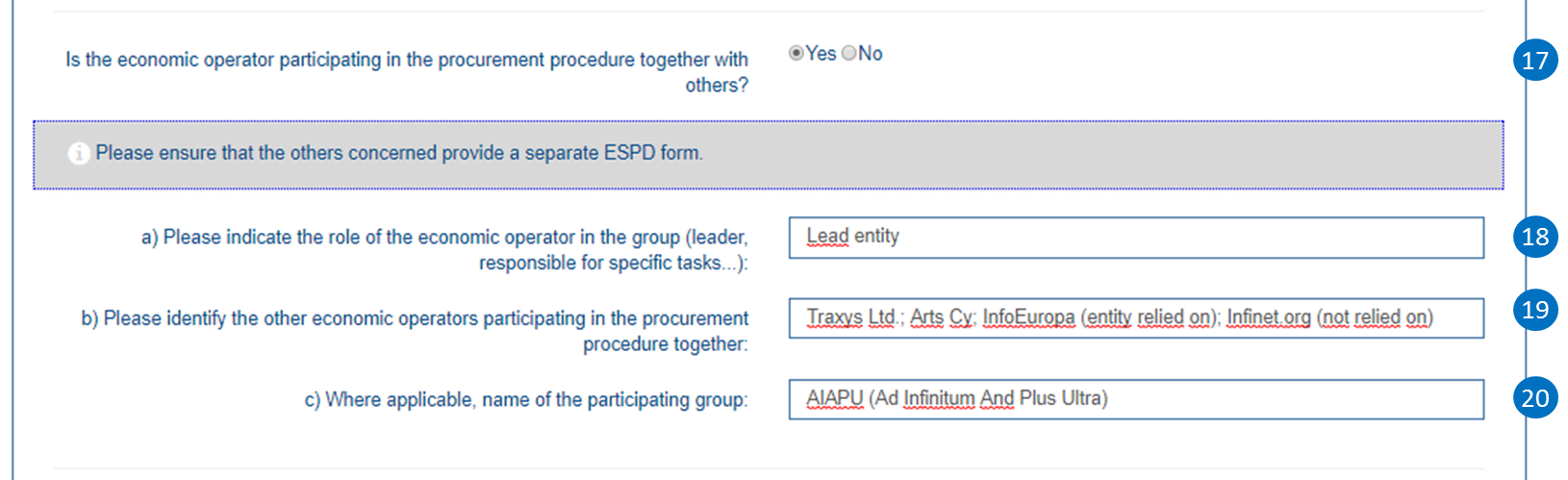
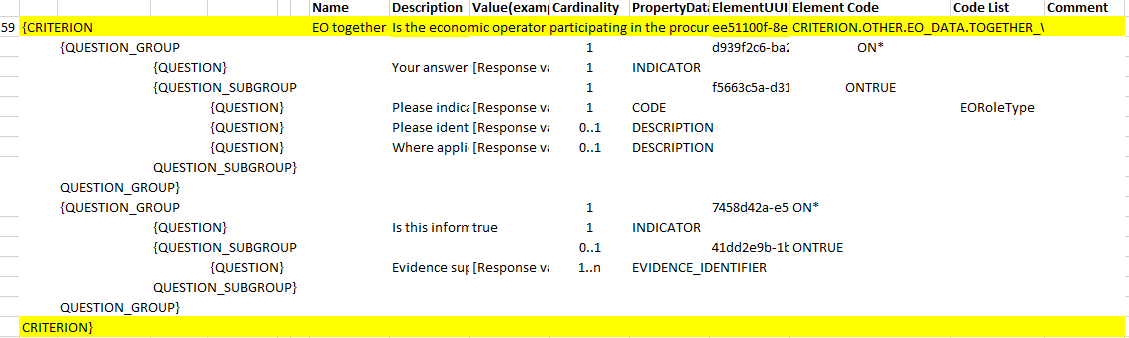
Data structure for the role and members of the group (when bidding as a Consortium, Joint Venture, etc.) Beware that the name of the group has its own placeholder in the UBL-2.2 data model: /QualificationApplicationResponse/cbc:EconomicOperatorGroupName
Mock-up: (5/8): Lots to which the economic operator tenders:

Data structure for the Lots to which the economic operator tenders to:

Mock-up(6/8): Certificates about contributions to the Tax Agency and/or Social Security:

Data structure for the certificates about contributions to the Tax Agency and/or Social Security:
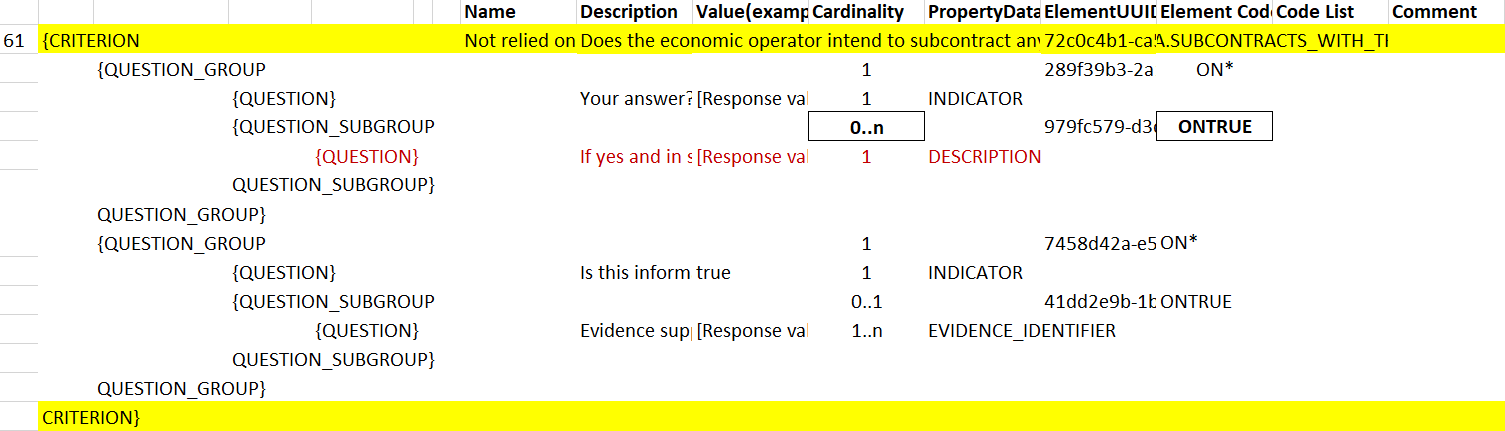
Mock-up (7/8): Entities on which the economic operator relies on to meet the selection criteria. Notice only a *Yes or No answer is expected:
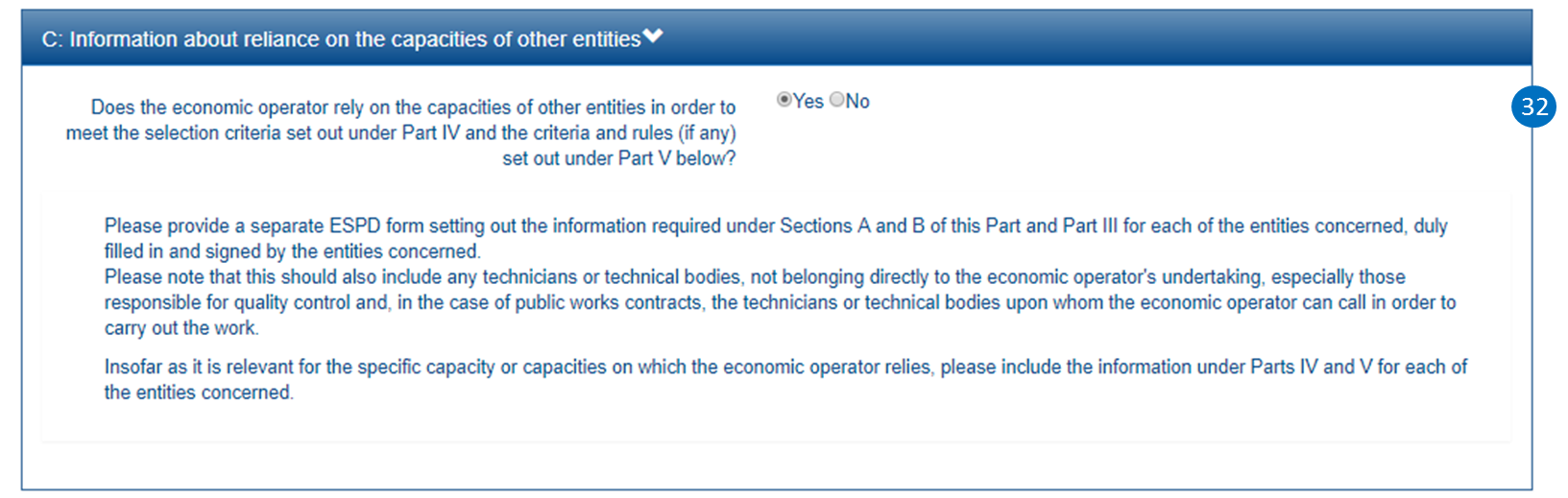
Data structure for the entities the EO relies on:
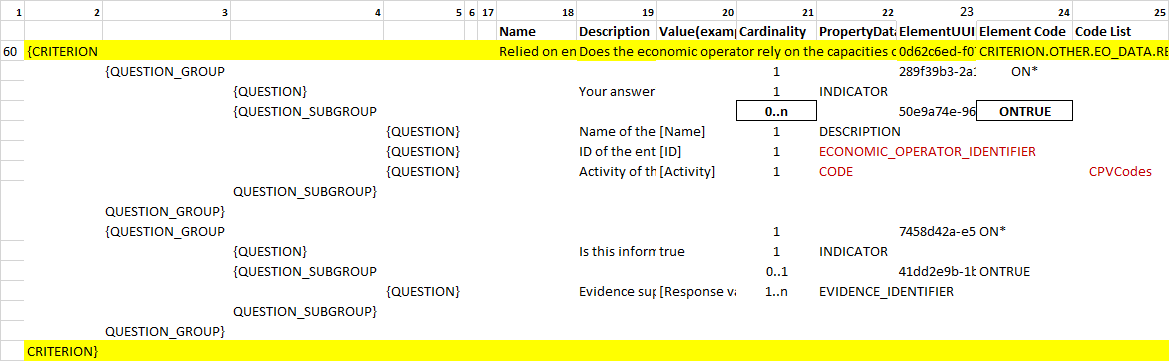
Mock-up: (8/8): Entities on which the economic operator does not rely on to meet the selection criteria. Notice only a *Yes or No answer is expected, plus a sequence of entity names as a text:
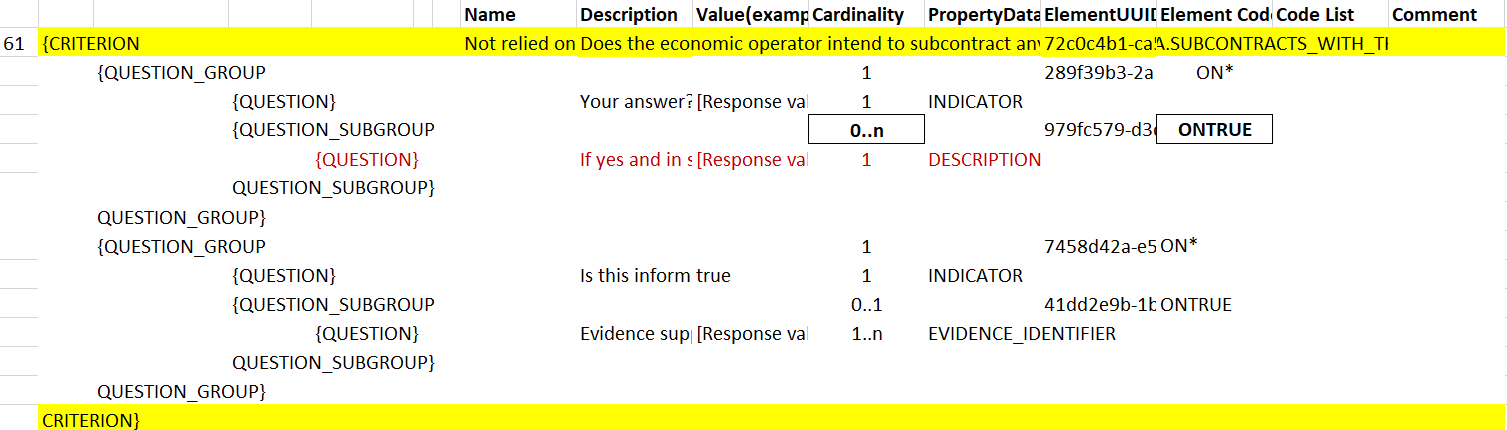
Data structure for the subcontractor upon which the EO does not relied to meet the selection criteria:
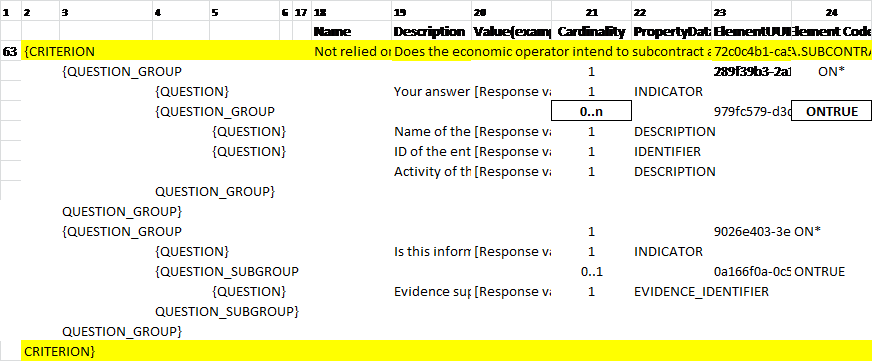
XML Example (BASIC economic operator)
This example contains all the data about an economic operator. Beware that the basic idenTification data is placed into the cac:EconomicOperatorParty component, whilst the rest of the data (namely for statististical purposes) is structured in the data structures described above.
Compare with the XML example about the economic operator for the EXTENDED ESPD Response. You will notice some differences, e.g. the Role of the economic operator, number of employees, and other.
The figure below shows how the data about the economic operator looks like in a 'collapsed' EXTENDED ESPD XML instance (notice that in this example the EO belongs to a group named 'AIAPU', element /cac:EconomicOperatorGroupName; beware that the group name is a data element located at the root of the document).
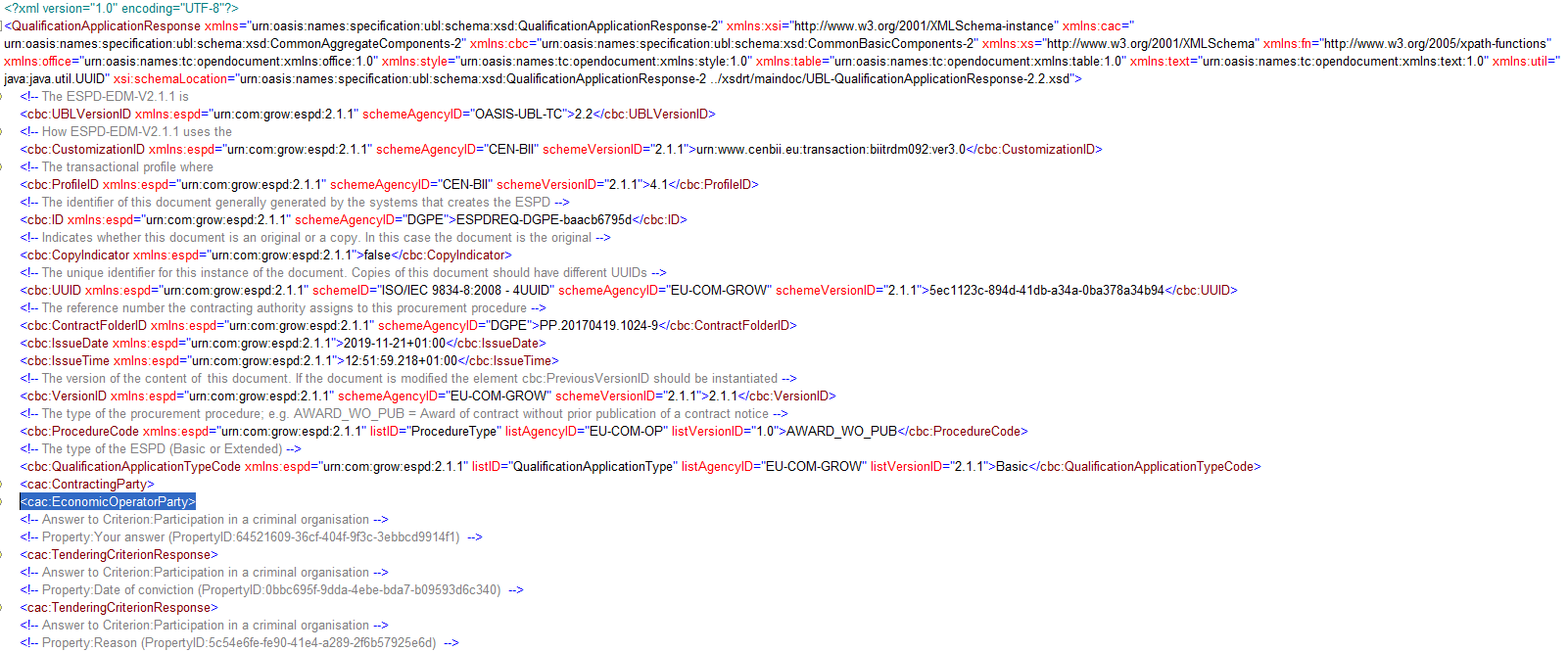
This fragment of XML does not include the responses to the QUESTION(s) in the data structures, yet. This is because the Responses have to be associated to a criterion property. The fragment below shows how these criterion properties are prepared and a 'dynamic' UUID is associated to each criterion property. Later on the response values will use these UUID to link the actual response to each QUESTION (i.e. with each cac:TenderingCriterionProperty element). Therefore the example does not include the data about the the EO yet. To see how the EO provides these data please see the sections below about the Response. There you will see that each element cac:ResponseValue is associated to a the UUID of the corresponding cac:TenderingCriterionProperty. For an example of a complete BASIC ESPD Response XML document you can also see the file BASIC-ESPDResponse-2.1.1.xml.
<!-- Root elements removed for the sake of brevity -->

<!-- Economic Operator Data -->
<cac:EconomicOperatorParty>
	<cac:QualifyingParty>
		<cac:Party>
			<!-- This EO company is NOT an SME -->
			<cbc:IndustryClassificationCode listID="EOIndustryClassificationCode" listAgencyID="EU-COM-GROW" listVersionID="2.1.1">LARGE</cbc:IndustryClassificationCode>
		</cac:Party>
	</cac:QualifyingParty>
	<cac:Party>
		<cbc:WebsiteURI>http://everis.com/global/en</cbc:WebsiteURI>
		<cac:PartyIdentification>
			<cbc:ID schemeAgencyID="ES-VAT" schemeAgencyName="Spanish Tax Agency" schemeID="VIES" schemeURI="http://ec.europa.eu/taxation_customs/vies/vieshome.do?locale=es" schemeName="ES Value Added Tax Number">B82387770</cbc:ID>
		</cac:PartyIdentification>
		<cac:PartyName><cbc:Name>Everis, Spain, S.L.U.</cbc:Name></cac:PartyName>
		<cac:PostalAddress>
		<cbc:CityName>Madrid</cbc:CityName>
			<cbc:PostalZone>28050</cbc:PostalZone>
			<cac:AddressLine>
				<cbc:Line>Manoteras, 52</cbc:Line>
		</cac:AddressLine>
		<cac:Country>
			<cbc:IdentificationCode listID="CountryCodeIdentifier" listName="ISO-1-ALPHA-2" listAgencyID="ISO" listVersionID="1.0">ES</cbc:IdentificationCode>
			<cbc:Name>Spain</cbc:Name>
		</cac:Country>
		</cac:PostalAddress>
		<cac:Contact>
			<cbc:Name>Xavi Ker; Ruth Gomis; Miguel Verde</cbc:Name>
			<cbc:Telephone>+34 91 749 00 00</cbc:Telephone>
			<cbc:ElectronicMail>Spain.Proposals.Office@everis.com</cbc:ElectronicMail>
		</cac:Contact>
	</cac:Party>
</cac:EconomicOperatorParty>
<!-- OTHER DATA ABOUT THE ECONOMIC OPERATOR THAT IS MODELLED AS CRITERIA -->
<!-- Criterion:EO is a sheltered workshop -->
<cac:TenderingCriterion>
	<cbc:ID schemeID="CriteriaTaxonomy" schemeAgencyID="EU-COM-GROW" schemeVersionID="2.1.1">2043338f-a38a-490b-b3ec-2607cb25a017</cbc:ID>
	<cbc:CriterionTypeCode listID="CriteriaTypeCode" listAgencyID="EU-COM-GROW" listVersionID="2.1.1">CRITERION.OTHER.EO_DATA.SHELTERED_WORKSHOP</cbc:CriterionTypeCode>
	<cbc:Name>EO is a sheltered workshop</cbc:Name>
	<cbc:Description>Only in case the procurement is reserved: is the economic operator a sheltered workshop, a 'social business' or will it provide for the performance of the contract in the context of sheltered employment programmes?</cbc:Description>
	<cac:TenderingCriterionPropertyGroup>
		<cbc:ID schemeID="CriteriaTaxonomy" schemeAgencyID="EU-COM-GROW" schemeVersionID="2.1.1">6febbe4a-e715-427c-a2b1-19cfabadaef0</cbc:ID>
		<cbc:PropertyGroupTypeCode listID="PropertyGroupType" listAgencyID="EU-COM-GROW" listVersionID="2.1.1">ON*</cbc:PropertyGroupTypeCode>
		<cac:TenderingCriterionProperty>
			<cbc:ID schemeID="CriteriaTaxonomy" schemeAgencyID="EU-COM-GROW" schemeVersionID="2.1.1">97402ce3-b321-469e-9fa2-d3c3e3e09ca9</cbc:ID>
			<cbc:Description>Your answer?</cbc:Description>
			<cbc:TypeCode listID="CriterionElementType" listAgencyID="EU-COM-GROW" listVersionID="2.1.1">QUESTION</cbc:TypeCode>
			<cbc:ValueDataTypeCode listID="ResponseDataType" listAgencyID="EU-COM-GROW" listVersionID="2.1.1">INDICATOR</cbc:ValueDataTypeCode>
		</cac:TenderingCriterionProperty>
		<cac:SubsidiaryTenderingCriterionPropertyGroup>
			<cbc:ID schemeID="CriteriaTaxonomy" schemeAgencyID="EU-COM-GROW" schemeVersionID="2.1.1">a5e33369-e2b5-45f7-9969-ddb1c3ae17c8</cbc:ID>
			<cbc:PropertyGroupTypeCode listID="PropertyGroupType" listAgencyID="EU-COM-GROW" listVersionID="2.1.1">ONTRUE</cbc:PropertyGroupTypeCode>
			<cac:TenderingCriterionProperty>
				<cbc:ID schemeID="CriteriaTaxonomy" schemeAgencyID="EU-COM-GROW" schemeVersionID="2.1.1">57dc3ba0-eda3-48cb-8e58-c065f12ad7a8</cbc:ID>
				<cbc:Description>What is the corresponding percentage of disabled or disadvantaged workers?</cbc:Description>
				<cbc:TypeCode listID="CriterionElementType" listAgencyID="EU-COM-GROW" listVersionID="2.1.1">QUESTION</cbc:TypeCode>
				<cbc:ValueDataTypeCode listID="ResponseDataType" listAgencyID="EU-COM-GROW" listVersionID="2.1.1">PERCENTAGE</cbc:ValueDataTypeCode>
			</cac:TenderingCriterionProperty>
			<cac:TenderingCriterionProperty>
				<cbc:ID schemeID="CriteriaTaxonomy" schemeAgencyID="EU-COM-GROW" schemeVersionID="2.1.1">f536b7eb-d393-483f-bbe8-67161e7552a2</cbc:ID>
				<cbc:Description>If required, please provide details on whether the employees concerned belong to a specific category of disabled or disadvantaged workers?</cbc:Description>
				<cbc:TypeCode listID="CriterionElementType" listAgencyID="EU-COM-GROW" listVersionID="2.1.1">QUESTION</cbc:TypeCode>
				<cbc:ValueDataTypeCode listID="ResponseDataType" listAgencyID="EU-COM-GROW" listVersionID="2.1.1">DESCRIPTION</cbc:ValueDataTypeCode>
			</cac:TenderingCriterionProperty>
		</cac:SubsidiaryTenderingCriterionPropertyGroup>
	</cac:TenderingCriterionPropertyGroup>
</cac:TenderingCriterion>
<!-- Criterion:EO registered in a PQS -->
<cac:TenderingCriterion>
	<cbc:ID schemeID="CriteriaTaxonomy" schemeAgencyID="EU-COM-GROW" schemeVersionID="2.1.1">9b19e869-6c89-4cc4-bd6c-ac9ca8602165</cbc:ID>
	<cbc:CriterionTypeCode listID="CriteriaTypeCode" listAgencyID="EU-COM-GROW" listVersionID="2.1.1">CRITERION.OTHER.EO_DATA.REGISTERED_IN_OFFICIAL_LIST</cbc:CriterionTypeCode>
	<cbc:Name>EO registered in a PQS</cbc:Name>
	<cbc:Description>If applicable, is the economic operator registered on an official list of approved economic operators or does it have an equivalent certificate (e.g. under a national (pre)qualification system)?</cbc:Description>
	<cac:TenderingCriterionPropertyGroup>
		<cbc:ID schemeID="CriteriaTaxonomy" schemeAgencyID="EU-COM-GROW" schemeVersionID="2.1.1">64162276-7014-408f-a9af-080426bfe1fd</cbc:ID>
		<cbc:PropertyGroupTypeCode listID="PropertyGroupType" listAgencyID="EU-COM-GROW" listVersionID="2.1.1">ON*</cbc:PropertyGroupTypeCode>
		<cac:TenderingCriterionProperty>
			<cbc:ID schemeID="CriteriaTaxonomy" schemeAgencyID="EU-COM-GROW" schemeVersionID="2.1.1">3f5959b0-6367-4f0e-96c2-a44635bbf84e</cbc:ID>
			<cbc:Description>Your answer?</cbc:Description>
			<cbc:TypeCode listID="CriterionElementType" listAgencyID="EU-COM-GROW" listVersionID="2.1.1">QUESTION</cbc:TypeCode>
			<cbc:ValueDataTypeCode listID="ResponseDataType" listAgencyID="EU-COM-GROW" listVersionID="2.1.1">INDICATOR</cbc:ValueDataTypeCode>
		</cac:TenderingCriterionProperty>
		<cac:SubsidiaryTenderingCriterionPropertyGroup>
			<cbc:ID schemeID="CriteriaTaxonomy" schemeAgencyID="EU-COM-GROW" schemeVersionID="2.1.1">7458d42a-e581-4640-9283-34ceb3ad4345</cbc:ID>
			<cbc:PropertyGroupTypeCode listID="PropertyGroupType" listAgencyID="EU-COM-GROW" listVersionID="2.1.1">ONTRUE</cbc:PropertyGroupTypeCode>
			<cac:TenderingCriterionProperty>
				<cbc:ID schemeID="CriteriaTaxonomy" schemeAgencyID="EU-COM-GROW" schemeVersionID="2.1.1">a1e91ee8-30d3-43bc-886c-c72fb2fc173b</cbc:ID>
				<cbc:Description>a) Please provide the name of the list or certificate and the relevant registration or certification number, if applicable</cbc:Description>
				<cbc:TypeCode listID="CriterionElementType" listAgencyID="EU-COM-GROW" listVersionID="2.1.1">QUESTION</cbc:TypeCode>
				<cbc:ValueDataTypeCode listID="ResponseDataType" listAgencyID="EU-COM-GROW" listVersionID="2.1.1">DESCRIPTION</cbc:ValueDataTypeCode>
			</cac:TenderingCriterionProperty>
			<cac:TenderingCriterionProperty>
				<cbc:ID schemeID="CriteriaTaxonomy" schemeAgencyID="EU-COM-GROW" schemeVersionID="2.1.1">c49b62b7-fc29-48ba-b55e-71071e26b967</cbc:ID>
				<cbc:Description>b) If the certificate of registration or certification is available electronically, please state where</cbc:Description>
				<cbc:TypeCode listID="CriterionElementType" listAgencyID="EU-COM-GROW" listVersionID="2.1.1">QUESTION</cbc:TypeCode>
				<cbc:ValueDataTypeCode listID="ResponseDataType" listAgencyID="EU-COM-GROW" listVersionID="2.1.1">URL</cbc:ValueDataTypeCode>
			</cac:TenderingCriterionProperty>
			<cac:TenderingCriterionProperty>
				<cbc:ID schemeID="CriteriaTaxonomy" schemeAgencyID="EU-COM-GROW" schemeVersionID="2.1.1">ebc94ce3-7344-4300-8b63-770b8dcf0f94</cbc:ID>
				<cbc:Description>c) Please state the references on which the registration or certification is based, and, where applicable, the classification obtained in the official list</cbc:Description>
				<cbc:TypeCode listID="CriterionElementType" listAgencyID="EU-COM-GROW" listVersionID="2.1.1">QUESTION</cbc:TypeCode>
				<cbc:ValueDataTypeCode listID="ResponseDataType" listAgencyID="EU-COM-GROW" listVersionID="2.1.1">DESCRIPTION</cbc:ValueDataTypeCode>
			</cac:TenderingCriterionProperty>
			<cac:TenderingCriterionProperty>
				<cbc:ID schemeID="CriteriaTaxonomy" schemeAgencyID="EU-COM-GROW" schemeVersionID="2.1.1">5d901b56-a49d-4f2f-b7d5-e91f8480e230</cbc:ID>
				<cbc:Description>d) Does the registration or certification cover all of the required selection criteria?</cbc:Description>
				<cbc:TypeCode listID="CriterionElementType" listAgencyID="EU-COM-GROW" listVersionID="2.1.1">QUESTION</cbc:TypeCode>
				<cbc:ValueDataTypeCode listID="ResponseDataType" listAgencyID="EU-COM-GROW" listVersionID="2.1.1">INDICATOR</cbc:ValueDataTypeCode>
			</cac:TenderingCriterionProperty>
		</cac:SubsidiaryTenderingCriterionPropertyGroup>
	</cac:TenderingCriterionPropertyGroup>
</cac:TenderingCriterion>
<!-- Criterion:EO together with others -->
<cac:TenderingCriterion>
	<cbc:ID schemeID="CriteriaTaxonomy" schemeAgencyID="EU-COM-GROW" schemeVersionID="2.1.1">ee51100f-8e3e-40c9-8f8b-57d5a15be1f2</cbc:ID>
	<cbc:CriterionTypeCode listID="CriteriaTypeCode" listAgencyID="EU-COM-GROW" listVersionID="2.1.1">CRITERION.OTHER.EO_DATA.TOGETHER_WITH_OTHERS</cbc:CriterionTypeCode>
	<cbc:Name>EO together with others</cbc:Name>
	<cbc:Description>Is the economic operator participating in the procurement procedure together with others?</cbc:Description>
	<cac:TenderingCriterionPropertyGroup>
		<cbc:ID schemeID="CriteriaTaxonomy" schemeAgencyID="EU-COM-GROW" schemeVersionID="2.1.1">d939f2c6-ba25-4dc4-889c-11d1853add19</cbc:ID>
		<cbc:PropertyGroupTypeCode listID="PropertyGroupType" listAgencyID="EU-COM-GROW" listVersionID="2.1.1">ON*</cbc:PropertyGroupTypeCode>
		<cac:TenderingCriterionProperty>
			<cbc:ID schemeID="CriteriaTaxonomy" schemeAgencyID="EU-COM-GROW" schemeVersionID="2.1.1">843676a4-303f-4ffa-bd0b-3531dcc3b731</cbc:ID>
			<cbc:Description>Your answer?</cbc:Description>
			<cbc:TypeCode listID="CriterionElementType" listAgencyID="EU-COM-GROW" listVersionID="2.1.1">QUESTION</cbc:TypeCode>
			<cbc:ValueDataTypeCode listID="ResponseDataType" listAgencyID="EU-COM-GROW" listVersionID="2.1.1">INDICATOR</cbc:ValueDataTypeCode>
		</cac:TenderingCriterionProperty>
		<cac:SubsidiaryTenderingCriterionPropertyGroup>
			<cbc:ID schemeID="CriteriaTaxonomy" schemeAgencyID="EU-COM-GROW" schemeVersionID="2.1.1">f5663c5a-d311-4ae4-be14-1575754be5f2</cbc:ID>
			<cbc:PropertyGroupTypeCode listID="PropertyGroupType" listAgencyID="EU-COM-GROW" listVersionID="2.1.1">ONTRUE</cbc:PropertyGroupTypeCode>
			<cac:TenderingCriterionProperty>
				<cbc:ID schemeID="CriteriaTaxonomy" schemeAgencyID="EU-COM-GROW" schemeVersionID="2.1.1">e0f36b44-1c60-419c-b4bd-e33049612f6d</cbc:ID>
				<cbc:Description>a) Please indicate the role of the economic operator in the group (leader, responsible for specific tasks...)</cbc:Description>
				<cbc:TypeCode listID="CriterionElementType" listAgencyID="EU-COM-GROW" listVersionID="2.1.1">QUESTION</cbc:TypeCode>
				<cbc:ValueDataTypeCode listID="ResponseDataType" listAgencyID="EU-COM-GROW" listVersionID="2.1.1">DESCRIPTION</cbc:ValueDataTypeCode>
			</cac:TenderingCriterionProperty>
			<cac:TenderingCriterionProperty>
				<cbc:ID schemeID="CriteriaTaxonomy" schemeAgencyID="EU-COM-GROW" schemeVersionID="2.1.1">cfea21b1-e431-4aeb-a535-1f8e2e27324b</cbc:ID>
				<cbc:Description>b) Please identify the other economic operators participating in the procurement procedure together</cbc:Description>
				<cbc:TypeCode listID="CriterionElementType" listAgencyID="EU-COM-GROW" listVersionID="2.1.1">QUESTION</cbc:TypeCode>
				<cbc:ValueDataTypeCode listID="ResponseDataType" listAgencyID="EU-COM-GROW" listVersionID="2.1.1">DESCRIPTION</cbc:ValueDataTypeCode>
			</cac:TenderingCriterionProperty>
		</cac:SubsidiaryTenderingCriterionPropertyGroup>
	</cac:TenderingCriterionPropertyGroup>
</cac:TenderingCriterion>
<!-- Criterion:Lots the EO tenders to -->
<cac:TenderingCriterion>
	<cbc:ID schemeID="CriteriaTaxonomy" schemeAgencyID="EU-COM-GROW" schemeVersionID="2.1.1">8b9700b7-b13c-41e6-a220-6bbf8d5fab31</cbc:ID>
	<cbc:CriterionTypeCode listID="CriteriaTypeCode" listAgencyID="EU-COM-GROW" listVersionID="2.1.1">CRITERION.OTHER.EO_DATA.LOTS_TENDERED</cbc:CriterionTypeCode>
	<cbc:Name>Lots the EO tenders to</cbc:Name>
	<cbc:Description>Where applicable, indication of the lot(s) for which the economic operator wishes to tender</cbc:Description>
	<cac:TenderingCriterionPropertyGroup>
		<cbc:ID schemeID="CriteriaTaxonomy" schemeAgencyID="EU-COM-GROW" schemeVersionID="2.1.1">289f39b3-2a15-421a-8050-a29858031f35</cbc:ID>
		<cbc:PropertyGroupTypeCode listID="PropertyGroupType" listAgencyID="EU-COM-GROW" listVersionID="2.1.1">ON*</cbc:PropertyGroupTypeCode>
		<cac:TenderingCriterionProperty>
			<cbc:ID schemeID="CriteriaTaxonomy" schemeAgencyID="EU-COM-GROW" schemeVersionID="2.1.1">b98984d5-95fa-45cd-a6d1-c017a6aeb62e</cbc:ID>
			<cbc:Description>Your answer?</cbc:Description>
			<cbc:TypeCode listID="CriterionElementType" listAgencyID="EU-COM-GROW" listVersionID="2.1.1">QUESTION</cbc:TypeCode>
			<cbc:ValueDataTypeCode listID="ResponseDataType" listAgencyID="EU-COM-GROW" listVersionID="2.1.1">DESCRIPTION</cbc:ValueDataTypeCode>
		</cac:TenderingCriterionProperty>
	</cac:TenderingCriterionPropertyGroup>
</cac:TenderingCriterion>
<!-- Criterion:Contributions certificates -->
<cac:TenderingCriterion>
	<cbc:ID schemeID="CriteriaTaxonomy" schemeAgencyID="EU-COM-GROW" schemeVersionID="2.1.1">5a8dea31-5db9-4e03-862b-07810aa6a7fd</cbc:ID>
	<cbc:CriterionTypeCode listID="CriteriaTypeCode" listAgencyID="EU-COM-GROW" listVersionID="2.1.1">CRITERION.OTHER.EO_DATA.CONTRIBUTIONS_CERTIFICATES</cbc:CriterionTypeCode>
	<cbc:Name>Contributions certificates</cbc:Name>
	<cbc:Description>Will the economic operator be able to provide a certificate with regard to the payment of social security contributions and taxes or provide information enabling the contracting authority or contracting entity to obtaining it directly by accessing a national database in any Member State that is available free of charge?</cbc:Description>
	<cac:TenderingCriterionPropertyGroup>
		<cbc:ID schemeID="CriteriaTaxonomy" schemeAgencyID="EU-COM-GROW" schemeVersionID="2.1.1">289f39b3-2a15-421a-8050-a29858031f35</cbc:ID>
		<cbc:PropertyGroupTypeCode listID="PropertyGroupType" listAgencyID="EU-COM-GROW" listVersionID="2.1.1">ON*</cbc:PropertyGroupTypeCode>
		<cac:TenderingCriterionProperty>
			<cbc:ID schemeID="CriteriaTaxonomy" schemeAgencyID="EU-COM-GROW" schemeVersionID="2.1.1">2021715e-2579-4e0b-bc94-14427f49879a</cbc:ID>
			<cbc:Description>Your answer?</cbc:Description>
			<cbc:TypeCode listID="CriterionElementType" listAgencyID="EU-COM-GROW" listVersionID="2.1.1">QUESTION</cbc:TypeCode>
			<cbc:ValueDataTypeCode listID="ResponseDataType" listAgencyID="EU-COM-GROW" listVersionID="2.1.1">DESCRIPTION</cbc:ValueDataTypeCode>
		</cac:TenderingCriterionProperty>
		<cac:SubsidiaryTenderingCriterionPropertyGroup>
			<cbc:ID schemeID="CriteriaTaxonomy" schemeAgencyID="EU-COM-GROW" schemeVersionID="2.1.1">7458d42a-e581-4640-9283-34ceb3ad4345</cbc:ID>
			<cbc:PropertyGroupTypeCode listID="PropertyGroupType" listAgencyID="EU-COM-GROW" listVersionID="2.1.1">ON*</cbc:PropertyGroupTypeCode>
			<cac:TenderingCriterionProperty>
				<cbc:ID schemeID="CriteriaTaxonomy" schemeAgencyID="EU-COM-GROW" schemeVersionID="2.1.1">5b5d1bcd-5a6c-4e1f-8948-62be4bda6211</cbc:ID>
				<cbc:Description>Is this information available electronically?</cbc:Description>
				<cbc:TypeCode listID="CriterionElementType" listAgencyID="EU-COM-GROW" listVersionID="2.1.1">QUESTION</cbc:TypeCode>
				<cbc:ValueDataTypeCode listID="ResponseDataType" listAgencyID="EU-COM-GROW" listVersionID="2.1.1">INDICATOR</cbc:ValueDataTypeCode>
			</cac:TenderingCriterionProperty>
			<cac:SubsidiaryTenderingCriterionPropertyGroup>
				<cbc:ID schemeID="CriteriaTaxonomy" schemeAgencyID="EU-COM-GROW" schemeVersionID="2.1.1">41dd2e9b-1bfd-44c7-93ee-56bd74a4334b</cbc:ID>
				<cbc:PropertyGroupTypeCode listID="PropertyGroupType" listAgencyID="EU-COM-GROW" listVersionID="2.1.1">ONTRUE</cbc:PropertyGroupTypeCode>
				<cac:TenderingCriterionProperty>
					<cbc:ID schemeID="CriteriaTaxonomy" schemeAgencyID="EU-COM-GROW" schemeVersionID="2.1.1">68d0a722-b1f1-4127-af27-7ef59b478805</cbc:ID>
					<cbc:Description>URL</cbc:Description>
					<cbc:TypeCode listID="CriterionElementType" listAgencyID="EU-COM-GROW" listVersionID="2.1.1">QUESTION</cbc:TypeCode>
					<cbc:ValueDataTypeCode listID="ResponseDataType" listAgencyID="EU-COM-GROW" listVersionID="2.1.1">EVIDENCE_IDENTIFIER</cbc:ValueDataTypeCode>
				</cac:TenderingCriterionProperty>
			</cac:SubsidiaryTenderingCriterionPropertyGroup>
		</cac:SubsidiaryTenderingCriterionPropertyGroup>
	</cac:TenderingCriterionPropertyGroup>
</cac:TenderingCriterion>
<!-- Criterion:Relied on entities -->
<cac:TenderingCriterion>
	<cbc:ID schemeID="CriteriaTaxonomy" schemeAgencyID="EU-COM-GROW" schemeVersionID="2.1.1">0d62c6ed-f074-4fcf-8e9f-f691351d52ad</cbc:ID>
	<cbc:CriterionTypeCode listID="CriteriaTypeCode" listAgencyID="EU-COM-GROW" listVersionID="2.1.1">CRITERION.OTHER.EO_DATA.RELIES_ON_OTHER_CAPACITIES</cbc:CriterionTypeCode>
	<cbc:Name>Relied on entities</cbc:Name>
	<cbc:Description>Does the economic operator rely on the capacities of other entities in order to meet the selection criteria set out under Part IV and the criteria and rules (if any) set out under Part V below?</cbc:Description>
	<cac:TenderingCriterionPropertyGroup>
		<cbc:ID schemeID="CriteriaTaxonomy" schemeAgencyID="EU-COM-GROW" schemeVersionID="2.1.1">289f39b3-2a15-421a-8050-a29858031f35</cbc:ID>
		<cbc:PropertyGroupTypeCode listID="PropertyGroupType" listAgencyID="EU-COM-GROW" listVersionID="2.1.1">ON*</cbc:PropertyGroupTypeCode>
		<cac:TenderingCriterionProperty>
			<cbc:ID schemeID="CriteriaTaxonomy" schemeAgencyID="EU-COM-GROW" schemeVersionID="2.1.1">de11ac14-c2d2-4af6-a08e-e6a848f5ff77</cbc:ID>
			<cbc:Description>Your answer?</cbc:Description>
			<cbc:TypeCode listID="CriterionElementType" listAgencyID="EU-COM-GROW" listVersionID="2.1.1">QUESTION</cbc:TypeCode>
			<cbc:ValueDataTypeCode listID="ResponseDataType" listAgencyID="EU-COM-GROW" listVersionID="2.1.1">INDICATOR</cbc:ValueDataTypeCode>
		</cac:TenderingCriterionProperty>
	</cac:TenderingCriterionPropertyGroup>
</cac:TenderingCriterion>
<!-- Criterion:Not relied on entities -->
<cac:TenderingCriterion>
	<cbc:ID schemeID="CriteriaTaxonomy" schemeAgencyID="EU-COM-GROW" schemeVersionID="2.1.1">72c0c4b1-ca50-4667-9487-461f3eed4ed7</cbc:ID>
	<cbc:CriterionTypeCode listID="CriteriaTypeCode" listAgencyID="EU-COM-GROW" listVersionID="2.1.1">CRITERION.OTHER.EO_DATA.SUBCONTRACTS_WITH_THIRD_PARTIES</cbc:CriterionTypeCode>
	<cbc:Name>Not relied on entities</cbc:Name>
	<cbc:Description>Does the economic operator intend to subcontract any share of the contract to third parties?</cbc:Description>
	<cac:TenderingCriterionPropertyGroup>
		<cbc:ID schemeID="CriteriaTaxonomy" schemeAgencyID="EU-COM-GROW" schemeVersionID="2.1.1">d5fe5a71-7fd3-4910-b6f4-5cd2a4d23524</cbc:ID>
		<cbc:PropertyGroupTypeCode listID="PropertyGroupType" listAgencyID="EU-COM-GROW" listVersionID="2.1.1">ON*</cbc:PropertyGroupTypeCode>
		<cac:TenderingCriterionProperty>
			<cbc:ID schemeID="CriteriaTaxonomy" schemeAgencyID="EU-COM-GROW" schemeVersionID="2.1.1">63857106-8b44-44af-8ab4-1e3e92bbcc2c</cbc:ID>
			<cbc:Description>Your answer?</cbc:Description>
			<cbc:TypeCode listID="CriterionElementType" listAgencyID="EU-COM-GROW" listVersionID="2.1.1">QUESTION</cbc:TypeCode>
			<cbc:ValueDataTypeCode listID="ResponseDataType" listAgencyID="EU-COM-GROW" listVersionID="2.1.1">INDICATOR</cbc:ValueDataTypeCode>
		</cac:TenderingCriterionProperty>
		<cac:SubsidiaryTenderingCriterionPropertyGroup>
			<cbc:ID schemeID="CriteriaTaxonomy" schemeAgencyID="EU-COM-GROW" schemeVersionID="2.1.1">7f18c64e-ae09-4646-9400-f3666d50af51</cbc:ID>
			<cbc:PropertyGroupTypeCode listID="PropertyGroupType" listAgencyID="EU-COM-GROW" listVersionID="2.1.1">ONTRUE</cbc:PropertyGroupTypeCode>
			<cac:TenderingCriterionProperty>
				<cbc:ID schemeID="CriteriaTaxonomy" schemeAgencyID="EU-COM-GROW" schemeVersionID="2.1.1">c983c80a-e826-4a88-93a5-46509e98cbcb</cbc:ID>
				<cbc:Description>If yes and in so far as known, please list the proposed subcontractors</cbc:Description>
				<cbc:TypeCode listID="CriterionElementType" listAgencyID="EU-COM-GROW" listVersionID="2.1.1">QUESTION</cbc:TypeCode>
				<cbc:ValueDataTypeCode listID="ResponseDataType" listAgencyID="EU-COM-GROW" listVersionID="2.1.1">DESCRIPTION</cbc:ValueDataTypeCode>
			</cac:TenderingCriterionProperty>
		</cac:SubsidiaryTenderingCriterionPropertyGroup>
	</cac:TenderingCriterionPropertyGroup>
</cac:TenderingCriterion>
<!-- EO DATA ENDS HERE -->

<!-- Exclusion and selection Criteria, Responses and Evidences removed for the sake of brevity -->
VIII.6.2 Extended economic operator party
-
The value expected for the EO identifier is of type
Identifier. For the identifier of the EO it is also required to specify the type of identifier, and a closed list of possible types is proposed. EOs must use one of the available values, but the preferred one is the VAT number. Beware that the data structure does not keep the type of the identifier. This is because the this type code is placed in the attribute@schemeIDof thecac:ResponseValue/cbc:ResponseIDelement (and the@schemeAgencyIDattribute must be set to the defaultEU-COM-GROW). See the information requirement about the identifiers of the economic operators at the beginning of the section. See also next sections about the responses, XSD schemas and XML example.
Mock-up (EXTENDED economic operator)
The figure below shows a possible mock-up with the information required related to the economic operator in the case of the EXTENDED ESPD Response.
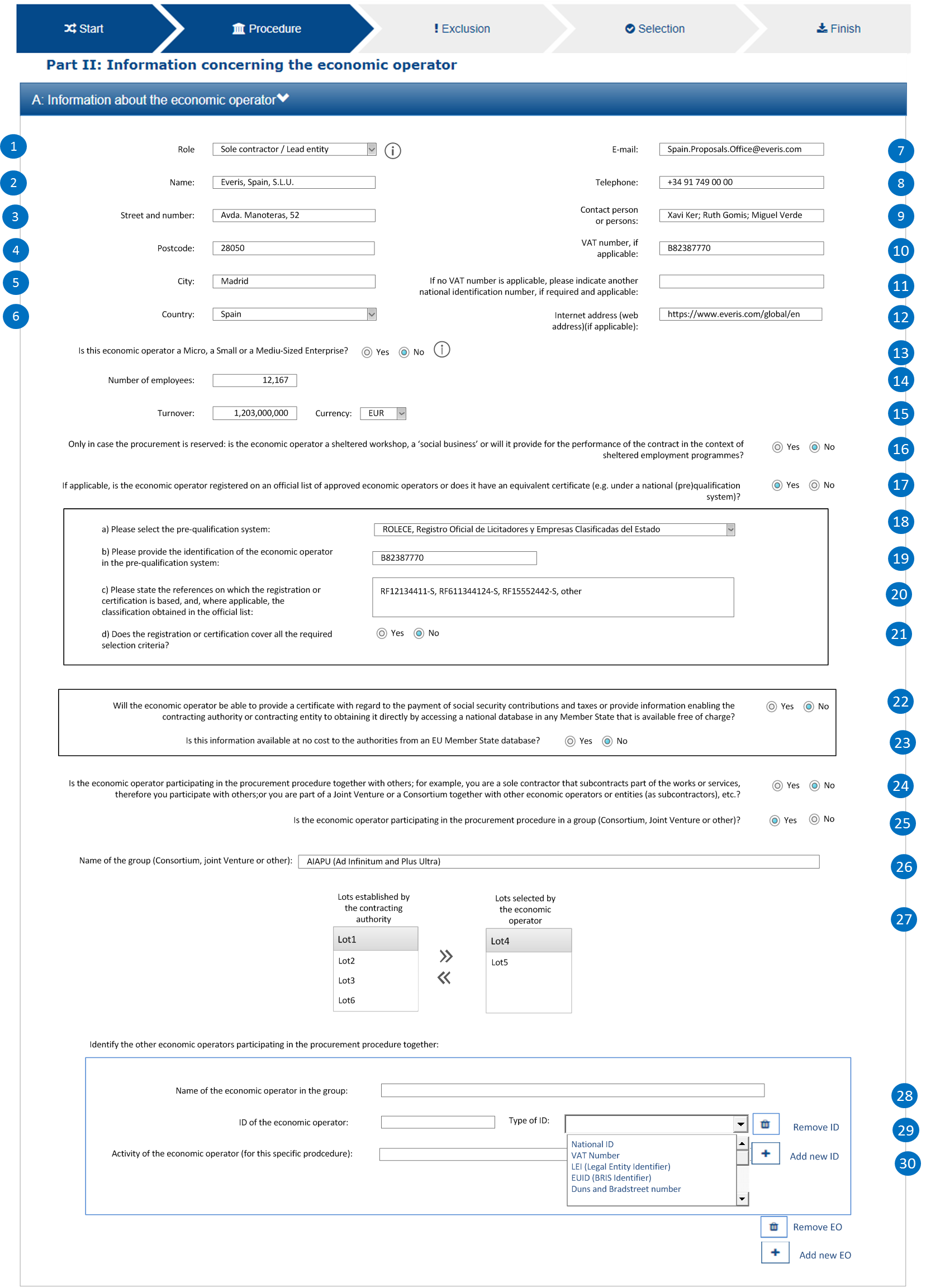
As you will see next, the information required about the economic operators varies depending on several factors:
-
Is the economic operator a sole trader or does it belong to a group?
-
If it belongs to a group, is the economic operator the leader of the group, a member or another entity (see the different types of 'roles' below);
-
Does the economic operator rely on other entities to fulfill the selection criteria?
-
Is the procurement procedure divided into lots?
One relevant aspect is the Role of the economic operator. The ESPD-EDM V2.1.1 defines four different roles for the EO. The information to be provided by each role varies depending on whether the EO is:
-
Sole contractor / Lead entity: Sole entity or, in case of Consortium, Joint Venture or other types of groups, the leader of the group. In this case:
-
The sole contractor or leader will have to produce a complete ESDP;
-
The sole contractor or leader will also have to identify the rest of the procurers (in the case of a group);
-
The sole contractor or leader will have to identify the entities upon which it relies (and about those on which the entities it relies on rely).
-
The sole contractor or leader will have to identify the entities upon which it does not relies.
-
The sole contractor or leader will have to specify the subcontracted proportion of the group (in the selection criteria "Subcontracted Proportion" of the ESPD).
-
-
Group member: Member (not leader) of the Consortium, Joint Venture or other type of group. In this case:
-
The member of the group will have to produce a complete ESPD;
-
The member of the group does not have to identify the rest of the procurers or entities.
-
-
Other entity (relied upon): Entity on which the main contractor, the group or another subcontractor relies in order to meet the selection criteria. In this case:
-
The entity will have to produce an ESPD;
-
The entity will not have have to identify the rest of the procurers or entities. Beware that an entity could have again another entity which it relies on or a a sub-contractor: in this case those entities and sub-contractors will have also to produce their own ESPD Response.
-
-
Other entity (not relied upon): Entity on which the main contractor, the group or another subcontractor does not rely in order to meet the selection criteria. In this case:
-
The entity will have to produce an ESPD, too;
-
The entity does not have to provide information about the selection criteria;
-
The entity does not have to provide information about the reduction of the number of qualified candidates [5].
-
The simplest case
The simplest case is when:
-
The economic operator (EO) is a sole contractor
-
The EO does not rely on other entities
-
The procurement procedure is not divided into lots
Notice the following:
-
Sole contractor. We know that the EO is a sole contractor when:
-
The role specified is 'Sole contractor / Lead entity' (first field of the mock-up); and (circle #1)
-
The EO states that it does not participate together with others; and (circle #24)
-
The EO states that it does not participate in a group (last field of the mock-up); (circle #25)
-
-
Not an SME. The EO is a large company (circles #13-#15). The definition of what is an SME is provided in the EU recommendation 2003/361[6]. Notice that, differently to the Basic ESPD, the EXTENDED ESPD asks for the number of employees and turnover. This can be used by the software applications to validate the consistency of the data provided by the EO with the definition. By the way, these data are all placed in the
cac:QualifyingPartyelement. See the XSD diagrams above the and the XML example below for details on the use of thecac:QualifyingPartyand sub-components. -
No lots. The software application GUI should not show any information about Lots if the procurement procedure is not divided into Lots. This information is available in the ESPD Request.
Sheltered workshop
For this case the EXTENDED ESPD works identically as the Basic ESPD. If the economic operator answers Yes the fields about the 'percentage of disabled/disadvantaged workers and the category of handicap to which they belong to should shown, validated or processed (see mock-up for the Basic ESPD in section VIII.6.1 Basic economic operator party. For this purpose the Basic and the EXTENDED data structures are identical:
Data structure for a sheltered workshop or social business in case of reserved procurement:
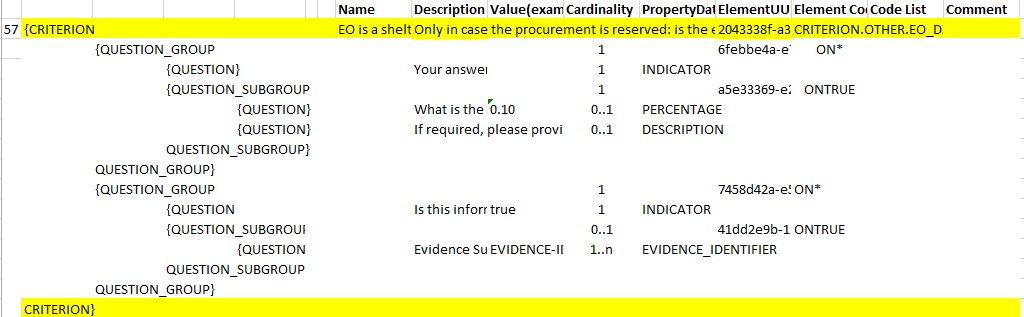
EO registered in a (Pre)Qualification System (PQS)
One of the questions asked is whether the economic operator is registered on an official list (e.g. on a national Pre-Qualification System). In the case the EO answers Yes, the software application should ask the EO for this other data about which the evaluators may be interested in (see mock-up, circles #17-#21).
Beware that the (pre)qualification system the EO is registered on must be know by the software application. One proposal is that each (pre)qualification systems is perfectly identified and registered in e-Certis so the applications can use it and trust it (and even download certificates from it) [7]. However if this were not possible (because e-Certis does not implement this timely, for example), the data structure for the PQS provides an alternative field to keep the name of the (pre)qualification system; see data structure below.
In case the EO is registered on several pre-qualification systems, the EO will need to choose the one that applies to this particular procurement procedure. The EO will also be required to provide the identification of the EO in the selected pre-qualification system.
Data structure for the (pre)qualification of the economic operator by an official list or similar:
The elements in the data structure for this EXTENDED ESPD are different to the Basic one. Notice that int the EXTENDED ESPD:
-
The identifier assigned by the (pre)qualification system to the economic operator is required. This value however is placed in the element
cac:QualifyingParty/cac:Party/cac:PartyIdentification/cbc:IDand therefore is not required in the data structure. -
The name of an alternative or additional (pre)qualification system (PQS) can also be provided by the EO. In principle this is not necessary as the PQS identifier is the value of the attribute
@schemeAgencyIDof the elementcbc:ID. -
The rest of the data are the same as for the Basic ESPD: references, classifications and the scope of the registration in respect of the selection criteria of the procurement procedure.
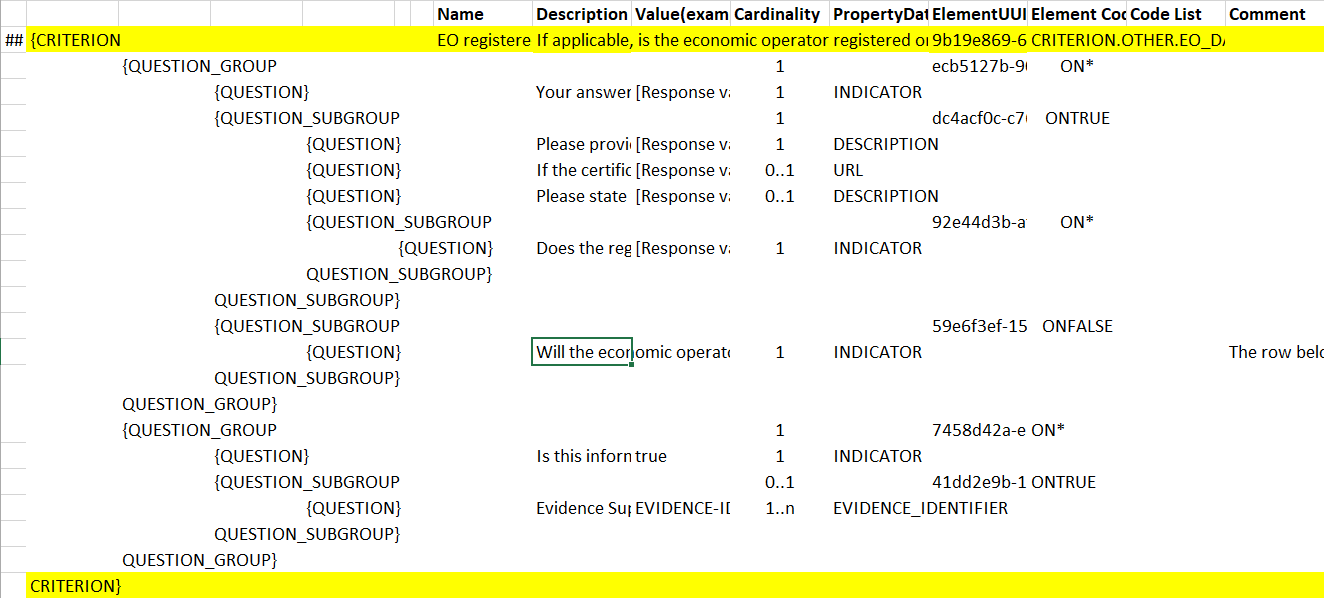
Lots (contracting authority perspective)
The economic operator should be able to specify to which Lots it tenders. Thus, if the procurement procedure is divided into Lots, the software application should show the list with all the Lots the contracted authority (CA) specified for the economic operator select one or more Lots. See the section III.11 Lots - Extended ESPD for details on how the CA specifies Lots. The mock-up below shows the requirements established by the contracting authorities about the Lots of the procurement procedure.
Lots (economic operator perspective)
The economic operator should then be able to select the Lots it will tender to. However the software application should control that the requirements established by the contracting authority (CA) are respected. Thus, for example, if the CA established that the economic operator can only tender to one lot the application should block the economic operator from selecting more than one lot.
Data structure for the Lots to which the economic operator tenders to:
Observe that the difference with the Basic ESPD is that in the EXTENDED the Lots are a list of multiple identifiers (cardinality 1..n) instead of a free-text field.

Roles of the economic operator
Depending on its role the data that the economic operator (EO) will have to provide is different. In this example (see mock-up):
-
The EO is the Leader of a Consortium it also had to select Yes to the question on whether it participates in a group. To this the software application reacts displaying a new field for the EO to provide the name of the Consortium (the rest of the members and entities related to this Consortium will have also to provide exactly the same name in their ESPDs).
-
As it is the Leader this EO will have to identify the rest of procurers and entities. The rest of members and entities participating in the tender shall not be requested to provide this information.
-
The Leader will also have to identify the entities it relies on and on those it does not rely on (this would also the case for the Sole Contractor). See the two next mock-ups below for the data to be provided on these two entities.
Data structure to identify the rest of the EOs that are members of the group:
In the EXTENDED ESPD the Lead entity of a group must identify the rest of economic operators that participate in the group. See the rest of the mock-ups and data structure below to see how, additionally, it also identifies other entities (e.g. sub-contractors).
Notice that:
-
The data required here is different from the data required in the Basic ESPD: name, identifier and activity of the EO.
-
The values expected for the name and activity are texts.
-
The value expected for the EO identifier is of type
Identifier. For the identifier of the EO it is also required to specify the type of identifier, and a closed list of possible types is proposed (see Code List EOIDType. EOs must use one of the available codes, but the preferred one is the VAT number. Beware that the data structure does not keep the type of the identifier. This is because this type code is placed in the attribute@schemeNameof thecac:ResponseValue/cbc:ResponseIDelement (and the@schemeAgencyIDattribute must be set to the defaultEU-COM-GROW). See information requirements at the beginning of the section. See also next sections about the responses, XSD schemas and XML example.
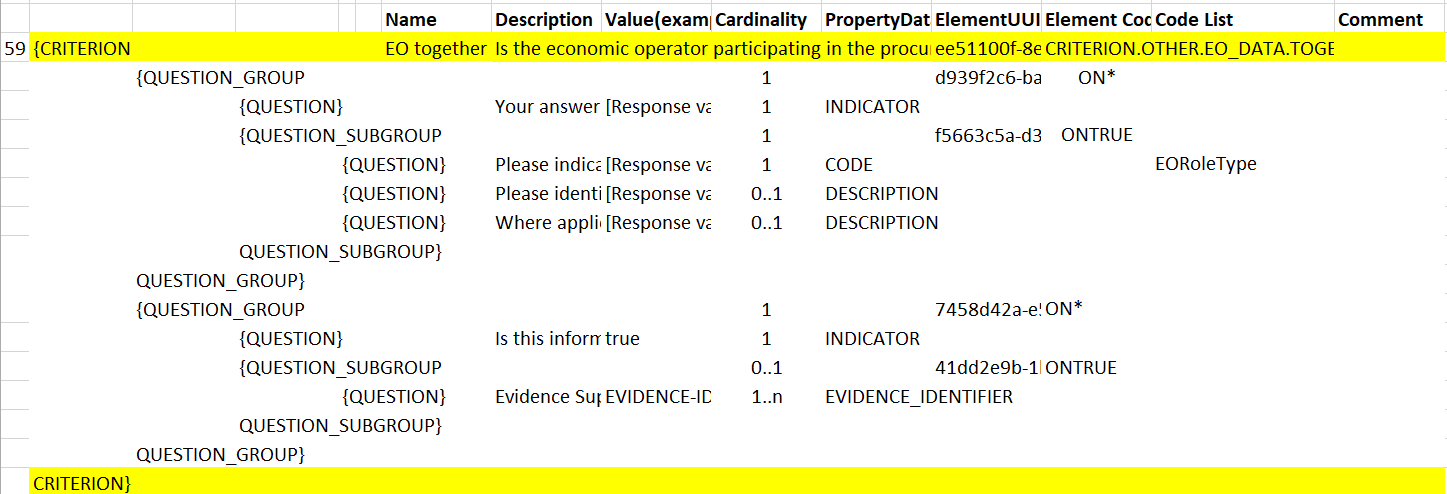
Certificates about contributions to the Tax Agency and/or Social Security
Data structure for the certificates about contributions to the Tax Agency and/or Social Security:
This data structure is identical to the Basic ESPD, see circles #22 and #23 in the mock-up above).
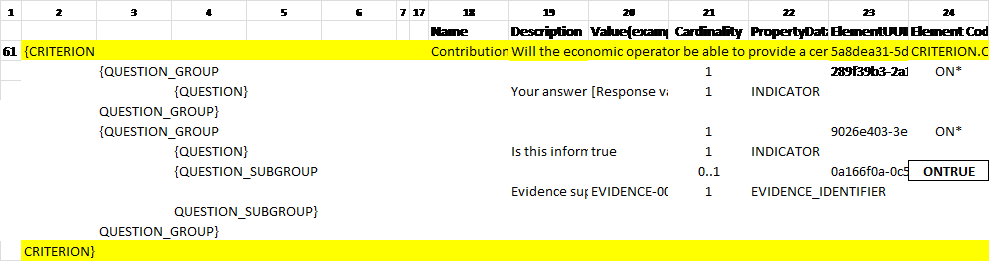
Mock-up: Information about reliance on the capacities of the other entities
As explained above, the Sole contractor or the Leader of a group will have to provide information about the entities it relies on in order to meet the selection criteria. The mock-up below shows the set of data the ESPD-EDM V2.1.1 expects from this role. Remember that this information does not need to be supplied by the members of a group or other entities.
Data structure for the entities upon which the EO relies on:
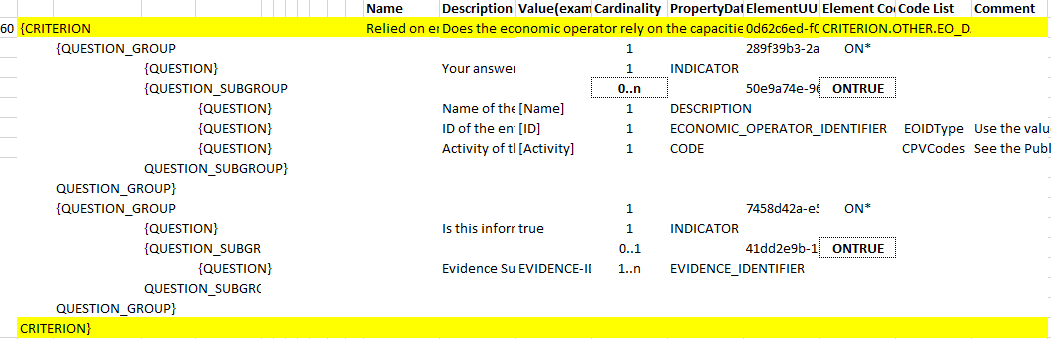
Mock-up: Information about third parties on which the EO does not rely on
The Sole contractor or the Leader of a group will have also to provide information about subcontractors on whose capacity the economic operator does not rely. Remember that this information does not need to be supplied by the members of a group or other entities.
Data structure for the entities upon which the EO does not relies on:
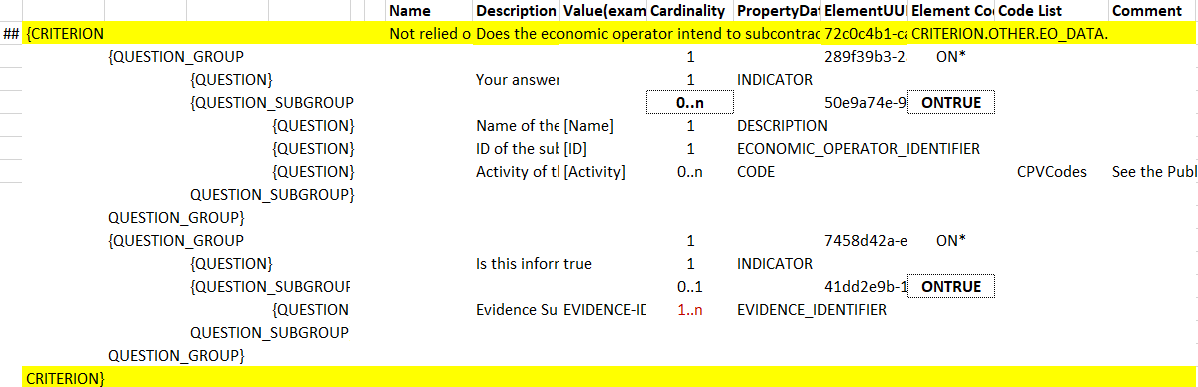
XML Example (EXTENDED economic operator)
This example contains all the data about an economic operator. Beware that the basic idenTification data is placed into the cac:EconomicOperatorParty component, whilst the rest of the data (namely for statististical purposes) is structured in the data structures described above.
Compare with the XML example about the economic operator for the BASIC ESPD Response. You will notice some differences, e.g. the Role of the economic operator, number of employees, and other.
The figure below shows how the data about the economic operator looks like in a 'collapsed' EXTENDED ESPD XML instance (notice that in this example the EO belongs to a group named 'AIAPU', element /cac:EconomicOperatorGroupName; beware that the group name is a data element located at the root of the document).
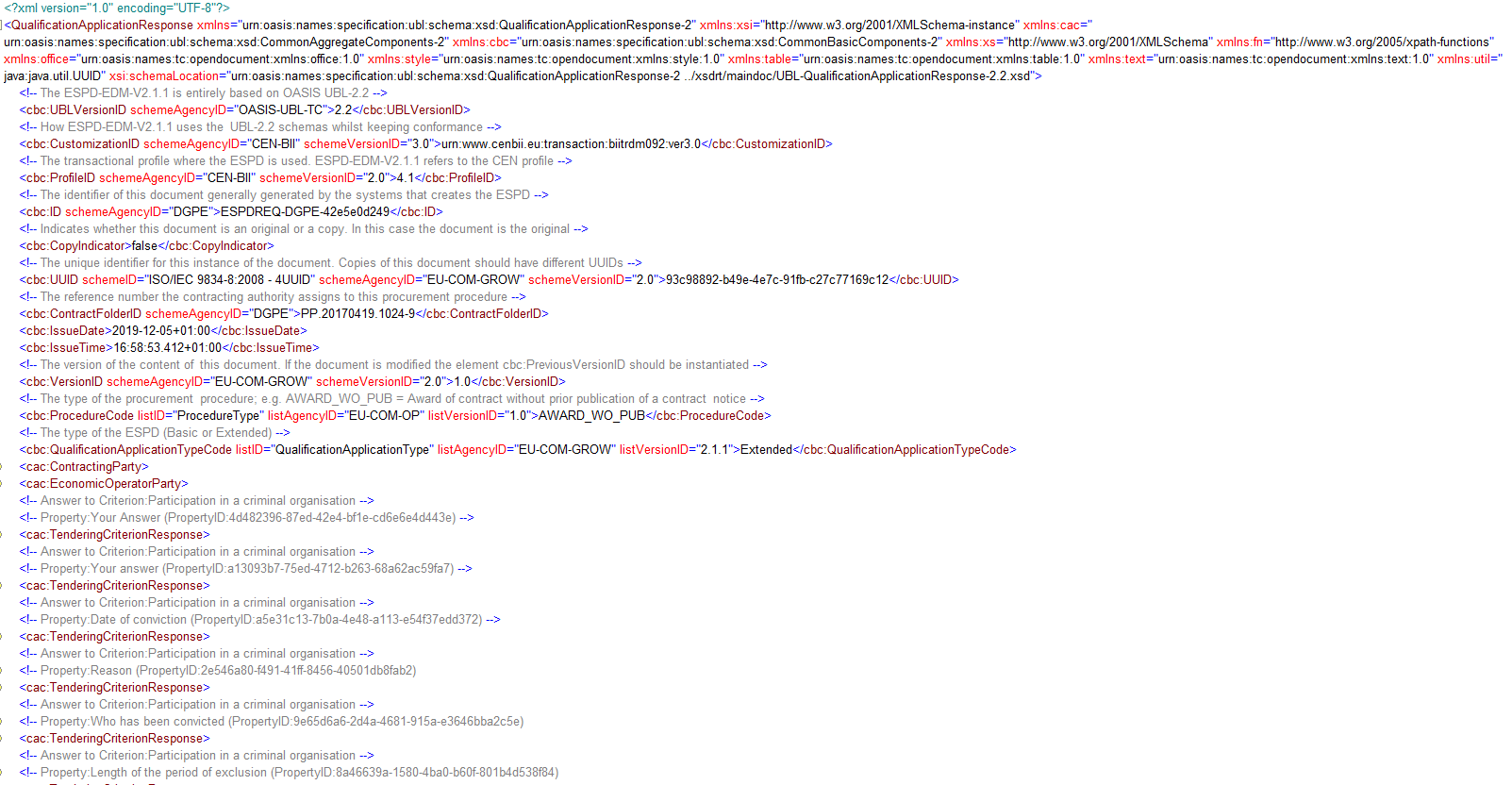
This fragment of XML does not include the responses to the QUESTION(s) in the data structures, yet. This is because the Responses have to be associated to a criterion property. The fragment below shows how these criterion properties are prepared and a 'dynamic' UUID is associated to each criterion property. Later on the response values will use these UUID to link the actual response to each QUESTION (i.e. with each cac:TenderingCriterionProperty element). Therefore the example does not include the data about the the EO yet. To see how the EO provides these data please see the sections below about the Response. There you will see that each element cac:ResponseValue is associated to the UUID of the corresponding cac:TenderingCriterionProperty via the element cbc:ValidatedCriterionPropertyID. For an example of a complete EXTENDED ESPD Response XML document you can also see the file EXTENDED-ESPDResponse-2.1.1.xml.
<!-- The group of the name is at the root of the document -->
<!-- The name of the group (Consortium, Joint Venture, etc.) if the tenderer is not a sole contractor -->
	<cbc:EconomicOperatorGroupName>ACME-Consortium</cbc:EconomicOperatorGroupName>(25)(26)

<!-- Root elements removed for the sake of brevity -->

<!-- Economic Operator Data -->
<cac:EconomicOperatorParty>
	<cac:QualifyingParty>
		<cbc:EmployeeQuantity>12167</cbc:EmployeeQuantity>(14)
		<cac:FinancialCapability>
			<cbc:ValueAmount currencyID="EUR">1203000000</cbc:ValueAmount>
		</cac:FinancialCapability>(15)
		<cac:Party>
			<!-- This EO company is NOT an SME -->
			<cbc:IndustryClassificationCode listID="EOIndustryClassificationCode" listAgencyID="EU-COM-GROW" listVersionID="2.1.1">LARGE</cbc:IndustryClassificationCode> (13)
		<!-- Notice that the ID and Name of the Pre-Qualification System is in the attributes. They would be captured from e-Certis. -->
		<cac:PartyIdentification>
		<cbc:ID schemeID="VAT" schemeAgencyID="ROLECE" schemeAgencyName="Registro Oficial de Licitadores y Empresas Clasificadas del Estado">B82387770</cbc:ID>
		</cac:PartyIdentification>(19)
		</cac:Party>
	</cac:QualifyingParty>
	<cac:EconomicOperatorRole>
		<cbc:RoleCode listID="EORoleType" listAgencyID="EU-COM-GROW" listVersionID="2.1.1">SCLE</cbc:RoleCode>
(1)
		<cbc:RoleDescription>Sole entity or, in case of Consortium, Joint Venture or other types of groups, the leader of the group.</cbc:RoleDescription>
	</cac:EconomicOperatorRole>
	<cac:Party>
		<!--Additional Identifier not provided --> (11)
		<cbc:WebsiteURI>http://everis.com/global/en</cbc:WebsiteURI> (12)
		<cac:PartyIdentification>
			<cbc:ID schemeAgencyID="VAT" schemeAgencyName="EU-COM-GROW" schemeID="VIES" schemeURI="http://ec.europa.eu/taxation_customs/vies/vieshome.do?locale=es" schemeName="VAT number">B82387770</cbc:ID>(10)
		</cac:PartyIdentification>
		<cac:PartyName><cbc:Name>Everis, Spain, S.L.U.</cbc:Name></cac:PartyName>(2)
		<cac:PostalAddress>
		<cbc:CityName>Madrid</cbc:CityName>(5)
			<cbc:PostalZone>28050</cbc:PostalZone>(4)
			<cac:AddressLine>
				<cbc:Line>Manoteras, 52</cbc:Line>(3)
		</cac:AddressLine>
		<cac:Country>
			<cbc:IdentificationCode listID="CountryCodeIdentifier" listName="ISO-1-ALPHA-2" listAgencyID="ISO" listVersionID="1.0">ES</cbc:IdentificationCode>(6)
			<cbc:Name>Spain</cbc:Name> (6)
		</cac:Country>
		</cac:PostalAddress>
		<cac:Contact>
			<cbc:Name>Xavi Ker; Ruth Gomis; Miguel Verde</cbc:Name>(9)
			<cbc:Telephone>+34 91 749 00 00</cbc:Telephone>(8)
			<cbc:ElectronicMail>Spain.Proposals.Office@everis.com</cbc:ElectronicMail> (7)
		</cac:Contact>
	</cac:Party>
</cac:EconomicOperatorParty>

<!-- OTHER DATA ABOUT THE ECONOMIC OPERATOR THAT IS MODELLED AS CRITERIA -->

<!-- Criterion:EO is a sheltered workshop -->
<cac:TenderingCriterion>
	<cbc:ID schemeID="CriteriaTaxonomy" schemeAgencyID="EU-COM-GROW" schemeVersionID="2.1.1">2043338f-a38a-490b-b3ec-2607cb25a017</cbc:ID>
	<cbc:CriterionTypeCode listID="CriteriaTypeCode" listAgencyID="EU-COM-GROW" listVersionID="2.1.1">CRITERION.OTHER.EO_DATA.SHELTERED_WORKSHOP</cbc:CriterionTypeCode>
	<cbc:Name>EO is a sheltered workshop</cbc:Name>
	<cbc:Description>Only in case the procurement is reserved: is the economic operator a sheltered workshop, a 'social business' or will it provide for the performance of the contract in the context of sheltered employment programmes?</cbc:Description> (16)
	<cac:TenderingCriterionPropertyGroup>
		<cbc:ID schemeID="CriteriaTaxonomy" schemeAgencyID="EU-COM-GROW" schemeVersionID="2.1.1">6febbe4a-e715-427c-a2b1-19cfabadaef0</cbc:ID>
		<cbc:PropertyGroupTypeCode listID="PropertyGroupType" listAgencyID="EU-COM-GROW" listVersionID="2.1.1">ON*</cbc:PropertyGroupTypeCode>
		<cac:TenderingCriterionProperty>
			<cbc:ID schemeID="CriteriaTaxonomy" schemeAgencyID="EU-COM-GROW" schemeVersionID="2.1.1">8d47e12d-2346-41d8-82fe-afb22ebbd791</cbc:ID>
			<cbc:Description>Your answer?</cbc:Description>
			<cbc:TypeCode listID="CriterionElementType" listAgencyID="EU-COM-GROW" listVersionID="2.1.1">QUESTION</cbc:TypeCode>
			<cbc:ValueDataTypeCode listID="ResponseDataType" listAgencyID="EU-COM-GROW" listVersionID="2.1.1">INDICATOR</cbc:ValueDataTypeCode>
		</cac:TenderingCriterionProperty>
		<cac:SubsidiaryTenderingCriterionPropertyGroup>
			<cbc:ID schemeID="CriteriaTaxonomy" schemeAgencyID="EU-COM-GROW" schemeVersionID="2.1.1">a5e33369-e2b5-45f7-9969-ddb1c3ae17c8</cbc:ID>
			<cbc:PropertyGroupTypeCode listID="PropertyGroupType" listAgencyID="EU-COM-GROW" listVersionID="2.1.1">ONTRUE</cbc:PropertyGroupTypeCode>
			<cac:TenderingCriterionProperty>
				<cbc:ID schemeID="CriteriaTaxonomy" schemeAgencyID="EU-COM-GROW" schemeVersionID="2.1.1">031953ad-2f92-4fca-a482-7b8efb7035a7</cbc:ID>
				<cbc:Description>What is the corresponding percentage of disabled or disadvantaged workers?</cbc:Description> (16)
				<cbc:TypeCode listID="CriterionElementType" listAgencyID="EU-COM-GROW" listVersionID="2.1.1">QUESTION</cbc:TypeCode>
				<cbc:ValueDataTypeCode listID="ResponseDataType" listAgencyID="EU-COM-GROW" listVersionID="2.1.1">PERCENTAGE</cbc:ValueDataTypeCode>(16)
			</cac:TenderingCriterionProperty>
			<cac:TenderingCriterionProperty>
				<cbc:ID schemeID="CriteriaTaxonomy" schemeAgencyID="EU-COM-GROW" schemeVersionID="2.1.1">6e2f7c96-61ac-443b-9039-c45fa3a3e595</cbc:ID>
				<cbc:Description>If required, please provide details on whether the employees concerned belong to a specific category of disabled or disadvantaged workers?</cbc:Description>(16)
				<cbc:TypeCode listID="CriterionElementType" listAgencyID="EU-COM-GROW" listVersionID="2.1.1">QUESTION</cbc:TypeCode>
				<cbc:ValueDataTypeCode listID="ResponseDataType" listAgencyID="EU-COM-GROW" listVersionID="2.1.1">DESCRIPTION</cbc:ValueDataTypeCode>
			</cac:TenderingCriterionProperty>
		</cac:SubsidiaryTenderingCriterionPropertyGroup>
	</cac:TenderingCriterionPropertyGroup>
</cac:TenderingCriterion>
<!-- Criterion:EO registered in a PQS -->
<cac:TenderingCriterion>
	<cbc:ID schemeID="CriteriaTaxonomy" schemeAgencyID="EU-COM-GROW" schemeVersionID="2.1.1">9b19e869-6c89-4cc4-bd6c-ac9ca8602165</cbc:ID>
	<cbc:CriterionTypeCode listID="CriteriaTypeCode" listAgencyID="EU-COM-GROW" listVersionID="2.1.1">CRITERION.OTHER.EO_DATA.REGISTERED_IN_OFFICIAL_LIST</cbc:CriterionTypeCode>
	<cbc:Name>EO registered in a PQS</cbc:Name>
	<cbc:Description>If applicable, is the economic operator registered on an official list of approved economic operators or does it have an equivalent certificate (e.g. under a national (pre)qualification system)?</cbc:Description>(17)
	<cac:TenderingCriterionPropertyGroup>
		<cbc:ID schemeID="CriteriaTaxonomy" schemeAgencyID="EU-COM-GROW" schemeVersionID="2.1.1">64162276-7014-408f-a9af-080426bfe1fd</cbc:ID>
		<cbc:PropertyGroupTypeCode listID="PropertyGroupType" listAgencyID="EU-COM-GROW" listVersionID="2.1.1">ON*</cbc:PropertyGroupTypeCode>
		<cac:TenderingCriterionProperty>
			<cbc:ID schemeID="CriteriaTaxonomy" schemeAgencyID="EU-COM-GROW" schemeVersionID="2.1.1">343b5c92-2a5f-4ef7-9d8a-41c8e7b70aa7</cbc:ID>
			<cbc:Description>Your answer?</cbc:Description>
			<cbc:TypeCode listID="CriterionElementType" listAgencyID="EU-COM-GROW" listVersionID="2.1.1">QUESTION</cbc:TypeCode>
			<cbc:ValueDataTypeCode listID="ResponseDataType" listAgencyID="EU-COM-GROW" listVersionID="2.1.1">INDICATOR</cbc:ValueDataTypeCode>
		</cac:TenderingCriterionProperty>
		<cac:SubsidiaryTenderingCriterionPropertyGroup>
			<cbc:ID schemeID="CriteriaTaxonomy" schemeAgencyID="EU-COM-GROW" schemeVersionID="2.1.1">7458d42a-e581-4640-9283-34ceb3ad4345</cbc:ID>
			<cbc:PropertyGroupTypeCode listID="PropertyGroupType" listAgencyID="EU-COM-GROW" listVersionID="2.1.1">ONTRUE</cbc:PropertyGroupTypeCode>
			<cac:TenderingCriterionProperty>
				<cbc:ID schemeID="CriteriaTaxonomy" schemeAgencyID="EU-COM-GROW" schemeVersionID="2.1.1">9f5528c1-6f7f-41e0-9287-054a0bef2f9f</cbc:ID>
				<cbc:Description>a)Alternative or additional name of the (pre)qualifiction system</cbc:Description>(18)
				<cbc:TypeCode listID="CriterionElementType" listAgencyID="EU-COM-GROW" listVersionID="2.1.1">QUESTION</cbc:TypeCode>
				<cbc:ValueDataTypeCode listID="ResponseDataType" listAgencyID="EU-COM-GROW" listVersionID="2.1.1">DESCRIPTION</cbc:ValueDataTypeCode>
			</cac:TenderingCriterionProperty>
			<cac:TenderingCriterionProperty>
				<cbc:ID schemeID="CriteriaTaxonomy" schemeAgencyID="EU-COM-GROW" schemeVersionID="2.1.1">3eb9b248-21de-47fa-9aa2-e34d0bf1d32c</cbc:ID>
				<cbc:Description>c) Please state the references on which the registration or certification is based, and, where applicable, the classification obtained in the official list</cbc:Description>(20)
				<cbc:TypeCode listID="CriterionElementType" listAgencyID="EU-COM-GROW" listVersionID="2.1.1">QUESTION</cbc:TypeCode>
				<cbc:ValueDataTypeCode listID="ResponseDataType" listAgencyID="EU-COM-GROW" listVersionID="2.1.1">DESCRIPTION</cbc:ValueDataTypeCode>
			</cac:TenderingCriterionProperty>
			<cac:TenderingCriterionProperty>
				<cbc:ID schemeID="CriteriaTaxonomy" schemeAgencyID="EU-COM-GROW" schemeVersionID="2.1.1">f6109977-1e25-4926-85f5-813db5c113d5</cbc:ID>
				<cbc:Description>d) Does the registration or certification cover all of the required selection criteria?</cbc:Description> (21)
				<cbc:TypeCode listID="CriterionElementType" listAgencyID="EU-COM-GROW" listVersionID="2.1.1">QUESTION</cbc:TypeCode>
				<cbc:ValueDataTypeCode listID="ResponseDataType" listAgencyID="EU-COM-GROW" listVersionID="2.1.1">INDICATOR</cbc:ValueDataTypeCode>
			</cac:TenderingCriterionProperty>
		</cac:SubsidiaryTenderingCriterionPropertyGroup>
	</cac:TenderingCriterionPropertyGroup>
</cac:TenderingCriterion>
<!-- Criterion:EO together with others -->
<cac:TenderingCriterion>
	<cbc:ID schemeID="CriteriaTaxonomy" schemeAgencyID="EU-COM-GROW" schemeVersionID="2.1.1">ee51100f-8e3e-40c9-8f8b-57d5a15be1f2</cbc:ID>
	<cbc:CriterionTypeCode listID="CriteriaTypeCode" listAgencyID="EU-COM-GROW" listVersionID="2.1.1">CRITERION.OTHER.EO_DATA.TOGETHER_WITH_OTHERS</cbc:CriterionTypeCode>
	<cbc:Name>EO together with others</cbc:Name>
	<cbc:Description>Is the economic operator participating in the procurement procedure together with others?</cbc:Description>(24)
	<cac:TenderingCriterionPropertyGroup>
		<cbc:ID schemeID="CriteriaTaxonomy" schemeAgencyID="EU-COM-GROW" schemeVersionID="2.1.1">d939f2c6-ba25-4dc4-889c-11d1853add19</cbc:ID>
		<cbc:PropertyGroupTypeCode listID="PropertyGroupType" listAgencyID="EU-COM-GROW" listVersionID="2.1.1">ON*</cbc:PropertyGroupTypeCode>
		<cac:TenderingCriterionProperty>
			<cbc:ID schemeID="CriteriaTaxonomy" schemeAgencyID="EU-COM-GROW" schemeVersionID="2.1.1">89f59f77-2dff-4463-8eef-269fdf455ae9</cbc:ID>
			<cbc:Description>Name of the economic operator in the group</cbc:Description>(28)
			<cbc:TypeCode listID="CriterionElementType" listAgencyID="EU-COM-GROW" listVersionID="2.1.1">QUESTION</cbc:TypeCode>
			<cbc:ValueDataTypeCode listID="ResponseDataType" listAgencyID="EU-COM-GROW" listVersionID="2.1.1">DESCRIPTION</cbc:ValueDataTypeCode>
		</cac:TenderingCriterionProperty>
		<cac:TenderingCriterionProperty>
			<cbc:ID schemeID="CriteriaTaxonomy" schemeAgencyID="EU-COM-GROW" schemeVersionID="2.1.1">1fa05728-308f-43b0-b547-c903ffb0a8af</cbc:ID>
			<cbc:Description>ID of the economic operator</cbc:Description>(29)
			<cbc:TypeCode listID="CriterionElementType" listAgencyID="EU-COM-GROW" listVersionID="2.1.1">QUESTION</cbc:TypeCode>
			<cbc:ValueDataTypeCode listID="ResponseDataType" listAgencyID="EU-COM-GROW" listVersionID="2.1.1">ECONOMIC_OPERATOR_IDENTIFIER</cbc:ValueDataTypeCode>
		</cac:TenderingCriterionProperty>
		<cac:TenderingCriterionProperty>
			<cbc:ID schemeID="CriteriaTaxonomy" schemeAgencyID="EU-COM-GROW" schemeVersionID="2.1.1">8b7e09d3-f537-43ec-85dc-32d6ad9bccd8</cbc:ID>
			<cbc:Description>Activity of the economic operator (for this specific procedure)</cbc:Description>(30)
			<cbc:TypeCode listID="CriterionElementType" listAgencyID="EU-COM-GROW" listVersionID="2.1.1">QUESTION</cbc:TypeCode>
			<cbc:ValueDataTypeCode listID="ResponseDataType" listAgencyID="EU-COM-GROW" listVersionID="2.1.1">CODE</cbc:ValueDataTypeCode>
		</cac:TenderingCriterionProperty>
	</cac:TenderingCriterionPropertyGroup>
</cac:TenderingCriterion>
<!-- Criterion:Lots the EO tenders to -->
<cac:TenderingCriterion>
	<cbc:ID schemeID="CriteriaTaxonomy" schemeAgencyID="EU-COM-GROW" schemeVersionID="2.1.1">8b9700b7-b13c-41e6-a220-6bbf8d5fab31</cbc:ID>
	<cbc:CriterionTypeCode listID="CriteriaTypeCode" listAgencyID="EU-COM-GROW" listVersionID="2.1.1">CRITERION.OTHER.EO_DATA.LOTS_TENDERED</cbc:CriterionTypeCode>
	<cbc:Name>Lots the EO tenders to</cbc:Name>
	<cbc:Description>Lots selected by the economic operator</cbc:Description>(27)
	<cac:TenderingCriterionPropertyGroup>
		<cbc:ID schemeID="CriteriaTaxonomy" schemeAgencyID="EU-COM-GROW" schemeVersionID="2.1.1">289f39b3-2a15-421a-8050-a29858031f35</cbc:ID>
		<cbc:PropertyGroupTypeCode listID="PropertyGroupType" listAgencyID="EU-COM-GROW" listVersionID="2.1.1">ON*</cbc:PropertyGroupTypeCode>
		<cac:TenderingCriterionProperty>
			<cbc:ID schemeID="CriteriaTaxonomy" schemeAgencyID="EU-COM-GROW" schemeVersionID="2.1.1">ca0e6adb-a8a3-40f0-9ffa-f9f0b3d95e31</cbc:ID>
			<cbc:Description>Lot ID</cbc:Description> (27)
			<cbc:TypeCode listID="CriterionElementType" listAgencyID="EU-COM-GROW" listVersionID="2.1.1">QUESTION</cbc:TypeCode>
			<cbc:ValueDataTypeCode listID="ResponseDataType" listAgencyID="EU-COM-GROW" listVersionID="2.1.1">IDENTIFIER</cbc:ValueDataTypeCode>
		</cac:TenderingCriterionProperty>
	</cac:TenderingCriterionPropertyGroup>
</cac:TenderingCriterion>
<!-- Criterion:Contributions certificates -->
<cac:TenderingCriterion>
	<cbc:ID schemeID="CriteriaTaxonomy" schemeAgencyID="EU-COM-GROW" schemeVersionID="2.1.1">5a8dea31-5db9-4e03-862b-07810aa6a7fd</cbc:ID>
	<cbc:CriterionTypeCode listID="CriteriaTypeCode" listAgencyID="EU-COM-GROW" listVersionID="2.1.1">CRITERION.OTHER.EO_DATA.CONTRIBUTIONS_CERTIFICATES</cbc:CriterionTypeCode>
	<cbc:Name>Contributions certificates</cbc:Name>
	<cbc:Description>Will the economic operator be able to provide a certificate with regard to the payment of social security contributions and taxes or provide information enabling the contracting authority or contracting entity to obtaining it directly by accessing a national database in any Member State that is available free of charge?</cbc:Description>(22)
	<cac:TenderingCriterionPropertyGroup>
		<cbc:ID schemeID="CriteriaTaxonomy" schemeAgencyID="EU-COM-GROW" schemeVersionID="2.1.1">289f39b3-2a15-421a-8050-a29858031f35</cbc:ID>
		<cbc:PropertyGroupTypeCode listID="PropertyGroupType" listAgencyID="EU-COM-GROW" listVersionID="2.1.1">ON*</cbc:PropertyGroupTypeCode>
		<cac:TenderingCriterionProperty>
			<cbc:ID schemeID="CriteriaTaxonomy" schemeAgencyID="EU-COM-GROW" schemeVersionID="2.1.1">c4f182c7-5c47-4a82-9a0c-8f71f84c35a0</cbc:ID>
			<cbc:Description>Your answer?</cbc:Description>
			<cbc:TypeCode listID="CriterionElementType" listAgencyID="EU-COM-GROW" listVersionID="2.1.1">QUESTION</cbc:TypeCode>
			<cbc:ValueDataTypeCode listID="ResponseDataType" listAgencyID="EU-COM-GROW" listVersionID="2.1.1">INDICATOR</cbc:ValueDataTypeCode>
		</cac:TenderingCriterionProperty>
		<cac:SubsidiaryTenderingCriterionPropertyGroup>
			<cbc:ID schemeID="CriteriaTaxonomy" schemeAgencyID="EU-COM-GROW" schemeVersionID="2.1.1">7458d42a-e581-4640-9283-34ceb3ad4345</cbc:ID>
			<cbc:PropertyGroupTypeCode listID="PropertyGroupType" listAgencyID="EU-COM-GROW" listVersionID="2.1.1">ON*</cbc:PropertyGroupTypeCode>
			<cac:TenderingCriterionProperty>
				<cbc:ID schemeID="CriteriaTaxonomy" schemeAgencyID="EU-COM-GROW" schemeVersionID="2.1.1">fb15e5ec-b67f-4fea-8422-c55347078b25</cbc:ID>
				<cbc:Description>Is this information available electronically?</cbc:Description>(23)
				<cbc:TypeCode listID="CriterionElementType" listAgencyID="EU-COM-GROW" listVersionID="2.1.1">QUESTION</cbc:TypeCode>
				<cbc:ValueDataTypeCode listID="ResponseDataType" listAgencyID="EU-COM-GROW" listVersionID="2.1.1">INDICATOR</cbc:ValueDataTypeCode>
			</cac:TenderingCriterionProperty>
			<cac:SubsidiaryTenderingCriterionPropertyGroup>
				<cbc:ID schemeID="CriteriaTaxonomy" schemeAgencyID="EU-COM-GROW" schemeVersionID="2.1.1">41dd2e9b-1bfd-44c7-93ee-56bd74a4334b</cbc:ID>
				<cbc:PropertyGroupTypeCode listID="PropertyGroupType" listAgencyID="EU-COM-GROW" listVersionID="2.1.1">ONTRUE</cbc:PropertyGroupTypeCode>
				<cac:TenderingCriterionProperty>
					<cbc:ID schemeID="CriteriaTaxonomy" schemeAgencyID="EU-COM-GROW" schemeVersionID="2.1.1">191b34a8-5af0-4d53-b431-4ecd624218ea</cbc:ID>
					<cbc:Description>Evidence supplied</cbc:Description>
					<cbc:TypeCode listID="CriterionElementType" listAgencyID="EU-COM-GROW" listVersionID="2.1.1">QUESTION</cbc:TypeCode>
					<cbc:ValueDataTypeCode listID="ResponseDataType" listAgencyID="EU-COM-GROW" listVersionID="2.1.1">EVIDENCE_IDENTIFIER</cbc:ValueDataTypeCode>
				</cac:TenderingCriterionProperty>
			</cac:SubsidiaryTenderingCriterionPropertyGroup>
		</cac:SubsidiaryTenderingCriterionPropertyGroup>
	</cac:TenderingCriterionPropertyGroup>
</cac:TenderingCriterion>
<!-- Criterion:Relied on entities -->
<cac:TenderingCriterion>
	<cbc:ID schemeID="CriteriaTaxonomy" schemeAgencyID="EU-COM-GROW" schemeVersionID="2.1.1">0d62c6ed-f074-4fcf-8e9f-f691351d52ad</cbc:ID>
	<cbc:CriterionTypeCode listID="CriteriaTypeCode" listAgencyID="EU-COM-GROW" listVersionID="2.1.1">CRITERION.OTHER.EO_DATA.RELIES_ON_OTHER_CAPACITIES</cbc:CriterionTypeCode>
	<cbc:Name>Relied on entities</cbc:Name>
	<cbc:Description>Does the economic operator rely on the capacities of other entities in order to meet the selection criteria set out under Part IV and the criteria and rules (if any) set out under Part V below?</cbc:Description>(31)
	<cac:TenderingCriterionPropertyGroup>
		<cbc:ID schemeID="CriteriaTaxonomy" schemeAgencyID="EU-COM-GROW" schemeVersionID="2.1.1">289f39b3-2a15-421a-8050-a29858031f35</cbc:ID>
		<cbc:PropertyGroupTypeCode listID="PropertyGroupType" listAgencyID="EU-COM-GROW" listVersionID="2.1.1">ON*</cbc:PropertyGroupTypeCode>
		<cac:TenderingCriterionProperty>
			<cbc:ID schemeID="CriteriaTaxonomy" schemeAgencyID="EU-COM-GROW" schemeVersionID="2.1.1">66dd1394-b278-4ee7-b589-e6d750024d16</cbc:ID>
			<cbc:Description>Your answer?</cbc:Description>
			<cbc:TypeCode listID="CriterionElementType" listAgencyID="EU-COM-GROW" listVersionID="2.1.1">QUESTION</cbc:TypeCode>
			<cbc:ValueDataTypeCode listID="ResponseDataType" listAgencyID="EU-COM-GROW" listVersionID="2.1.1">INDICATOR</cbc:ValueDataTypeCode>
		</cac:TenderingCriterionProperty>
		<cac:SubsidiaryTenderingCriterionPropertyGroup>
			<cbc:ID schemeID="CriteriaTaxonomy" schemeAgencyID="EU-COM-GROW" schemeVersionID="2.1.1">50e9a74e-969e-4d79-8e19-8af71cb7c54a</cbc:ID>
			<cbc:PropertyGroupTypeCode listID="PropertyGroupType" listAgencyID="EU-COM-GROW" listVersionID="2.1.1">ONTRUE</cbc:PropertyGroupTypeCode>
			<cac:TenderingCriterionProperty>
				<cbc:ID schemeID="CriteriaTaxonomy" schemeAgencyID="EU-COM-GROW" schemeVersionID="2.1.1">1f24933d-6b65-439a-98a7-f235a46ee895</cbc:ID>
				<cbc:Description>Name of the entity</cbc:Description>(32)
				<cbc:TypeCode listID="CriterionElementType" listAgencyID="EU-COM-GROW" listVersionID="2.1.1">QUESTION</cbc:TypeCode>
				<cbc:ValueDataTypeCode listID="ResponseDataType" listAgencyID="EU-COM-GROW" listVersionID="2.1.1"/>
			</cac:TenderingCriterionProperty>
			<cac:TenderingCriterionProperty>
				<cbc:ID schemeID="CriteriaTaxonomy" schemeAgencyID="EU-COM-GROW" schemeVersionID="2.1.1">55b05d39-56b4-4d1f-8af5-9340a071b1bc</cbc:ID>
				<cbc:Description>ID of the entity</cbc:Description>(33)
				<cbc:TypeCode listID="CriterionElementType" listAgencyID="EU-COM-GROW" listVersionID="2.1.1">QUESTION</cbc:TypeCode>
				<cbc:ValueDataTypeCode listID="ResponseDataType" listAgencyID="EU-COM-GROW" listVersionID="2.1.1"/>
			</cac:TenderingCriterionProperty>
			<cac:TenderingCriterionProperty>
				<cbc:ID schemeID="CriteriaTaxonomy" schemeAgencyID="EU-COM-GROW" schemeVersionID="2.1.1">024a5f37-6c39-4c20-8dc0-be55b736f310</cbc:ID>
				<cbc:Description>Activity of the entity (for this specific procedure)</cbc:Description>(34)
				<cbc:TypeCode listID="CriterionElementType" listAgencyID="EU-COM-GROW" listVersionID="2.1.1">QUESTION</cbc:TypeCode>
				<cbc:ValueDataTypeCode listID="ResponseDataType" listAgencyID="EU-COM-GROW" listVersionID="2.1.1"/>
			</cac:TenderingCriterionProperty>
		</cac:SubsidiaryTenderingCriterionPropertyGroup>
	</cac:TenderingCriterionPropertyGroup>
</cac:TenderingCriterion>
<!-- Criterion:Not relied on entities -->
<cac:TenderingCriterion>
	<cbc:ID schemeID="CriteriaTaxonomy" schemeAgencyID="EU-COM-GROW" schemeVersionID="2.1.1">72c0c4b1-ca50-4667-9487-461f3eed4ed7</cbc:ID>
	<cbc:CriterionTypeCode listID="CriteriaTypeCode" listAgencyID="EU-COM-GROW" listVersionID="2.1.1">CRITERION.OTHER.EO_DATA.SUBCONTRACTS_WITH_THIRD_PARTIES</cbc:CriterionTypeCode>
	<cbc:Name>Not relied on entities</cbc:Name>
	<cbc:Description>Does the economic operator intend to subcontract any share of the contract to third parties?</cbc:Description>(35)
	<cac:TenderingCriterionPropertyGroup>
		<cbc:ID schemeID="CriteriaTaxonomy" schemeAgencyID="EU-COM-GROW" schemeVersionID="2.1.1">289f39b3-2a15-421a-8050-a29858031f35</cbc:ID>
		<cbc:PropertyGroupTypeCode listID="PropertyGroupType" listAgencyID="EU-COM-GROW" listVersionID="2.1.1">ON*</cbc:PropertyGroupTypeCode>
		<cac:TenderingCriterionProperty>
			<cbc:ID schemeID="CriteriaTaxonomy" schemeAgencyID="EU-COM-GROW" schemeVersionID="2.1.1">2f7f9459-c020-4b89-8b27-4e52f25242ce</cbc:ID>
			<cbc:Description>Your answer?</cbc:Description>
			<cbc:TypeCode listID="CriterionElementType" listAgencyID="EU-COM-GROW" listVersionID="2.1.1">QUESTION</cbc:TypeCode>
			<cbc:ValueDataTypeCode listID="ResponseDataType" listAgencyID="EU-COM-GROW" listVersionID="2.1.1">INDICATOR</cbc:ValueDataTypeCode>
		</cac:TenderingCriterionProperty>
		<cac:SubsidiaryTenderingCriterionPropertyGroup>
			<cbc:ID schemeID="CriteriaTaxonomy" schemeAgencyID="EU-COM-GROW" schemeVersionID="2.1.1">50e9a74e-969e-4d79-8e19-8af71cb7c54a</cbc:ID>
			<cbc:PropertyGroupTypeCode listID="PropertyGroupType" listAgencyID="EU-COM-GROW" listVersionID="2.1.1">ONTRUE</cbc:PropertyGroupTypeCode>
			<cac:TenderingCriterionProperty>
				<cbc:ID schemeID="CriteriaTaxonomy" schemeAgencyID="EU-COM-GROW" schemeVersionID="2.1.1">3fb6d7cc-f605-4eda-80f0-045dcb2c540a</cbc:ID>
				<cbc:Description>Name of the subcontractor</cbc:Description>(36)
				<cbc:TypeCode listID="CriterionElementType" listAgencyID="EU-COM-GROW" listVersionID="2.1.1">QUESTION</cbc:TypeCode>
				<cbc:ValueDataTypeCode listID="ResponseDataType" listAgencyID="EU-COM-GROW" listVersionID="2.1.1"/>
			</cac:TenderingCriterionProperty>
			<cac:TenderingCriterionProperty>
				<cbc:ID schemeID="CriteriaTaxonomy" schemeAgencyID="EU-COM-GROW" schemeVersionID="2.1.1">c186fefa-1923-4dbd-85a7-8a007bb75e2c</cbc:ID>
				<cbc:Description>ID of the subcontractor</cbc:Description> (37)
				<cbc:TypeCode listID="CriterionElementType" listAgencyID="EU-COM-GROW" listVersionID="2.1.1">QUESTION</cbc:TypeCode>
				<cbc:ValueDataTypeCode listID="ResponseDataType" listAgencyID="EU-COM-GROW" listVersionID="2.1.1"/>
			</cac:TenderingCriterionProperty>
			<cac:TenderingCriterionProperty>
				<cbc:ID schemeID="CriteriaTaxonomy" schemeAgencyID="EU-COM-GROW" schemeVersionID="2.1.1">98e3401b-4024-4a60-98d2-9e9ad0ba2814</cbc:ID>
				<cbc:Description>Activity of the entity (for this specific procedure)</cbc:Description>(38)
				<cbc:TypeCode listID="CriterionElementType" listAgencyID="EU-COM-GROW" listVersionID="2.1.1">QUESTION</cbc:TypeCode>
				<cbc:ValueDataTypeCode listID="ResponseDataType" listAgencyID="EU-COM-GROW" listVersionID="2.1.1"/>
			</cac:TenderingCriterionProperty>
		</cac:SubsidiaryTenderingCriterionPropertyGroup>
	</cac:TenderingCriterionPropertyGroup>
</cac:TenderingCriterion>

<!-- EO DATA ENDS HERE -->

<!-- EXCLUSION CRITERIA START HERE -->

<!-- Exclusion and selection Criteria, Responses and Evidences removed for the sake of brevity -->| 1 | Role of the economic operator. The values are defined in the Code List EORoleType. The selection of the value SCLE determines whether the data about the relied-on and not-relied-on entities is instantiated in this XML. In this case, as the value is SCLE these data is present in the XML document. |
| 2 | Name of the economic operator. A text field. |
| 3 | Street and number of the economic operator. Notice that the cac:AddressLine element is used instead of cbc:StreetnName and cbc:BuildingNumber. This is because name and number are not split in two fields. |
| 4 | Postcode (zip code) of the EO. A text field. Either the GUI and/or an external Schematron rule could be implemented to control the pattern of this text. |
| 5 | City, the name of the town of the EO. Applications could check whether the town exists in the country. |
| 6 | Country, only the country code identifier is needed. In this example the description is also used, but is redundant. Software applications should be able to, based on the language of the user, retrieve the name of the country based on the country code. |
| 7 | E-mail address of the EO. A text field. Either the GUI and/or an external Schematron rule could be implemented to control the pattern of this text. |
| 8 | Telephone of the EO. A text field. Either the GUI and/or an external Schematron rule could be implemented to control the pattern of this text. |
| 9 | A coma separated list of persons of contact. |
| 10 | The VAT number of the EO. Notice how the attributes of the cbc:ID element are used: they respect the information requirements established for the identification of the EO (see requirements at the beginning of the section). |
| 11 | Additional identifier. In this example it is not used, thus the absence of the element. |
| 12 | Internet address, normally the official web-site of the EO. |
| 13 | Code to identify the type of the company (micro, small, medium, SME, Large). Notice the use of the Code List EOIndustryClassificationCode (for statistical purposes). |
| 14 | Number of employees of the EO’s company. Do not use separators. The software application should take care of the formatting (for statistical purposes). |
| 15 | Indicative turnover of the EO’s company (for statistical purposes). |
| 16 | Set of data about a sheltered workshop. |
| 17 | Set of data about a (pre)qualification system (PQS) where the EO is registered. |
| 18 | Alternative name of the PQS. |
| 19 | The ID and name of the PQS are in principle to be captured from e-Certis and set in the attributes. If they are not available use the alternative name of the PQS (see previous note <18> and circle #18 in the mock-up). |
| 20 | References used to get a classification in the PQS. |
| 21 | Statement by the EO kept taken as a self-declaration: scope of the registration or certification in/by a PQS. |
| 22 | Statement by the EO kept taken as a self-declaration: engagement to supply a certificate with regard to its social contributions (taxes and social security). |
| 23 | Online location of the certificate, if available. A text field. Either the GUI and/or an external Schematron rule could be implemented to control the pattern of this text. |
| 24 | Statement by the EO kept taken as a self-declaration: procurement procedure together with others. |
| 25 | Statement by the EO kept taken as a self-declaration: part of a group. |
| 26 | If the previous question (note <25> and circle #25 of the mock-up) is answered with a Yes the name of the group is placed in the element cbc:EconomicOperatorGroupName. Beware that all the members and entities belonging to the group must provide in their respective ESPD Response exactly the same name. Special attention must be paid to the spelling so to ensure that the name of the group can be used as an identifier to link all the members and entities of the group. |
| 27 | Lots the EO tenders to. See the responses in the next section to see how this list of Lots is constructed. |
| 28 | Name of one member of the group. This EO is the Lead entity and therefore has to identify all the members of the group (ACME-Consortium, in this example). The EO will have to introduce as many groups of name, ID, and activity data as members has the group (except itself). |
| 29 | Identifier of the member. The ESPD-EDM preferred option is the VAT number. Notice in the response (in further sections) that the type of identifier goes to the attribute schemeID (see values in the Code List
EOIDType. |
| 30 | Activity of the EO. Free-text field. |
| 31 | Group of data about the relied-on entities. As this EO is the Lead entity it has to provide this data. Thus the instance of this data structure in this XML example. |
| 32 | Name of an entity. A free-text field. |
| 33 | ID of the entity. The ESPD-EDM preferred option is the VAT number. Notice in the response (in further sections) that the type of identifier goes to the attribute schemeID (see values in the Code List
EOIDType. |
| 34 | Activity of the entity. Free-text field. |
| 35 | Group of data about the entities upon which the EO does not rely on. As this EO is the Lead entity it has to provide this data. Thus the instance of this data structure in this XML example. |
| 36 | Name of a subcontractor. A free-text field. |
| 37 | ID of a subcontractor. The ESPD-EDM preferred option is the VAT number. Notice in the response (in further sections) that the type of identifier goes to the attribute schemeID (see values in the Code List
EOIDType. |
| 38 | Activity of the subcontractor. Free-text field. |
Related information requirements
See formal requirements related to the representatives of the economic operator in the e-Sens site: tbr92-021.
Notice that the economic operator may specify more than one representative.
Differences between the Basic and Extended models
There are no differences between the Basic and Extended models as far as the economic operator representatives are concerned. Thus, the mock-up, data structure and XML example proposed below are applicable to both cases.
Mock-up (Basic and Extended)
In this example of mock-up the economic operator is specifying two representatives:.
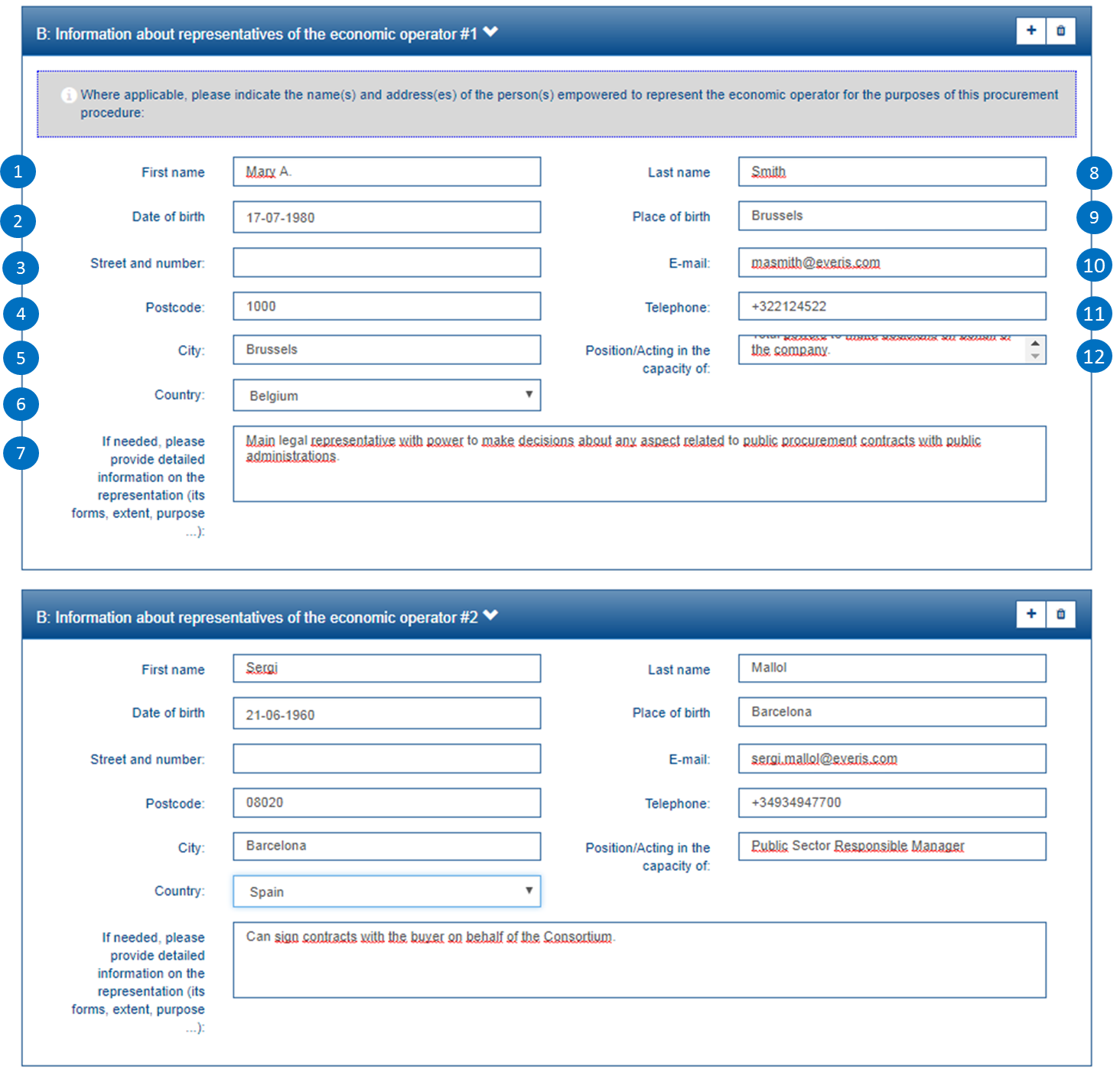
XSD Schema (Basic and Extended)
In the The ESPD-EDM V2.1.1 all the data regarding the representative of the economic operators is placed in the UBL-2.2 component cac:EconomicOperatorParty/cac:Party/cac:PowerOfAttorney. In principle the elements expected by the ESPD-EDM are very few, only the ones represented in the mock-up above. However this UBL element provides other possibilities that may be used in the future or for other purposes (or as a national extension of the ESPD).
Thus, additionally to the expected elements, the cac:PowerOfAttorney component caters also for, at least, two other data could be required at some point (e.g. cac:MandateDocumentReference, see figure below):
-
The place of registration of the representative. The logic first element to look at is the place of birth (this is one of the expected elements). But other elements could be used complementarily: (i)
cac:Person/cac:IdentityDocumentReference(A reference to a document that can precisely identify this person (e.g., a residence certificate), (ii)cac:Person/cbc:NationalityID, and/orcac:Person/cbc:CitizenshipCountry. -
Official documentation demonstrating that the person representing has an authentic mandate (e.g. a reference to a register where this mandate is located). For this the element
cac:/PowerOfAttorney/cac:MandateDocumentReferenceshould be used.
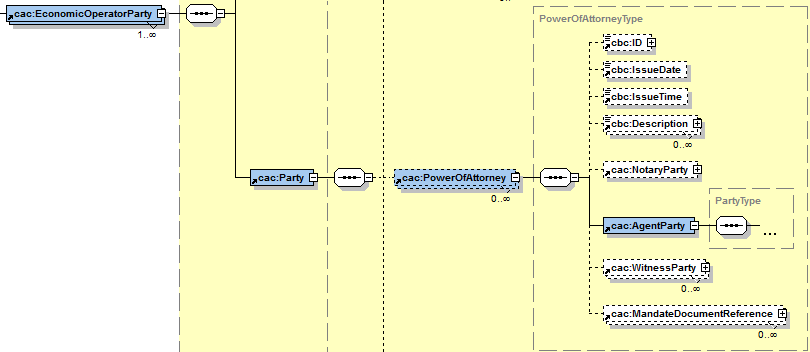
Notice that the largest part of the data is held in the component cac:EconomicOperatorParty/cac:Party/cac:PowerOfAttorney/cac:AgentParty/cac:Person. The figure below shows (in blue) the expected elements. See the table "Expecte Elements" and the XML example below for the details (e.g. how to use the cac:Person/cac:Contact element to contact the representative.
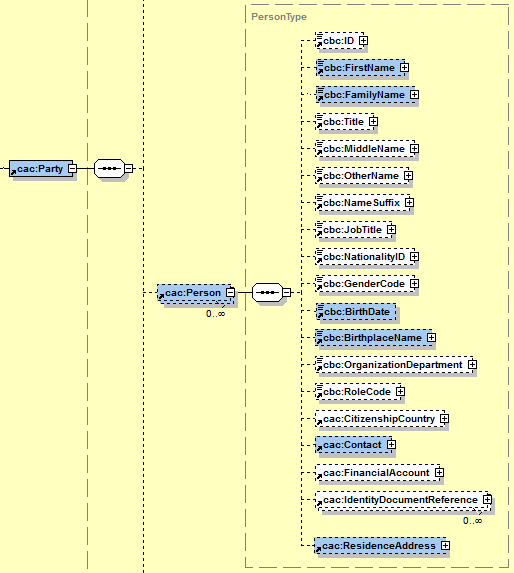
Contact elements, such as telephone and e-mail are in the cac:Contact associated to the the cac:Person information element:
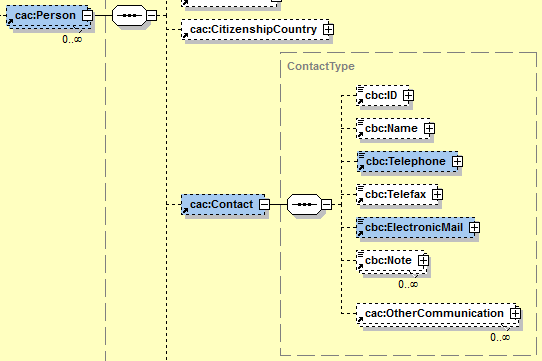
Expected Elements (Basic and Extended)
Class name: |
cac:PowerOfAttorney |
Definition: |
Official or legal mandate issued by an authority (e.g. an attorney or a notary) to represent the economic operator as a representative of the economic operator in public procurement procedures. |
Business rule(s): |
Common (BR-RESP-20) |
File: |
dist/common/xsdrt/UBL-CommonAggregateComponents-2.2.xsd |
Path: |
/QualificationApplicationResponse/cac:EconomicOperatorParty/cac:Party/cac:PowerOfAttorney |
Context of use: |
The economic operator in the ESPD Response document. Use this element to refer to the natural persons that represent the economic operator. See requirement tbr92-018. |
| Components | Type | Card | Description | Requirements |
|---|---|---|---|---|
cac:PowerOfAttorney/cac:AgentParty/ cac:Person/cbc:FirstName |
Text |
1 |
Name of the natural person. |
Information Requirement: tbr92-009 Rule: Name of the natural person is mandatory. Rule scope: Common (BR-RESP-20-01) |
cac:PowerOfAttorney/cac:AgentParty/ cac:Person/cbc:FamilyName |
Text |
1 |
Family Name of the natural person. |
Information Requirement: tbr92-009 Rule: Family Name of the natural person is mandatory. Rule scope: Common (BR-RESP-20-02) |
cac:PowerOfAttorney/cac:AgentParty/ cac:Person/cbc:BirthDate |
Date |
0..1 |
Date of birth of the natural person. |
Information Requirement: tbr92-009 Rule: None. |
cac:PowerOfAttorney/cac:AgentParty/ cac:Person/cbc:BirthplaceName |
Text |
0..1 |
Place of birth of the natural person. |
Information Requirement: tbr92-009 Rule: None. |
cac:PowerOfAttorney/cac:AgentParty/ cac:Person/cac:ResidenceAddress/cac:AddressLine |
Text |
0..1 |
The main address line in an address. Usually the street name and number or post office box. |
Information Requirement: tbr92-009 Rule: Use it to specify the street name and number of the building of the representative natural person in one line. Beware that specifying the address of a natural person might enter in conflict with the current Data Protection rules. |
cac:PowerOfAttorney/cac:AgentParty/ cac:Person/cac:ResidenceAddress/cbc:PostalZone |
Text |
0..1 |
The identifier for an addressable group of properties according to the relevant postal service, such as a ZIP code or Post Code. |
Information Requirement: tbr92-009 Rule: None. |
cac:PowerOfAttorney/cac:AgentParty/ cac:Person/cac:ResidenceAddress/cbc:CityName |
Text |
0..1 |
The common name of a city where the address is located. |
Information Requirement: tbr92-009 Rule: None. |
cac:PowerOfAttorney/cac:AgentParty/ cac:Person/cac:ResidenceAddress/ cac:Country/cbc:IdentificationCode |
Code |
1 |
A code that identifies the country. |
Information Requirement: tbr92-009 Rule: Compulsory use of the Code List CountryCodeIdentifier. Rule scope: Common (BR-RESP-20-03, BR-OTH-01, BR-OTH-01#5, BR-OTH-03) |
cac:PowerOfAttorney/cac:AgentParty/ cac:Person/cac:ResidenceAddress/ cac:Country/cbc:Name |
Text |
0..1 |
The name of the country. |
Information Requirement: tbr92-009 Rule: Try to use the name provided in the Code List CountryCodeIdentifier and in the language of the user. |
cac:PowerOfAttorney/cac:AgentParty/ cac:Person/cac:Contact/cbc:ElectronicMail |
Text |
0..1 |
An e-mail address for the contact point. |
Information Requirement: tbr92-009 Rule: None. |
cac:PowerOfAttorney/cac:AgentParty/ cac:Person/cac:Contact/cbc:Telephone |
Text |
0..1 |
A phone number for the contact point. |
Information Requirement: tbr92-009 Rule: None. |
cac:PowerOfAttorney/cbc:Description |
Text |
0..n |
The short description for the role of the economic operstors representative and other detailed information on the representation. |
Information Requirement: tbr92-010 Rule: Use line 1 of the description to describe the role of the representative. Use line 2 to provide detailed information on the representation (its forms, extent, purpose, etc.) |
Data Structure (Basic or Extended)
None, all the data is placed in the UBL-2.2 component cac:PowerOfAttorney
XML Example (Basic and Extended)
Notice that this XML example contains two representatives, as in the mock-up.
<!-- Economic Operator Data -->

<cac:EconomicOperatorParty>
	<cac:QualifyingParty>
		<cbc:EmployeeQuantity>12167</cbc:EmployeeQuantity>
		<cac:FinancialCapability><cbc:ValueAmount currencyID="EUR">1203000000</cbc:ValueAmount></cac:FinancialCapability>
		<cac:Party>
			<!-- This EO company is NOT an SME -->
			<cbc:IndustryClassificationCode listID="EOIndustryClassificationCode" listAgencyID="EU-COM-GROW" listVersionID="2.1.1">LARGE</cbc:IndustryClassificationCode>
			<!-- Notice that the ID and Name of the Pre-Qualification System is in the attributes. They would be captured from e-Certis. -->
			<cac:PartyIdentification>
				<cbc:ID schemeID="VAT" schemeAgencyID="ROLECE" schemeAgencyName="Registro Oficial de Licitadores y Empresas Clasificadas del Estado">B82387770</cbc:ID>
			</cac:PartyIdentification>
		</cac:Party>
	</cac:QualifyingParty>
	<cac:EconomicOperatorRole>
			<cbc:RoleCode listID="EORoleType" listAgencyID="EU-COM-GROW" listVersionID="2.1.1">SCLE</cbc:RoleCode>
			<cbc:RoleDescription>Sole entity or, in case of Consortium, Joint Venture or other types of groups, the leader of the group.</cbc:RoleDescription>
	</cac:EconomicOperatorRole>
	<cac:Party>
		<cbc:WebsiteURI>http://everis.com/global/en</cbc:WebsiteURI>
		<cac:PartyIdentification>
			<cbc:ID schemeAgencyID="VAT" schemeAgencyName="EU-COM-GROW" schemeID="VIES" schemeURI="http://ec.europa.eu/taxation_customs/vies/vieshome.do?locale=es" schemeName="VAT number">B82387770</cbc:ID>
		</cac:PartyIdentification>
		<cac:PartyName><cbc:Name>Everis, Spain, S.L.U.</cbc:Name></cac:PartyName>
		<cac:PostalAddress>
		<cbc:CityName>Madrid</cbc:CityName>
			<cbc:PostalZone>28050</cbc:PostalZone>
			<cac:AddressLine>
				<cbc:Line>Manoteras, 52</cbc:Line>
		</cac:AddressLine>
		<cac:Country>
			<cbc:IdentificationCode listID="CountryCodeIdentifier" listAgencyID="EU-COM-GROW" listVersionID="1.0">ES</cbc:IdentificationCode>
			<cbc:Name>Spain</cbc:Name>
		</cac:Country>
		</cac:PostalAddress>
		<cac:Contact>
			<cbc:Name>Xavi Ker; Ruth Gomis; Miguel Verde</cbc:Name>
			<cbc:Telephone>+34 91 749 00 00</cbc:Telephone>
			<cbc:ElectronicMail>Spain.Proposals.Office@everis.com</cbc:ElectronicMail>
		</cac:Contact>

		<!-- REPRESENTATIVES of the Economic Operator -->
		<!-- Representative 1 -->
		<cac:PowerOfAttorney>
		<cbc:Description>Total powers to make decisions on behalf of the company.</cbc:Description>(12)
		<cbc:Description>Main legal representative with power to make decisions about any aspect related to public procurement contracts with public administrations.</cbc:Description>(7)
		<cac:AgentParty>
			<cac:Person>
				<cbc:FirstName>Mary A.</cbc:FirstName>(1)
				<cbc:FamilyName>Smith</cbc:FamilyName>(8)
				<cbc:BirthDate>1980-07-17</cbc:BirthDate>(2)
				<!-- No element for "street and number" present. The user decided not to provide it -->(3)
				<cbc:BirthplaceName>Brussels</cbc:BirthplaceName>(9)
				<cac:Contact>
					<cbc:Telephone>+322124522</cbc:Telephone>(11)
					<cbc:ElectronicMail>masmith@everis.com</cbc:ElectronicMail>(10)
				</cac:Contact>
				<cac:ResidenceAddress>
					<cbc:CityName>Brussels</cbc:CityName>(5)
					<cbc:PostalZone>1000</cbc:PostalZone>(4)
					<cac:Country>
						<cbc:IdentificationCode listID="CountryCodeIdentifier" listAgencyID="EU-COM-GROW" listVersionID="2.1.1">>BE</cbc:IdentificationCode>(6)
						<cbc:Name languageID="en">Belgium</cbc:Name>(6)
					</cac:Country>
				</cac:ResidenceAddress>
			</cac:Person>
		</cac:AgentParty>
		</cac:PowerOfAttorney>
		<!-- Representative 2 -->
		<cac:PowerOfAttorney>
		<cbc:Description>Public Sector Responsible Manager</cbc:Description>
		<cbc:Description>Can sign contracts with the buyer on behalf of the Consortium.</cbc:Description>
		<cac:AgentParty>
			<cac:Person>
				<cbc:FirstName>Sergi</cbc:FirstName>
				<cbc:FamilyName>Mallol</cbc:FamilyName>
				<cbc:BirthDate>1960-06-21</cbc:BirthDate>
				<cbc:BirthplaceName>Barcelona</cbc:BirthplaceName>
				<cac:Contact>
					<cbc:Telephone>+34934947700</cbc:Telephone>
					<cbc:ElectronicMail>sergi.mallol@everis.com</cbc:ElectronicMail>
				</cac:Contact>
				<cac:ResidenceAddress>
					<cbc:CityName>Barcelona</cbc:CityName>
					<cbc:PostalZone>08020</cbc:PostalZone>
					<cac:Country>
						<cbc:IdentificationCode listID="CountryCodeIdentifier" listAgencyID="EU-COM-GROW" listVersionID="2.1.1">>ES</cbc:IdentificationCode>
						<cbc:Name languageID="en">Spain</cbc:Name>
					</cac:Country>
				</cac:ResidenceAddress>
			</cac:Person>
		</cac:AgentParty>
		</cac:PowerOfAttorney>
	</cac:Party>
</cac:EconomicOperatorParty>

<!-- Exclusion and selection Criteria, Responses and Evidences removed for the sake of brevity -->| 1 | First Name of the natural person that represents the economic operator. |
| 2 | Data of birth of the natural person that represents the economic operator. |
| 3 | Notice that no street name and building number or postbox was provided. Hence the element cac:AddressLine has not been instantiated in this XML document. |
| 4 | Postal or zip code in the city where the natural person lives. |
| 5 | Name of the city where the natural person lives. |
| 6 | Code representing the country where the natural person lives. |
| 7 | Second line of the cac:Description element reserved to hold the additional information providing detailed information about the representation (such as the extent of the representation, its forms, purposes, etc.). |
| 8 | The family name of the natural person that represents the economic operator. |
| 9 | Name of the place where the natural person representing the EO was born. This can be used to further identify the natural person. |
| 10 | Electronic mail of the natural person. |
| 11 | Telephone number of the natural person. |
| 12 | Firts line of the cac:Description element reserved to hold the 'representation' role the natural person plays for this economic operator. |
VIII.7 Answering QUESTIONs
REQUIREMENT |
The ESPD Response must include one criterion response (one answer), and only one, linked to one, and only one, criterion property (one QUESTION) copied from the ESPD Request into the ESPD Response document; and to each criterion property added by the economic operator to the ESDP Response. One criterion response, though, may contain a list of response values of the same type. |
REQUIREMENT |
If the response to a criterion property is marked as confidential the evidences linked to this criterion property must also be treated as confidential. |
The section Data Structures established a mapping between each data structure elements 'label' and the corresponding UBL-2.2 XML element of the cac:TenderingCriterion component. Thus:
-
REQUIREMENT_GROUP and QUESTION_GROUP are mapped to
cac:TenderingCriterionPropertyGroup; -
REQUIREMENT_SUBGROUP and QUESTION_SUBGROUP are mapped to
cac:SubsidiaryTenderingCriterionPropertyGroup; and -
REQUIREMENT and QUESTION are mapped to
cac:TenderingCriterionProperty.
If you have a look at the data structure tables (the fragments of spread-sheets in previous chapters), you will observe that all groups and subgroups have a UUID associated. These UUID are generated by e-Certis and identify the structure inside the group or subgroup.
In the same data structures REQUIREMENT(s) and QUESTION(s) do not have a UUID assigned. This is because the UUID for each cac:TenderingCriterionProperty element has to be generated dynamically: each criterion property needs a unique identifier. The reasons are:
-
In the UBL-2.2 model the answers are separated from inside the criterion. This differs from the previous models of the ESPD-EDM. The motivation for this separation was to allow drafting QualificationApplicationResponse documents without having to copy every criterion from the QualificationApplicationRequest, having in mind other scenarios different to the European Single Procurement Document. This could be used, perhaps, by public administrations that would like to use the UBL-2.2 XSDs for "under-the-threshold contract" ESPDs. Even in that situation the QualificationApplicationResponse would need to refer to the specific QualificationApplicationRequest instance (so the UUIDs are exactly the ones that were automatically generated for that instance). Remember that this is not possible in the ESPD-EDM, as there is a specific requirement asking to copy every criterion from the QualificationApplicationRequest into the QualificationApplicationResponse; see this business requirement at the beginning of the section.
-
If the UUID of
cac:TenderingCriterionPropertywas 'fixed' (as are the groups and subgroups) one answer could refer to more than one REQUIREMENT or QUESTION; and this is not permissible (see business requirement above, one criterion property → one answer, one answer → one criterion property).
Differences between the Basic and Extended models
There are no differences between the Basic and Extended models as far as the answers to the QUESTION(s) are concerned.
XSD Schema (Basic and Extended)
To answer a QUESTION the ESPD-EDM V2.1.1 uses the UBL-2.2 component cac:TenderingCriterionResponse. The expected elements are highlighted in blue in the figure below:
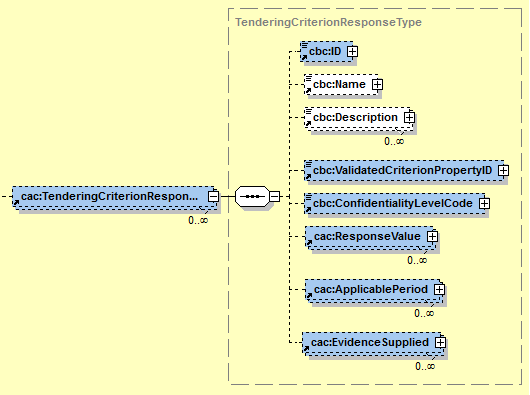
To answer one QUESTION one of the different possible types of values from the cac:ResponseValue element (inside the cac:TenderingCriterionResponse) must be selected. In other words, the types of elements inside the cac:ResponseValue are all disjoint amongst themselves.
If the need is to build a list of values, e.g. the list of Common Procurement Vocabulary codes (CPV) corresponding to an activity, or a the list of Lot identifiers the EO tenders to, a sequence of cac:ResponseValues shall be instantiated. See XML examples below.
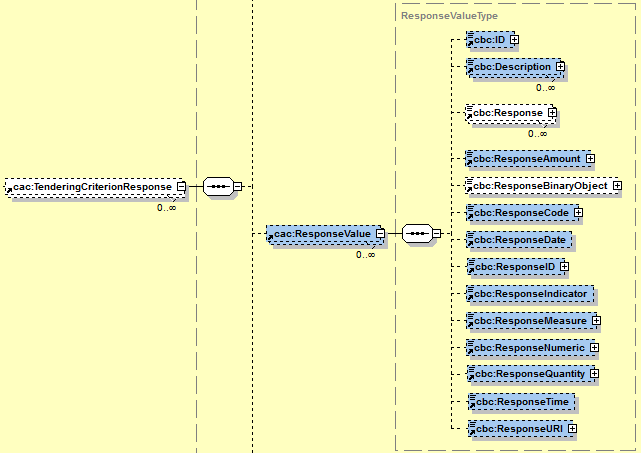
The cac:ApplicablePeriod is used to hold the start date and the end-date provided by the economic operator to a QUESTION for which the expected data is of type 'PERIOD'. (See expected types in the Code List ResponseDataType).
|
Note for the future
Future versions of UBL could consider moving this element inside the element |
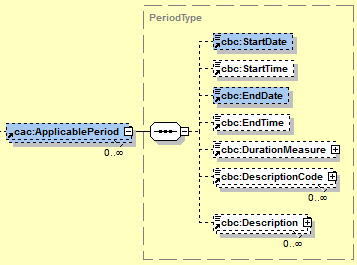
One answer to one QUESTION may be linked to multiple evidences. The XSD diagram below shows that to make this link possible the element cac:TenderingCriterionResponse element associates a class cac:EvidenceSupplied. This class contains only one basic information element, a cbc:ID. In UBL, except for cbc:Description, basic information elements (typically prefixed as cbc:) cannot be of multiple cardinality, but associated classes can. Thus the need to place the cbc:ID inside a class. This ID points at an instance of cac:Evidence present in the XML.
This design is an interesting feature as, by separating the evidence object instances from inside the response, one evidence may be used for different criteria. See the component cac:Evidence below in the section "IX. Evidences". See also XML examples.
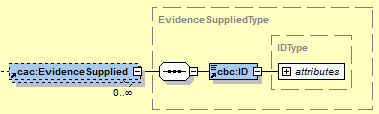
Mock-ups and data structures
The answers to QUESTION(s) are provided in the example mock-ups of the previous sections about how the contracting authority specify REQUIREMENT(s) and QUESTION(s), and how the economic operator adds or removes instances of elements (such as data on the economic operator, references to similar works and services, etc. Please refer to those mock-ups and compare the values shown in the fields reserved for the EO to answer and compare those values with the ones in the example XML snippets below.
Responses are not associated to ESPD custom data structures. All the values regarding an answer are always placed in one instance of the UBL-2.2 data element cac:TenderingCriterionResponse.
Expected Elements (Basic and Extended)
Class name: |
cac:TenderingCriterionResponse |
Definition: |
A class to describe a response to a criterion property. |
Business rule(s): |
Extended (BR-RESP-80, BR-RESP-80-S10, BR-RESP-80-S20), Common (BR-LEAD-10) |
File: |
dist/common/xsdrt/UBL-CommonAggregateComponents-2.2.xsd |
Path: |
/QualificationApplicationResponse/cac:TenderingCriterionResponse |
Context of use: |
The economic operator uses it in the ESPD Response document to answer a QUESTION. tbr92-018, tbr92-007, tbr92-005, tbr92-006. |
| Components | Type | Card | Description | Requirements |
|---|---|---|---|---|
cbc:ID |
Identifier |
0..1 |
A language-independent token, e.g., a number, that allows to identify a criterion response uniquely as well as allows to reference the criterion response in other documents. A criterion response describes how an economic operators fulfills an specific criterion. |
Information Requirement: tbr92-018, tbr92-007, tbr92-005, tbr92-006 Rule: This ID SHOULD be provided by the EO or the service provider that instantiates the ESPDResponse XML document. Rule scope: Common (BR-TCR-05, BR-OTH-02) |
cbc:ValidatedCriterionPropertyID |
Identifier |
1 |
A cross-reference to the criterion propertys which is validated thorugh this response expressed as an identifier. |
Information Requirement: tbr92-018, tbr92-007, tbr92-005, tbr92-006 Rule: This ID MUST point at one of the TenderingCriterionProperty/cbc:ID that were included in the Request document. Rule scope: Common (BR-RESP-30, BR-RESP-40, BR-RESP-60, BR-RESP-60-S10, BR-RESP-60-S20, BR-TCR-01, BR-TCR-03, BR-LEAD-10-S20, BR-LEAD-10-S30) |
cbc:ConfidentialityLevelCode |
Code |
0..1 |
A code specifying the confidentiality level of the given response for this criterion. |
Information Requirement: tbr92-018, tbr92-007, tbr92-005, tbr92-006 Rule: If the value is true, all the evidences associated to this response becomes also confidential. Rule scope: Extended (BR-TCR-02, BR-OTH-01, BR-OTH-01#19, BR-OTH-03) |
cac:ResponseValue |
Associated class |
0..n |
A class to describe the criterion property response value. |
Information Requirement: tbr92-018 Rule: This class contains the main disjoint elements used to provide the actual answer. The UBL-2.2 model provides cardinality 0..n, this allows for building up lists of, namely, identifier and code values that are all "packaged" into one Rule scope: Common (BR-TCR-08, BR-TCR-04) |
cac:ApplicablePeriod |
Associated class |
0..1 |
A class for the economic operator to specify the start date and the end-date when the expected answer to a criterion property is a lapse of time. |
Information Requirement: tbr92-018 Rule: The ESPD-EDM does only expect start date and end date. Software applications may take leverage of the richness of this class though for other purposes beyond the scope of this specification. |
cac:EvidenceSupplied |
Associated class |
0..1 |
A reference to the evidence supporting this criterion property response. |
Information Requirement: tbr92-017 Rule: Used to point at an instance of the cac:Evidence. |
|
Disjointness of the elements inside cac:ResponseValue
Beware that one Thus, for example, if in the ESPD Request the expected type is DESCRIPTION the cac:ResponseValue must use the element See the codes used for This disjointness rule applies to the type of the value, but not to the values of the same type. Thus, for lists of values that constitute the actual answer (e.g. the list of LotIDs the economic operator tenders to, or a list of CPV codes to describe with granularity an activity), a sequence of |
Class name: |
cac:Period |
Definition: |
A class to describe a period of time. |
Business rule(s): |
None |
File: |
dist/common/xsdrt/UBL-CommonAggregateComponents-2.2.xsd |
Path: |
/QualificationApplicationResponse/cac:TenderingCriterionResponse/cac:ApplicablePeriod |
Context of use: |
A class for the economic operator to specify the start date and the end-date when the expected answer to a criterion property is a lapse of time; tbr92-018. |
| Components | Type | Card | Description | Requirements |
|---|---|---|---|---|
cbc:StartDate |
Date |
0..1 |
The date on which this period begins. |
Information Requirement: tbr92-018 Rule: Expected format 'YYYY-MM-DD'. |
cbc:EndDate |
Date |
0..1 |
The date on which this period ends. |
Information Requirement: tbr92-018 Rule: Expected format 'YYYY-MM-DD'. |
Class name: |
cac:EvidenceSupplied |
Definition: |
A reference to the evidence supporting this criterion property response. |
Business rule(s): |
None |
File: |
dist/common/xsdrt/UBL-CommonAggregateComponents-2.2.xsd |
Path: |
/QualificationApplicationResponse/cac:TenderingCriterionResponse/cac:EvidenceSupplied |
Context of use: |
Used to refer to one ore more evidences that are present in the QualificationApplicationResponse XML instance; tbr92-017. |
| Components | Type | Card | Description | Requirements |
|---|---|---|---|---|
cbc:ID |
Identifier |
1 |
The identifier of the referenced evidence. |
Information Requirement: tbr92-018 Rule: The expected identifier must match the value of a Rule scope: Common (BR-TCR-09, BR-OTH-0) |
The table below lists the elements expected in the sub-class cac:ResponseValue. Remember that the elements of distinct types are all disjoint amongst themselves: i.e. you cannot associate one amount AND one indicator to the same cac:TenderingCriterionProperty element (but several values for elements of one type may be used to build up lists, e.g. lists of Lots and lists of CPV codes).
Class name: |
cac:ResponseValue |
Definition: |
A class to describe the criterion property response value. |
Business rule(s): |
Common (BR-TCR-08, BR-TCR-04) |
File: |
dist/common/xsdrt/UBL-CommonAggregateComponents-2.2.xsd |
Path: |
/QualificationApplicationResponse/cac:TenderingCriterionResponse/cac:ResponseValue |
Context of use: |
Used to specify one value or a collection of values (in the case of a list) as a response to one, and only one, cac:TenderingCriterionProperty that is typified as a QUESTION. |
| Components | Type | Card | Description | Requirements |
|---|---|---|---|---|
cbc:ID |
Identifier |
0..1 |
An identifier to refer to this criterion response value. |
Information Requirement: tbr92-018 Rule: Recommendation: use a UUDI-version 4 number. Rule scope: Extended (BR-TCR-05) |
cbc:Description |
Text |
0..n |
A description used as a reply to the criterion property. |
Information Requirement: tbr92-018 Rule: The ESPD-EDM uses this element to place a response that is a string. UBL-2.2 instead uses cbc:Response, for this. This is something that needs to be reviewed and agreed between ESPD-EDM and future versions of the UBL. See the XML provided in this ESPD-EDM specifications for details on its usage. |
cbc:ResponseAmount |
Amount |
0..1 |
An amount used as a reply to the criterion property. |
Information Requirement: tbr92-018 Rule: The currencyID attribute is MANDATORY (e.g. "EUR"). Compulsory use of the code list "ISO 4217 3A:2015". BEWARE that amounts can use decimal separators (e.g. 14134,95 but not hundred or thousand separators). Rule scope: Common (BR-OTH-01, BR-OTH-01#17, BR-OTH-03) |
cbc:ResponseCode |
Code |
0..1 |
A code used as a reply to the criterion property. |
Information Requirement: tbr92-018 Rule: Compulsory use of the attributes mentioned in the section "II.4 Codes and Identifiers" for codes. Rule scope: Common (BR-OTH-01) |
cbc:ResponseDate |
Date |
0..1 |
A date used as a reply to the criterion property. |
Information Requirement: tbr92-018 Rule: Format 'YYYY-MM-DD'. |
cbc:ResponseTime |
Time |
0..1 |
A time used as a reply to the criterion property. |
Information Requirement: tbr92-018 Rule: Format 'HH:MM:SS'. |
cbc:ResponseID |
Identifier |
0..1 |
An identifier used as a reply to the criterion property. |
Information Requirement: tbr92-018 Rule: Compulsory use of the attributes mentioned in the section "II.4 Codes and Identifiers" for codes. Several identifiers may be linked to one criterion property thus building a list of identifiers. See XML examples (e.g. in Extended references ESPD Response, 'Lots tendered the EO tenders to'). |
cbc:ResponseIndicator |
Indicator |
0..1 |
An indicator used as a reply to the criterion property. |
Information Requirement: tbr92-018 Rule: The only possible values are False and True. Rule scope: Common (BR-TCR-06, BR-TCR-07) |
cbc:ResponseMeasure |
Measure |
0..1 |
A measure used as a reply to the criterion property. |
Information Requirement: tbr92-018 Rule: None. |
cbc:ResponseNumeric |
Numeric |
0..1 |
A number used as a reply to the criterion property. |
Information Requirement: tbr92-018 Rule: Do not format the percentage with the "%" symbol, just provide a float value like in the example (e.g. 0.4). |
cbc:ResponseQuantity |
Quantity |
0..1 |
A quantity used as a reply to the criterion property. |
Information Requirement: tbr92-018 Rule: BEWARE that different types of Quantities can be required, some of them with a special attribute. Up to three different types of Quantities can be specified: (1) QUANTITY_INTEGER, a number representing a quantity in a specific unit of measure. The unit has to be specified (e.g. number of workers); (2) QUANTITY_YEAR, a non-negative integer (i.e. a natural number) representing a year. The unit has to be specified as YEAR, and (3) QUANTITY, a number representing a generic quantity with no unit specified (e.g. a ratio). Beware that in the case of QUANTITY_INTEGER and QUANTITY_YEAR the attribute unitCode MUST be always specified. |
cbc:ResponseURI |
URI |
0..1 |
A URI used as a reply to the criterion property. |
Information Requirement: tbr92-018 Rule: None. |
Request/Response XML Example
To start with a simple example let us re-take the last case presented in section Reduction of candidates.
The first thing to take into account is that the responses go at the end of the document, just after the last set of REQUIREMENT(s) and QUESTION(s) that were copied from the ESPD-Request into the ESPD-Response, and before the evidences.
The second important thing is to keep in mind is that each response is linked to one, and only one, QUESTION via the identifier of that QUESTION.
Having said this, imagine that the following snippet of XML code is the last criterion from the ESPD-Request that has been instantiated in your ESPD-Response (pay attention to the bullets and comments under the example).
<!-- ... beginning of document removed for brevity -->
<cac:TenderingCriterion>
        <cbc:ID schemeID="CriteriaTaxonomy" schemeAgencyID="EU-COM-GROW"
                schemeVersionID="2.1.1">51c39ba9-0444-4967-afe9-36f753b30175</cbc:ID>
        <cbc:CriterionTypeCode listID="CriteriaTypeCode" listAgencyID="EU-COM-GROW"
                listVersionID="2.1.1"
                >CRITERION.OTHER.EO_DATA.REDUCTION_OF_CANDIDATES</cbc:CriterionTypeCode>
        <cbc:Name>Reduction of the number of qualified candidates</cbc:Name>
        <cbc:Description>The economic operator declares that It meets the objective and non
                discriminatory criteria or rules to be applied in order to limit the number
                of candidates in the following way:</cbc:Description>
        <cac:TenderingCriterionPropertyGroup>
                <cbc:ID schemeID="CriteriaTaxonomy" schemeAgencyID="EU-COM-GROW"
                        schemeVersionID="2.1.1"
                        >ecc69670-f428-4446-908f-689568ca0d0d</cbc:ID>
                <cbc:PropertyGroupTypeCode listID="PropertyGroupType"
                        listAgencyID="EU-COM-GROW" listVersionID="2.1.1"
                        >ON*</cbc:PropertyGroupTypeCode>
                <cac:TenderingCriterionProperty>
                        <cbc:ID schemeID="CriteriaTaxonomy" schemeAgencyID="EU-COM-GROW"
                                schemeVersionID="2.1.1"
                                >087ecf5a-a0df-4a0b-a09f-7e6a8392bb35</cbc:ID>
                        <cbc:Description>Your answer?</cbc:Description>
                        <cbc:TypeCode listID="CriterionElementType"
                                listAgencyID="EU-COM-GROW" listVersionID="2.1.1"
                                >QUESTION</cbc:TypeCode>
                        <cbc:ValueDataTypeCode listID="ResponseDataType"
                                listAgencyID="EU-COM-GROW" listVersionID="2.1.1"
                                >INDICATOR</cbc:ValueDataTypeCode>
                </cac:TenderingCriterionProperty>
                <cac:SubsidiaryTenderingCriterionPropertyGroup>
                        <cbc:ID schemeID="CriteriaTaxonomy" schemeAgencyID="EU-COM-GROW"
                                schemeVersionID="2.1.1"
                                >f13754df-7e15-4155-aaa6-7ca6407baa47</cbc:ID>
                        <cbc:PropertyGroupTypeCode listID="PropertyGroupType"
                                listAgencyID="EU-COM-GROW" listVersionID="2.1.1"
                                >ONTRUE</cbc:PropertyGroupTypeCode>
                        <cac:TenderingCriterionProperty>
                                <cbc:ID schemeID="CriteriaTaxonomy"
                                        schemeAgencyID="EU-COM-GROW" schemeVersionID="2.1.1"
                                        >27a9f64c-16e0-4dd8-b35f-c4e50b8d2242</cbc:ID>
                                <cbc:Description>Please describe them</cbc:Description>
                                <cbc:TypeCode listID="CriterionElementType"
                                        listAgencyID="EU-COM-GROW" listVersionID="2.1.1"
                                        >QUESTION</cbc:TypeCode>
                                <cbc:ValueDataTypeCode listID="ResponseDataType"
                                        listAgencyID="EU-COM-GROW" listVersionID="2.1.1"
                                        >DESCRIPTION</cbc:ValueDataTypeCode>
                        </cac:TenderingCriterionProperty>
                </cac:SubsidiaryTenderingCriterionPropertyGroup>
        </cac:TenderingCriterionPropertyGroup>
        <cac:TenderingCriterionPropertyGroup>
                <cbc:ID schemeID="CriteriaTaxonomy" schemeAgencyID="EU-COM-GROW"
                        schemeVersionID="2.1.1"
                        >7458d42a-e581-4640-9283-34ceb3ad4345</cbc:ID>
                <cbc:PropertyGroupTypeCode listID="PropertyGroupType"
                        listAgencyID="EU-COM-GROW" listVersionID="2.1.1"
                        >ON*</cbc:PropertyGroupTypeCode>
                <cac:TenderingCriterionProperty>
                        <cbc:ID schemeID="CriteriaTaxonomy" schemeAgencyID="EU-COM-GROW"
                                schemeVersionID="2.1.1"
                                >97735936-388a-4a2e-8f18-be1e19e21607</cbc:ID>
                        <cbc:Description>Is this information available
                                electronically?</cbc:Description>
                        <cbc:TypeCode listID="CriterionElementType"
                                listAgencyID="EU-COM-GROW" listVersionID="2.1.1"
                                >QUESTION</cbc:TypeCode>
                        <cbc:ValueDataTypeCode listID="ResponseDataType"
                                listAgencyID="EU-COM-GROW" listVersionID="2.1.1"
                                >INDICATOR</cbc:ValueDataTypeCode>
                </cac:TenderingCriterionProperty>
                <cac:SubsidiaryTenderingCriterionPropertyGroup>
                        <cbc:ID schemeID="CriteriaTaxonomy" schemeAgencyID="EU-COM-GROW"
                                schemeVersionID="2.1.1"
                                >41dd2e9b-1bfd-44c7-93ee-56bd74a4334b</cbc:ID>
                        <cbc:PropertyGroupTypeCode listID="PropertyGroupType"
                                listAgencyID="EU-COM-GROW" listVersionID="2.1.1"
                                >ONTRUE</cbc:PropertyGroupTypeCode>
                        <cac:TenderingCriterionProperty>
                                <cbc:ID schemeID="CriteriaTaxonomy"
                                        schemeAgencyID="EU-COM-GROW" schemeVersionID="2.1.1"
                                        >97bba377-3a10-45dc-8b8d-dad5c23bbfee</cbc:ID>
                                <cbc:Description>Evidence supplied</cbc:Description>
                                <cbc:TypeCode listID="CriterionElementType"
                                        listAgencyID="EU-COM-GROW" listVersionID="2.1.1"
                                        >QUESTION</cbc:TypeCode>
                                <cbc:ValueDataTypeCode listID="ResponseDataType"
                                        listAgencyID="EU-COM-GROW" listVersionID="2.1.1"
                                        >EVIDENCE_IDENTIFIER</cbc:ValueDataTypeCode>
                        </cac:TenderingCriterionProperty>
                </cac:SubsidiaryTenderingCriterionPropertyGroup>
        </cac:TenderingCriterionPropertyGroup>
</cac:TenderingCriterion>
(1)(2)(3)(4)(5)(6)(7)(8)
<!-- ... rest of document removed for brevity -->| 1 | Here starts the first QUESTION (a criterion property of type QUESTION, the type follows below). |
| 2 | Here the contracting authority (CA) is requesting to the economic Operator that it states whether it meets the ''objective and non-discriminatory criteria or rules [..]". |
| 3 | The type of the criterion property: QUESTION. |
| 4 | The type of data that the economic operator (EO) will have to provide in the response (true or false). |
| 5 | The next QUESTION is enclose in a SUBGROUP because the processing instruction ONTRUE can be used only by GROUPs or SUBGROUPs of REQUIREMENTs and QUESTIONs. |
| 6 | If the previous QUESTION is answered with a true the EO will be presented with a new demand expressed in th next QUESTION. |
| 7 | The QUESTION ''Please describe them'', presented if the EO answered true to the previous QUESTION (''Your answer''). |
| 8 | The type of data expected here is a free text bythe EO (for the Response, a DESCRIPTION maps to the UBL-2.2 element cbc:Description, which is an extension of the xsd:String). |
XML example (Responses to the QUESTION(s))
This other XML snippet below shows the responses to the two QUESTION(s) expressed in the ESPD-Request for this criterion (the block related to evidences is omitted for the sake of clarity and brevity):
<!-- ... beginning of document removed for brevity -->

<cac:TenderingCriterionResponse>
    <cbc:ID schemeID="ISO/IEC 9834-8:2008 - 4UUID" schemeAgencyID="EU-COM-GROW" schemeVersionID="2.1.1">d47daca4-4a27-4461-9db9-f483d3b7a114</cbc:ID>
    <cbc:ValidatedCriterionPropertyID schemeID="CriteriaTaxonomy" schemeAgencyID="EU-COM-GROW" schemeVersionID="2.1.1">c110177c-aa9a-4acd-809a-79a2353a41ef</cbc:ValidatedCriterionPropertyID> (1)
    <cac:ResponseValue>
            <cbc:ID schemeID="ISO/IEC 9834-8:2008 - 4UUID" schemeAgencyID="EU-COM-GROW" schemeVersionID="2.1.1">de6f1bdd-abce-42f7-b9b8-30c4e7c4c94d</cbc:ID>
            <cbc:ResponseIndicator>true</cbc:ResponseIndicator> (2)
    </cac:ResponseValue>
</cac:TenderingCriterionResponse>
<cac:TenderingCriterionResponse>
    <cbc:ID schemeID="ISO/IEC 9834-8:2008 - 4UUID" schemeAgencyID="EU-COM-GROW" schemeVersionID="2.1.1">d47daca4-4a27-4461-9db9-f483d3b7a114</cbc:ID>
    <cbc:ValidatedCriterionPropertyID schemeID="CriteriaTaxonomy" schemeAgencyID="EU-COM-GROW" schemeVersionID="2.1.1">e437cac1-3a89-4f36-bcc7-3219dda49d30</cbc:ValidatedCriterionPropertyID>(3)
    <cac:ResponseValue>
            <cbc:ID schemeID="ISO/IEC 9834-8:2008 - 4UUID" schemeAgencyID="EU-COM-GROW" schemeVersionID="2.1.1">de6f1bdd-abce-42f7-b9b8-30c4e7c4c94d</cbc:ID>
            <cbc:Description>This Consortium fulfills all the conditions defined by the buyer in the contract notice, and notably
             the Consortium is duly registered in the national pre-qualification system of the country of the Consortium lead where
             all the information about its classification and documentation about its financial standing are up to the date.</cbc:Description>(4)
    </cac:ResponseValue>(3)
</cac:TenderingCriterionResponse>

<!-- ... rest of document removed for brevity -->| 1 | Notice this UUID is identical to the cac:TenderingCriterionProperty one. This is the way the UBL-2.2 Qualification Application Response document links each QUESTION(s) to one response (and only one), or viceversa. |
| 2 | The economic operator states here that it meets the criteria. Notice that the data element is the UBL-2.2 element cbc:ResponseIndicator, which is an
''semantisation'' (a specialisation) of cbc:Indicator and therefore corresponds to the type of data expected by the CA in the Request (in cbc:ValueDataTypeCode). |
| 3 | This is the UUID corresponding to the QUESTION in the Request ''Please describe them''. |
| 4 | The economic operator describes how it meets the criteria. The data element containing the explanation by the EO. Notice that the type of data is the UBL-2.2 element cbc:Description, as requested by the CA in cbc:ValueDataTypeCode. |
VIII.8 Evidence
Related information requirements
See formal requirements related to evidences in the e-Sens site: (tbr092-017).
Differences between the Basic and Extended models
There are no differences between the Basic and Extended models as far as evidences are concerned.
XSD Schema (Basic and Extended)
Remember that evidences are indirectly linked to responses based on the identifier of the evidence: in the response, the element cac:EvidenceSupplied/cbc:ID contains the identifier set in /QualificationApplicationResponse/cac:Evidence/cbc:ID. See XML example below; see also the example XML file "Extended-ESPDResponse-2.1.1.xml" for an example.
The figure below shows the XSD Diagram for the UBL-2.2 component cac:Evidence (elements in blue are the expected ones in ESPD-EDM V2.1.1):
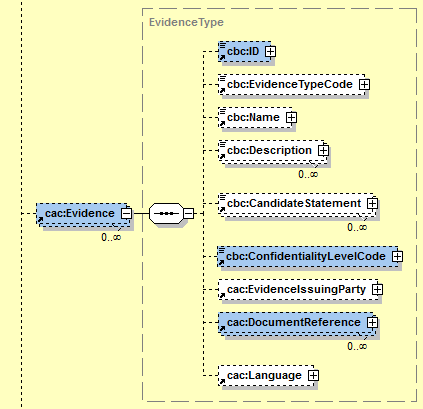
The UBL-2.2 element cac:Evidence is a specialisation of cac:DocumentReference. This other XSD diagram shows this association and, in blue, highlights the elements expected in the ESPD-EDM V2.1.1:
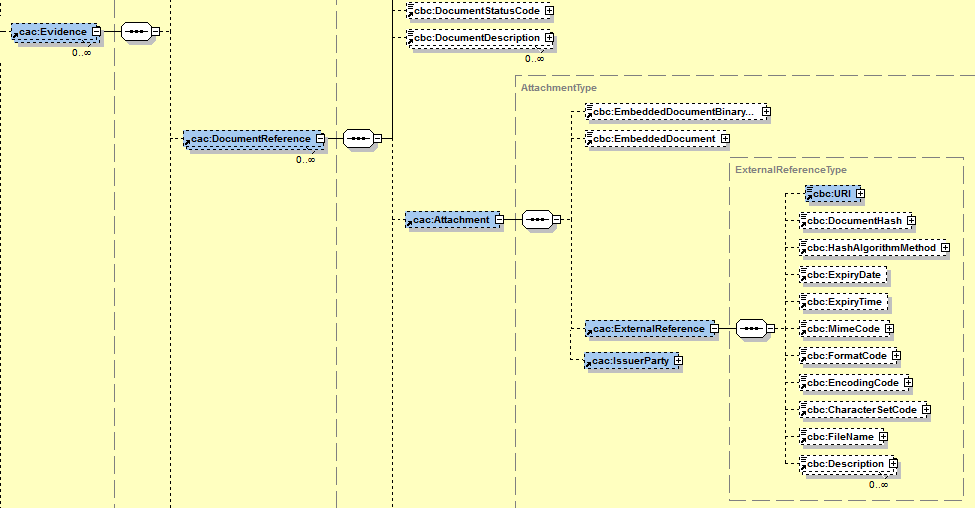
Mock-ups and data structures
In principle only a few elements are kept in the ESPD Response document about an evidence: its Identifier, a URL from where to access its content, a Reference/Code, a Confidentiality indicator, and the Issuer.
This group of data repeats frequently in the many different mock-ups presented in this document. The one below is just one example and will be used to illustrate where the three element go in the XML instance of an evidence (compare the circled numbers #9 to #12 with the comments in the XML snippet below).
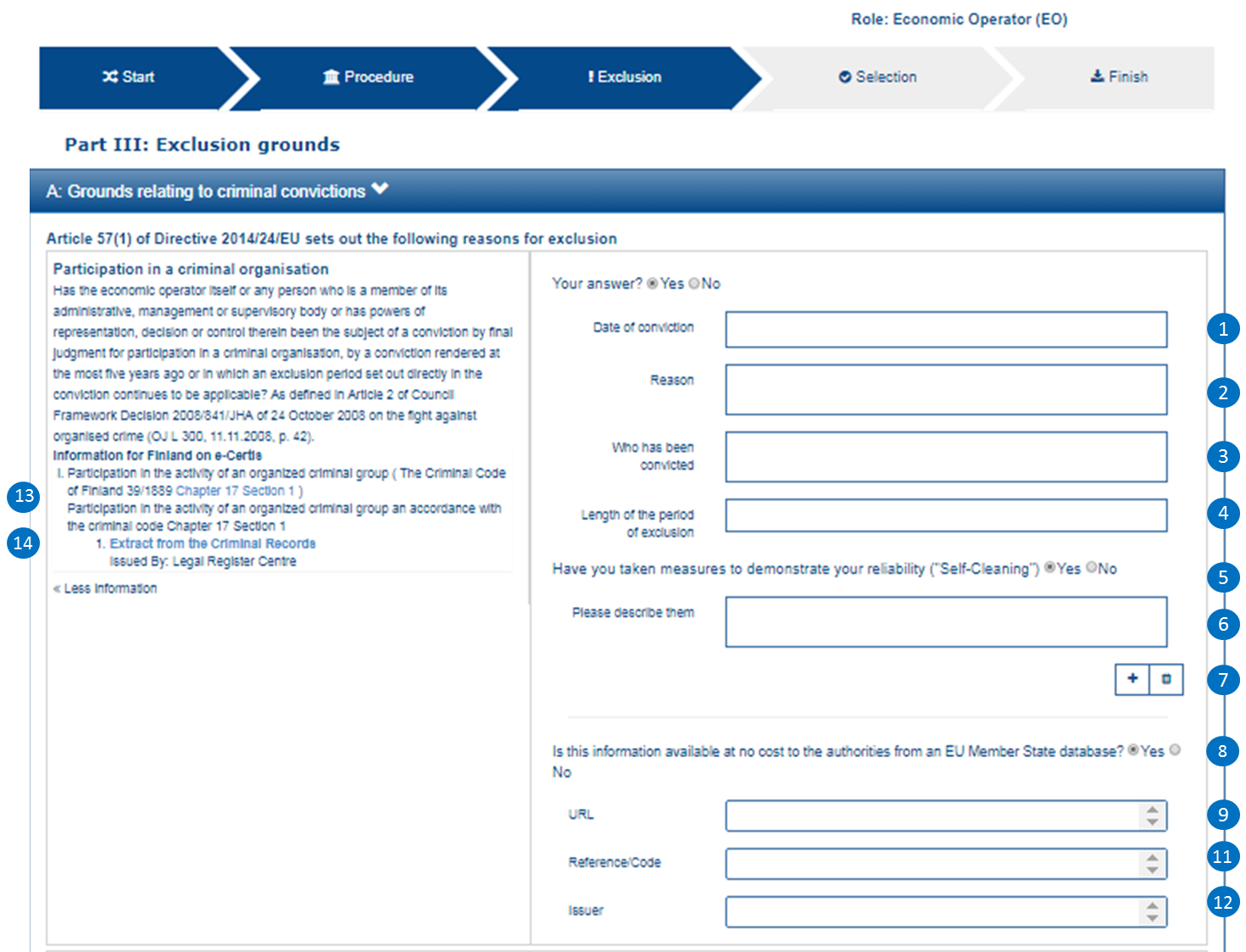
|
Duplicity of the Issuer
Beware that the current modeel of UBL-2.2 provides two elements for the Issuer, one for the issuer of the evidence and another for the issuer of the document reference. The ESPD-EDM V2.1.1 uses always the one inside the document reference to refer to the issuer of the evidence (and of the document that 'is' the evidence). Thus the element used in the ESPD is |
Expected (and other) Elements (Basic and Extended)
This list below enumerates the elements of cac:Evidence that could be used in (that make sense for) an ESPD Response. Notice though that the current versions of the ESPD-EDM only use the few elements mentioned above: ID, URL, Reference/Code, Confidentiality level and Issuer.
Class name: |
cac:Evidence |
Definition: |
A class to describe an item of evidentiary support for representations of capabilities or the ability to meet tendering requirements, which an economic operator must provide for acceptance into a tendering process. |
Business rule(s): |
None |
File: |
dist/common/xsdrt/UBL-CommonAggregateComponents-2.2.xsd |
Path: |
/QualificationApplicationResponse/cac:Evidence |
Context of use: |
The economic operator uses it in the ESPD Response document to provide evidentiary support to one or more criteria (tbr092-017). |
| Components | Type | Card | Description | Requirements |
|---|---|---|---|---|
cbc:ID |
Identifier |
1 |
An identifier for this item of evidentiary support. |
Information Requirement: tbr092-017 Rule: The Evidence ID MUST be unique in the ESPD Response XML instance (i.e. two evidences cannot have the same ID value). It is recommended to use always a UUID UUID of version 4 (random generated UUID). Rule scope: Common (BR-TCR-09, BR-OTH-0) |
cbc:EvidenceTypeCode |
Code |
0..1 |
A code signifying the type of evidence. |
Information Requirement: tbr092-017, tbr092-007, tbr092-006 Rule: A code signifying the type of evidence. Could be used in the future in alignment to e-Certis. Rule scope: Extended (BR-OTH-01) |
cbc:Name |
Text |
0..1 |
The name of the evidence. |
Information Requirement: tbr092-017, tbr092-007, tbr092-006 Rule: None. Could be used in the future in alignment to e-Certis. |
cbc:Description |
Text |
0..1 |
The textual description for this Evidence. |
Information Requirement: tbr092-017, tbr092-007, tbr092-006 Rule: Use this field to keep the Reference/Code of the Evidence. |
cbc:CandidateStatement |
Text |
0..1 |
Information about a candidate statement that the contracting authority accepts as a sufficient response. |
Information Requirement: tbr092-017, tbr092-007, tbr092-006 Rule: None. Not currently used in ESPD. |
cbc:ConfidentialityLevelCode |
Code |
0..1 |
A code specifying the confidentiality level of this evidence. |
Information Requirement: tbr092-017 Rule: Compulsory use of the Code List ConfidentialityLevel. Software application should set this code to CONFIDENTIAL automatically when the confidentiality level code of at least one criterion to which this evidence is associated is set to CONFIDENTIAL. Rule scope: Extended (BR-TCR-02, BR-OTH-01, BR-OTH-01#18, BR-OTH-03) |
This other table lists the elements from cac:Evidence/cac:DocumentReference used in the ESPD-EDM-V2.1.1:
Class name: |
cac:DocumentReference |
Definition: |
A reference to the evidentiary document. |
Business rule(s): |
None |
File: |
dist/common/xsdrt/UBL-CommonAggregateComponents-2.2.xsd |
Path: |
/QualificationApplicationResponse/cac:Evidence/cac:DocumentReference |
Context of use: |
The economic operator uses it in the ESPD Response document to supply the URL of the evidence and the party who issued the evidentiary document. (tbr092-017, tbr092-022, tbr092-006, tbr092-007). |
| Components | Type | Card | Description | Requirements |
|---|---|---|---|---|
cbc:ID |
Identifier |
1 |
An identifier for the referenced document. |
Information Requirement: tbr092-017, tbr092-022, tbr092-006, tbr092-007 Rule: If the reference or verification code is provided for the evidence use this element to place it. This 'code' is used in some countries (e.g. Spain) to check that the document is authentic. If a verification code is supplied you can use an official 'end-point' to retrieve an image (or a PDF) of the document and check that the evidence is authentic. Rule scope: Extended (BR-OTH-02) |
cac:Attachment/cac:ExternalReference/cbc:URI |
Identifier |
1 |
The Uniform Resource Identifier (URI) that identifies the external object as an Internet resource. |
Information Requirement: tbr092-017, tbr092-022, tbr092-006, tbr092-007 Rule: None. Not currently used in ESPD. |
cac:IssuerParty/cbc:ID |
Identifier |
0..1 |
The identifier of the party issuer of the documentary evidence. |
Information Requirement: tbr092-017, tbr092-007, tbr092-006 Rule: Not currently used in ESPD, but if you decide to use it try to use the VAT number whenever possible. Rule scope: Extended (BR-OTH-02) |
cac:IssuerParty/cbc:Name |
Text |
0..1 |
The name of the party issuer of the documentary evidence. |
Information Requirement: tbr092-017, tbr092-007, tbr092-006 Rule: ESPD-EDM uses this element to keep the name of the evidence issuer in the ESPD Response XML instance. |
cac:IssuerParty/cbc:WebsiteURI |
URI |
0..1 |
The website of the party issuer of the documentary evidence. |
Information Requirement: tbr092-017, tbr092-007, tbr092-006 Rule: None. Not currently used in ESPD-EDM V2.1.1. |
XML Examples
Example 1: One evidence shared by two criteria
XML snippet 1.a) the criteria defined in the ESPD Request, and 'copied' in the ESPD Response
	<!-- Criterion #1:Participation in a criminal organisation -->

	<cac:TenderingCriterion>
		<cbc:ID schemeID="CriteriaTaxonomy" schemeAgencyID="EU-COM-GROW" schemeVersionID="2.1.1">005eb9ed-1347-4ca3-bb29-9bc0db64e1ab</cbc:ID>
		<cbc:CriterionTypeCode listID="CriteriaTypeCode" listAgencyID="EU-COM-GROW" listVersionID="2.1.1">CRITERION.EXCLUSION.CONVICTIONS.PARTICIPATION_IN_CRIMINAL_ORGANISATION</cbc:CriterionTypeCode>
		<cbc:Name>Participation in a criminal organisation</cbc:Name>

	<!-- ... -->
	<!-- Elements removed for brevity -->
	<!-- ... -->

			<cac:TenderingCriterionProperty>
				<cbc:ID schemeID="CriteriaTaxonomy" schemeAgencyID="EU-COM-GROW" schemeVersionID="2.1.1">3f61215a-cd38-438b-a355-e4d06c57384c</cbc:ID>
				<cbc:Description>Is this information available electronically?</cbc:Description>
				<cbc:TypeCode listID="CriterionElementType" listAgencyID="EU-COM-GROW" listVersionID="2.1.1">QUESTION</cbc:TypeCode>
				<cbc:ValueDataTypeCode listID="ResponseDataType" listAgencyID="EU-COM-GROW" listVersionID="2.1.1">INDICATOR</cbc:ValueDataTypeCode>
			</cac:TenderingCriterionProperty>
			<cac:SubsidiaryTenderingCriterionPropertyGroup>
				<cbc:ID schemeID="CriteriaTaxonomy" schemeAgencyID="EU-COM-GROW" schemeVersionID="2.1.1">41dd2e9b-1bfd-44c7-93ee-56bd74a4334b</cbc:ID>
				<cbc:PropertyGroupTypeCode listID="PropertyGroupType" listAgencyID="EU-COM-GROW" listVersionID="2.1.1">ONTRUE</cbc:PropertyGroupTypeCode> (1)
				<cac:TenderingCriterionProperty>
					<cbc:ID schemeID="CriteriaTaxonomy" schemeAgencyID="EU-COM-GROW" schemeVersionID="2.1.1">d8d5478e-cc65-48c9-a189-19bbe87a9bfd</cbc:ID>(2)
					<cbc:Description>Evidence Supplied</cbc:Description>
					<cbc:TypeCode listID="CriterionElementType" listAgencyID="EU-COM-GROW" listVersionID="2.1.1">QUESTION</cbc:TypeCode>
					<cbc:ValueDataTypeCode listID="ResponseDataType" listAgencyID="EU-COM-GROW" listVersionID="2.1.1">EVIDENCE_IDENTIFIER</cbc:ValueDataTypeCode> (3)
				</cac:TenderingCriterionProperty>
			</cac:SubsidiaryTenderingCriterionPropertyGroup>
		</cac:TenderingCriterionPropertyGroup>
	</cac:TenderingCriterion>

	<!-- Criterion #2:Contributions certificates -->

	<cac:TenderingCriterion>
		<cbc:ID schemeID="CriteriaTaxonomy" schemeAgencyID="EU-COM-GROW" schemeVersionID="2.1.1">5a8dea31-5db9-4e03-862b-07810aa6a7fd</cbc:ID>
		<cbc:CriterionTypeCode listID="CriteriaTypeCode" listAgencyID="EU-COM-GROW" listVersionID="2.1.1">CRITERION.OTHER.EO_DATA.CONTRIBUTIONS_CERTIFICATES</cbc:CriterionTypeCode>
		<cbc:Name>Contributions certificates</cbc:Name>
		<cbc:Description>Will the economic operator be able to provide a certificate with regard to the payment of social security contributions and taxes or provide information enabling the contracting authority or contracting entity to obtaining it directly by accessing a national database in any Member State that is available free of charge?</cbc:Description>

	<!-- ... -->
	<!-- Elements removed for brevity -->
	<!-- ... -->

						<cbc:Description>Is this information available electronically?</cbc:Description>
					<cbc:TypeCode listID="CriterionElementType" listAgencyID="EU-COM-GROW" listVersionID="2.1.1">QUESTION</cbc:TypeCode>
					<cbc:ValueDataTypeCode listID="ResponseDataType" listAgencyID="EU-COM-GROW" listVersionID="2.1.1">INDICATOR</cbc:ValueDataTypeCode>
				</cac:TenderingCriterionProperty>
				<cac:SubsidiaryTenderingCriterionPropertyGroup>
					<cbc:ID schemeID="CriteriaTaxonomy" schemeAgencyID="EU-COM-GROW" schemeVersionID="2.1.1">41dd2e9b-1bfd-44c7-93ee-56bd74a4334b</cbc:ID>
					<cbc:PropertyGroupTypeCode listID="PropertyGroupType" listAgencyID="EU-COM-GROW" listVersionID="2.1.1">ONTRUE</cbc:PropertyGroupTypeCode>
					<cac:TenderingCriterionProperty>
						<cbc:ID schemeID="CriteriaTaxonomy" schemeAgencyID="EU-COM-GROW" schemeVersionID="2.1.1">191b34a8-5af0-4d53-b431-4ecd624218ea</cbc:ID>(2)
						<cbc:Description>Evidence Supplied</cbc:Description>
						<cbc:TypeCode listID="CriterionElementType" listAgencyID="EU-COM-GROW" listVersionID="2.1.1">QUESTION</cbc:TypeCode>
						<cbc:ValueDataTypeCode listID="ResponseDataType" listAgencyID="EU-COM-GROW" listVersionID="2.1.1">EVIDENCE_IDENTIFIER</cbc:ValueDataTypeCode>(3)
					</cac:TenderingCriterionProperty>
				</cac:SubsidiaryTenderingCriterionPropertyGroup>
			<!-- elements removed for brevity -->
</cac:TenderingCriterion>| 1 | The group of fields requesting the URL, Reference/Code and Issuer of the evidence will only be shown, validated or otherwise processed if the answer to the QUESTION is Yes (true). |
| 2 | The ID of the criterion property that the response will use in the cac:ValidatedCriterionPropertyID. See the response in the XML snippet 1.b) below. |
| 3 | The type of the data expected in the response value (when a code EVIDENCE_IDENTIFIER is encountered → an object cac:Evidence must be present in the ESPD Response XML instance. |
XML snippet 1.b) One evidentiary document supporting the three responses
<!-- ... elements removed for brevity .. -->

<!-- Answer to Criterion:Participation in a criminal organisation -->
<!-- Property:Evidence Supplied (PropertyID:d8d5478e-cc65-48c9-a189-19bbe87a9bfd) -->
<cac:TenderingCriterionResponse>
	<cbc:ID schemeID="ISO/IEC 9834-8:2008 - 4UUID" schemeAgencyID="EU-COM-GROW" schemeVersionID="2.1.1">219949a1-b7bb-4d7e-8c3b-cc8ca695e15b</cbc:ID>
	<cbc:ValidatedCriterionPropertyID schemeID="CriteriaTaxonomy" schemeAgencyID="EU-COM-GROW" schemeVersionID="2.1.1">d8d5478e-cc65-48c9-a189-19bbe87a9bfd</cbc:ValidatedCriterionPropertyID>(1)
	<cbc:ConfidentialityLevelCode listID="ConfidentialityLevel" listAgencyID="EU-COM-GROW" listVersionID="2.1.1">CONFIDENTIAL</cbc:ConfidentialityLevelCode>(2)
	<cac:EvidenceSupplied>
		<cbc:ID>7dea9283-f8a2-481f-9ea6-41438e25fdd4</cbc:ID>(3)
	</cac:EvidenceSupplied>
</cac:TenderingCriterionResponse>


<!-- Answer to Criterion:Contributions certificates -->
<!-- Property:URL (PropertyID:191b34a8-5af0-4d53-b431-4ecd624218ea) -->
<cac:TenderingCriterionResponse>
	<cbc:ID schemeID="ISO/IEC 9834-8:2008 - 4UUID" schemeAgencyID="EU-COM-GROW" schemeVersionID="2.1.1">7c7fb445-c5f9-4f92-8b58-7f06a541951f</cbc:ID>
	<cbc:ValidatedCriterionPropertyID schemeID="CriteriaTaxonomy" schemeAgencyID="EU-COM-GROW" schemeVersionID="2.1.1">191b34a8-5af0-4d53-b431-4ecd624218ea</cbc:ValidatedCriterionPropertyID>
	<cbc:ConfidentialityLevelCode listID="ConfidentialityLevel" listAgencyID="EU-COM-GROW" listVersionID="2.1.1">PUBLIC</cbc:ConfidentialityLevelCode>
	<cac:EvidenceSupplied>
		<cbc:ID>7dea9283-f8a2-481f-9ea6-41438e25fdd4</cbc:ID>(3)
	</cac:EvidenceSupplied>
</cac:TenderingCriterionResponse>

<cac:Evidence>
	<cbc:UUID schemeID="ISO/IEC 9834-8:2008 - 4UUID" schemeAgencyID="EU-COM-GROW" schemeVersionID="2.0">7dea9283-f8a2-481f-9ea6-41438e25fdd4</cbc:UUID>(4)
	<cbc:ConfidentialityLevelCode listID="ConfidentialityLevel" listAgencyID="EU-COM-GROW" listVersionID="2.1.1">CONFIDENTIAL</cbc:ConfidentialityLevelCode>(5)
	<cac:DocumentReference>
		<!-- Verification code (an EAN-13 barcode number) used in Spain to check the authenticity of the document. -->
		<cbc:ID schemeID="EAN-13" schemeAgencyID="EU-COM-GROW" schemeVersionID="2.0">5901234123457</cbc:ID>(6)
		<cac:Attachment>
			<cac:ExternalReference>
				<cbc:URI>http://minafhp.gob.es/pub/cert?id=5901234123457</cbc:URI>(7)
			</cac:ExternalReference>
		</cac:Attachment>
		<cac:IssuerParty>
			<cac:PartyName> (8)
				<cbc:Name languageID="es">Ministerio de Hacienda y Administracions Públicas</cbc:Name>
			</cac:PartyName>
		</cac:IssuerParty>
	</cac:DocumentReference>
</cac:Evidence>

</QualificationApplicationResponse>| 1 | ID value of the criterion property (QUESTION) for which this response value is the answer. |
| 2 | The criteron MUST be treated as confidential: only the members of the evaluation team should have access to it. This makes the evidence confidential too. |
| 3 | Identifier of the only evidence object that is used for both criteria: it must match the value provided for the cac:Evidence/cbc:ID element of the evidence. |
| 4 | Identifer of the evidence. It matches the values in the cac:EvidenceSupplied/cbc:ID of the two criteria. |
| 5 | Confidentiality level is set to 'CONFIDENTIAL' because the first criterion requires to be treated as confidential. Thus even if the second criterion sets 'PUBLIC' as for its level of confidentiality the evidence will be kept confidential. |
| 6 | The Reference/Verification code (5901234123457) is in this case a 13 digit EAN-13 barcode number. |
| 7 | URL to access the evidentiary document (in this case it’s and end-point using the verification code as an end-point parameter). |
| 8 | The name of the issuer party. |
Example 2: Two different evidences for two criteria
The following snippet uses the same two criteria shown in the XML example snippet 1.a): hence the values of the cac:ValidatedCriterionPropertyID are 'd8d5478e-cc65-48c9-a189-19bbe87a9bfd' (criterion property 'participation in a criminal organisation') and '7c7fb445-c5f9-4f92-8b58-7f06a541951f' (criterion property 'contributions certificates').
XML snippet 2 different evidentiary documents per response
<!-- ANSWERS TO QUESTION(s) -->

<!-- ... elements removed for brevity .. -->

<!-- Answer to Criterion:Participation in a criminal organisation -->
<!-- Property:Evidence Supplied (PropertyID:d8d5478e-cc65-48c9-a189-19bbe87a9bfd) -->
<cac:TenderingCriterionResponse>
	<cbc:ID schemeID="ISO/IEC 9834-8:2008 - 4UUID" schemeAgencyID="EU-COM-GROW" schemeVersionID="2.1.1">219949a1-b7bb-4d7e-8c3b-cc8ca695e15b</cbc:ID>
	<cbc:ValidatedCriterionPropertyID schemeID="CriteriaTaxonomy" schemeAgencyID="EU-COM-GROW" schemeVersionID="2.1.1">d8d5478e-cc65-48c9-a189-19bbe87a9bfd</cbc:ValidatedCriterionPropertyID> (1)
	<cbc:ConfidentialityLevelCode listID="ConfidentialityLevel" listAgencyID="EU-COM-GROW" listVersionID="2.1.1">PUBLIC</cbc:ConfidentialityLevelCode>(2)
	<cac:EvidenceSupplied>
		<cbc:ID>7dea9283-f8a2-481f-9ea6-41438e25fdd4</cbc:ID>(3)
	</cac:EvidenceSupplied>
</cac:TenderingCriterionResponse>


<!-- Answer to Criterion:Contributions certificates -->
<!-- Property:URL (PropertyID:191b34a8-5af0-4d53-b431-4ecd624218ea) -->
<cac:TenderingCriterionResponse>
	<cbc:ID schemeID="ISO/IEC 9834-8:2008 - 4UUID" schemeAgencyID="EU-COM-GROW" schemeVersionID="2.1.1">7c7fb445-c5f9-4f92-8b58-7f06a541951f</cbc:ID>
	<cbc:ValidatedCriterionPropertyID schemeID="CriteriaTaxonomy" schemeAgencyID="EU-COM-GROW" schemeVersionID="2.1.1">191b34a8-5af0-4d53-b431-4ecd624218ea</cbc:ValidatedCriterionPropertyID>(4)
	<cbc:ConfidentialityLevelCode listID="ConfidentialityLevel" listAgencyID="EU-COM-GROW" listVersionID="2.1.1">CONFIDENTIAL</cbc:ConfidentialityLevelCode>(5)
	<cac:EvidenceSupplied>
		<cbc:ID>3b3be32e-3b7f-4a17-a0bb-a84210f61bb8</cbc:ID>(6)
	</cac:EvidenceSupplied>
</cac:TenderingCriterionResponse>

<!-- EVIDENCES -->

<cac:Evidence>
	<cbc:UUID schemeID="ISO/IEC 9834-8:2008 - 4UUID" schemeAgencyID="EU-COM-GROW" schemeVersionID="2.0">7dea9283-f8a2-481f-9ea6-41438e25fdd4</cbc:UUID>(7)
	<cbc:ConfidentialityLevelCode listID="ConfidentialityLevel" listAgencyID="EU-COM-GROW" listVersionID="2.1.1">PUBLIC</cbc:ConfidentialityLevelCode>(8)
	<cac:DocumentReference>
		<!-- Verification code to access an authentic 'manifestation' of the document from the original issuer end-point -->
		<cbc:ID schemeID="EAN-13" schemeAgencyID="EU-COM-GROW" schemeVersionID="2.0">5901234123457</cbc:ID>(9)
		<cac:Attachment>
			<cac:ExternalReference>
				<cbc:URI>http://interior.gob.es/pub/cert?id=5901234123457</cbc:URI>(10)
			</cac:ExternalReference>
		</cac:Attachment>
		<cac:IssuerParty>
			<cac:PartyName>
				<cbc:Name languageID="es">Ministerio del Interior</cbc:Name>(11)
			</cac:PartyName>
		</cac:IssuerParty>
	</cac:DocumentReference>
</cac:Evidence>

<cac:Evidence>
	<cbc:UUID schemeID="ISO/IEC 9834-8:2008 - 4UUID" schemeAgencyID="EU-COM-GROW" schemeVersionID="2.0">3b3be32e-3b7f-4a17-a0bb-a84210f61bb8</cbc:UUID>(12)
	<cbc:ConfidentialityLevelCode listID="ConfidentialityLevel" listAgencyID="EU-COM-GROW" listVersionID="2.1.1">CONFIDENTIAL</cbc:ConfidentialityLevelCode>(13)
	<cac:DocumentReference>
		<!-- Verification code to access an authentic 'manifestation' of the document from the original issuer end-point -->
		<cbc:ID schemeID="EAN-13" schemeAgencyID="EU-COM-GROW" schemeVersionID="2.0">6002345234568</cbc:ID>(14)
		<cac:Attachment>
			<cac:ExternalReference>
				<cbc:URI>http://aeat.gob.es/pub/cert?id=6002345234568</cbc:URI>(15)
			</cac:ExternalReference>
		</cac:Attachment>
		<cac:IssuerParty>
			<cac:PartyName>
				<cbc:Name languageID="es">Agencia Tributaria</cbc:Name>(16)
			</cac:PartyName>
		</cac:IssuerParty>
	</cac:DocumentReference>
</cac:Evidence>

</QualificationApplicationResponse>| 1 | ID value of the first criterion property (QUESTION) for which this response value is the answer. |
| 2 | The criteron is to be treated as 'PUBLIC': it could be published. |
| 3 | Identifier of the first evidence object that is used for this criterion: it must match the value provided for the cac:Evidence/cbc:ID element of the evidence. |
| 4 | ID value of the second criterion property (QUESTION) for which this response value is the answer. |
| 5 | Confidentiality level is set to 'CONFIDENTIAL'. Therefore the evidence linked to this response will also be treated as 'CONFIDENTIAL'. |
| 6 | Identifier of the second evidence object that is used for this second criterion: it must match the value provided for the cac:Evidence/cbc:ID element of the evidence. |
| 7 | The identifier of the first evidence. It matches the cac:EvidenceSupplied/cbc:ID element value of the first response. |
| 8 | Confidentiality code for the first evidence: 'PUBLIC', notice that it is consistent with the fact that the response is also set as 'PUBLIC'. |
| 9 | Verification code ID for the first evidence (a 13 digit EAN-13 barcode number in this case). |
| 10 | URL from where to get the document. The fact that the evidence MUST BE treated as CONFIDENTIAL is not inconsistent with the fact that the evidence is available online from a free-of-charge national data base. |
| 11 | The name of the issuer of the first evidenciary document. |
| 12 | ID of the second criterion property (QUESTION) for which this response value is the answer. |
| 13 | The criteron is to be treated as 'CONFIDENTIAL': addressed only to the evaluators. |
| 14 | Verification code ID of the second evidence. |
| 15 | URL from where to get the document. |
| 16 | The name of the issuer of the second evidenciary document. |