IX Putting the pieces together
The ESPD-EDM specification, notably regarding the Extended ESPD, defines different complex sets of data that are scattered in distant locations of the corresponding XML instance.
Consequently, implementors of software dealing with the ESPD XML instances may have a hard time identifying what needs to go in the XML instance and where. This is the case of, specifically, the data related to three topics: 1) economic operators, 2) lots, and 3) weights.
To help implementors understand these topics and how to deal with them, the sub-sections of this chapter illustrate how to put together the different sets of data related to each topic with abundant figures and comments.
IX.1 All about lots
When a procurement procedure is divided in Lots not all the selection criteria apply to all Lots, i.e. some Lots need to be linked to specific criteria.
In the Extended ESPD-EDM specification, instead of defining criteria per each Lot, it is for the criterion to specify to which Lots it applies.
To link a criterion with one or more Lots, the ESPD-EDM uses a GROUP (or SUBGROUP) of REQUIREMENT(s), where each REQUIREMENT specifies the identifier of each Lot that is affected by the criterion. The figures below show how this is represented in the four different criteria data structures listed above (''Suitability'', ''Professional risk indemnity'', ''Other economic or financial requirements'' and ''References'').
For more complete examples on how the Extended ESPD-Request specifies these criteria see the sub-sections VI.2.2 Extended suitability (enrolments), Extended risk indemnity insurance, VI.7.2 Extended other economic or financial requirements, and VI.8.2 Extended references.
The folder dist/xml also contains complete XML instances of both Basic and Extended ESPD-Request and ESPD-Response documents.
The Basic ESPD documents can only define the Lots into which the procedure is divided into and the Lots to which the economic operator tenders to. The maximum expressivity of information requirements related to Lots is only possible in the Extended ESPD documents.
Therefore this section focuses only the Extended ESPD-Response document.
Lots: general information requirement check-list
-
Criteria with references to Lots: The current design of the UBL-2.2
cac:TenderingCriterionallows referencing Lots for any type of Criteria. However the current version of the ESPD-EDM only identifies this need in a reduced set of Selection Criteria (see the Criteria Taxonomy spread-sheets for more details, like the Criterion description, UUID, Code, etc.):-
Suitability I
-
Criterion #25 - Enrolment in a relevant professional register
-
Criterion #26 - Enrolment in a trade register
-
Criterion #27 - For service contracts: authorisation of particular organisation needed
-
Criterion #28 - For service contracts: membership of particular organisation needed
-
-
Risk insurance
-
Criterion #35 - Professional risk indemnity insurance
-
-
Other economic or financial requirements
-
Criterion #36 -Other economic or financial requirements
-
-
References
-
Criterion #37 - For works contracts: performance of works of the specified type
-
Criterion #38 - For supply contracts: performance of deliveries of the specified type
-
Criterion #39 - For service contracts: performance of services of the specified type
-
-
-
Order of occurrence: The table below presents the different ''blocks'' of data related to Lots in the sequence they must occur in the ESPD-Response. The aim of this table is help implementors identify the type of data structure, what it is used for, where to locate its definition (in the UBL-2.2 XSD Schema and the Criteria Taxonomy spread-sheet), and which comes first and which goes after (i.e. how they are sequenced).
|
A complete ESPD-Response document with the examples provided in this section can be found in the file Lots-Extended-Response_V2.1.1.xml |
Nº |
Data Element |
Description |
Location |
Rules |
1 |
Procurement Procedure Lots |
The Lots into which the procurement procedure has been divided into. |
At the root of the QualificationApplicationResponse document, in the element |
Only the |
2 |
Criterion ''CA Lots'' |
Requirements by the CA about the submission of tenders when the procedure is divided into Lots. |
Inside a ''false'' criterion data structure C#64 ''CA Lots'' (CRITERION.OTHER.CA_DATA.LOTS_SUBMISSION) |
The data provided herein by the CA must be coherent amongst themselves and with the Lots into which the procedure is divided into. This set of data is common to all the ESPD-Request and ESPD-Response documents about procedures divided into lots; |
3 |
Criterion ''Lots the EO tenders to'' |
The Lots to which the economic operator tenders |
Inside a UBL-2.2 element |
The Lots specified by the EO in its response must be coherent with the list of Lots specified by the CA (e.g. if the CA has specified 5 Lots, the EO cannot tender to a ''Lot6'' (see row 1 of this table). This set of data is common to all the ESPD-Request and ESPD-Response documents about procedures divided into lots; |
4 |
CA’s REQUIREMENT(s) and QUESTION(s) linked to specific Lots |
One or more REQUERIMENT(s) and QUESTION(s) linking one criterion to the lots to which it applies (see XML examples) |
Inside a specific criterion, e.g. REQUIREMENTs defined in the ''Suitability'', ''Professional risk insurance'', ''Other economic or financial requirements'' and ''References criteria'' |
The Lots specified by the CA inside one REQUIREMENT must be coherent with the list of Lots into which the procurement procedure is divided into (see row 1 or this table) |
5 |
EO’s response on its Lots |
List of the Lot Identifiers to which the EO tenders to |
Inside |
The Lot identifiers provided by the EO must be coherent with the ones it (the EO) tenders to (see row 2 of this table) and with 1) the ones into which the procedure is divided into, and 2) the ones the CA has specified in the REQUIREMENT(s) |
Example 1: Suitability
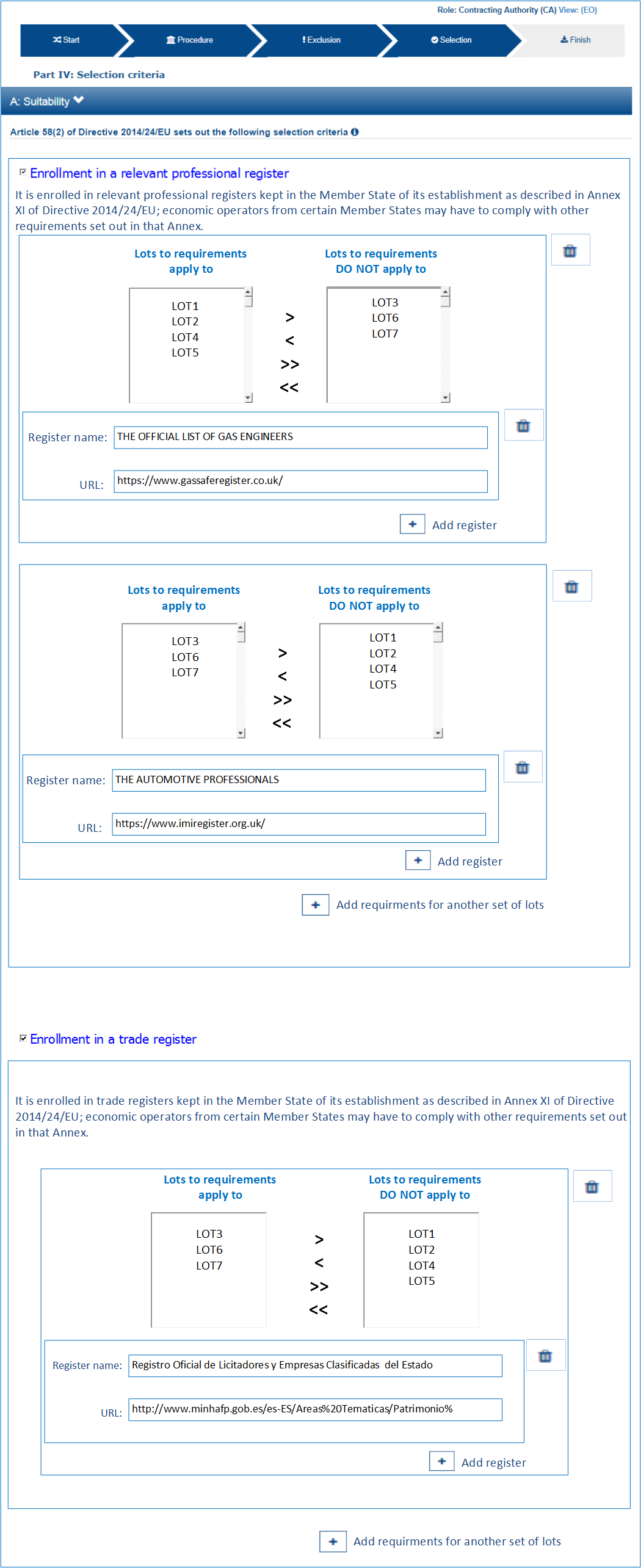
Mock-up - contracting authority perspective
For each criteria regarding suitability, the CA should be able to provide: the register name, its URL and the Lots to which each requirement apply.
This mock-up represents the situation when the procurement procedure is divided into lots. The contracting authority (CA) may request that the economic operator is registered in one or multiple registers (the REQUIREMENT). Per each register the CA specifies to which Lots this make sense.
This behaviour of “one set of lots per group of properties is regular for all those selection criteria where the allocation of lots to a set of 'criterion properties' make sense.
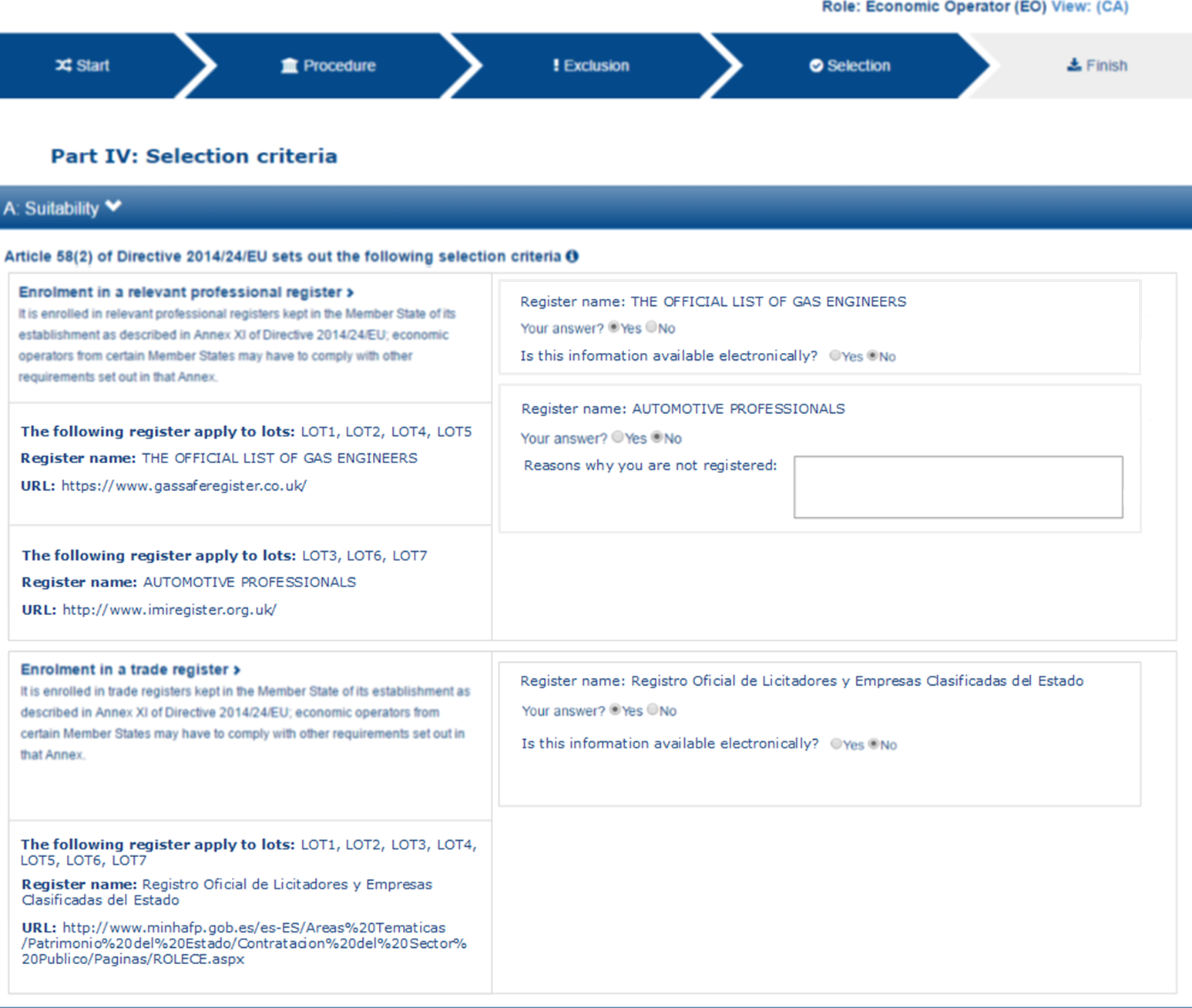
Mock-up - economic operator perspective
Notice that:
-
The Lots and registers specified by the contracting authority are presented to the economic operator (on the left side of the mock-up, circles 1 to 6);
-
The expected answer is "Yes", meaning that the economic operator fulfills the criterion;
-
In case of answering "No" the economic operator will have to provide the reasons why it is not registered.
Criterion data structure
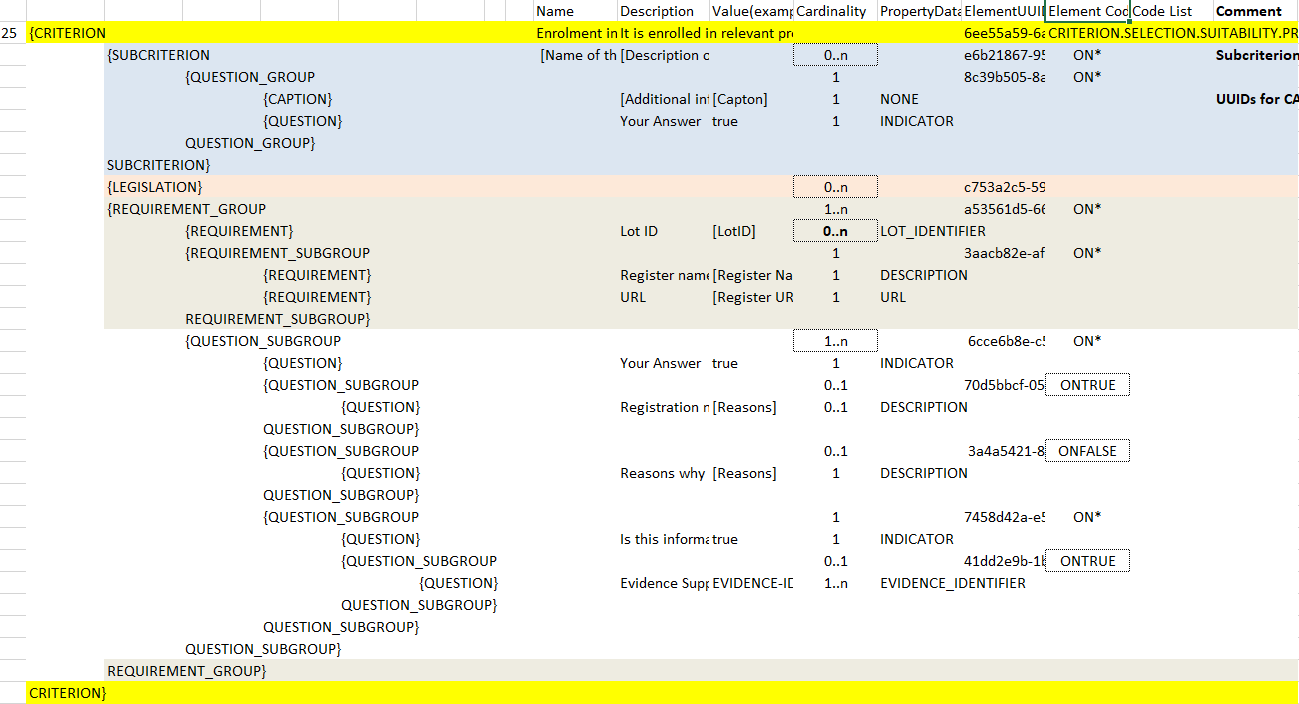
In this case, ''Enrolment in a relevant professional register'', the ESPD-Request document will contain one or more GROUP(s) of one (only one) REQUIREMENT of multiple cardinality: it can be applied to refer to a subset of Lots. The REQUIREMENT_SUBGROUP, following this list of Lots, contains the specific CA’s constraint that affect the Lots, in this case the CA’s request that the EO needs to be registered in one concrete Register.
XML example
|
Many compulsory elements and attributes of the XML example below that are not related to the subject covered in this section have been removed to gain clarity and brevity. For complete XML samples download the files under folder dist/xml. |
<?xml version="1.0" encoding="UTF-8" standalone="yes"?>
<cac:QualificationApplicationResponse xmlns="urn:oasis:names:specification:ubl:schema:xsd:CommonBasicComponents-2" ... etc. -->
    <!-- Root elements start here-->
    <cbc:UBLVersionID schemeAgencyID="OASIS-UBL-TC">2.2</cbc:UBLVersionID>
    <!-- ... etc. (beware that some root elements are compulsory, e.g. cbc:ID -->
    <!-- Main aggregate components -->
    <cac:ContractingParty> ... </cac:ContractingParty>
    <cac:EconomicOperatorParty> ... </cac:EconomicOperatorParty>
    <cac:ProcurementProject>...</cac:ProcurementProject>
    <!-- Root elements end here -->

    <!-- *FIRST SET OF DATA RELATED TO LOTS!* -->
    <!-- In this example the CA informs that the Procurement Procedure is divided into three Lots -->
    <!-- Only the IDs are truly necessary, but the CA is free to provide any other additional data -->

    <cac:ProcurementProjectLot>
         <cbc:ID schemeAgencyID="EU-COM-GROW">Lot1</cbc:ID>
    </cac:ProcurementProjectLot>
    <cac:ProcurementProjectLot>
         <cbc:ID schemeAgencyID="EU-COM-GROW">Lot2</cbc:ID>
    </cac:ProcurementProjectLot>
    <cac:ProcurementProjectLot>
         <cbc:ID schemeAgencyID="EU-COM-GROW">Lot3</cbc:ID>
    </cac:ProcurementProjectLot>
    <cac:ProcurementProjectLot>
         <cbc:ID schemeAgencyID="EU-COM-GROW">Lot4</cbc:ID>
    </cac:ProcurementProjectLot>
    <cac:ProcurementProjectLot>
         <cbc:ID schemeAgencyID="EU-COM-GROW">Lot5</cbc:ID>
    </cac:ProcurementProjectLot>
    <cac:ProcurementProjectLot>
         <cbc:ID schemeAgencyID="EU-COM-GROW">Lot6</cbc:ID>
    </cac:ProcurementProjectLot>
    <cac:ProcurementProjectLot>
         <cbc:ID schemeAgencyID="EU-COM-GROW">Lot7</cbc:ID>
    </cac:ProcurementProjectLot>


    <!-- *2nd. SET OF DATA RELATED TO LOTS: conditions concerning the submission of tenders when a procedure is divided into Lots.
         This is currently modelled as a kind of 'participation' criterion, however UBL-2.2 has a specific different treatment of these information requirements (see the `cac:LotDistribution` element)
         This issue will be reviewed in future versions of the ESPD-EDM. For version 2.1 it is necessary to use this Criterion data structure.
        *Please do not use the UBL-2.2 `cac:LotDistribution` for the time being, as it does not catter for the specification of the type of submission as a code, which is required in the ESPD-EDM. *
        *Beware* that the data provided by the CA needs to be coherent, e.g. the Maximun number of lots that may be awarded to one tenderer
        (2 in this example) cannot be greater than the number of Lots into which this procedure is divided, nor than the value of the Maximum number of
        lots or with the code assigned to the field "Tenders may be submitted for" (LOT_ALL) in this case).
    -->

    <cac:TenderingCriterion>
        <cbc:ID schemeID="CriteriaTaxonomy" schemeAgencyID="EU-COM-GROW" schemeVersionID="2.1.1">6a21c421-5c1e-46f4-9762-116fbcd33097</cbc:ID>
        <cbc:CriterionTypeCode listID="CriteriaTypeCode" listAgencyID="EU-COM-GROW" listVersionID="2.1.1">CRITERION.OTHER.CA_DATA.LOTS_SUBMISSION</cbc:CriterionTypeCode>
        <cbc:Name>CA Lots</cbc:Name>
        <cbc:Description>Please take into account the following requirements regarding the lots of this procurement procedure:</cbc:Description>
        <cac:TenderingCriterionPropertyGroup>
            <cbc:ID schemeAgencyID="EU-COM-GROW" schemeVersionID="2.1.1">03cff8d1-4d22-4435-82fa-d6361af84be6</cbc:ID>
            <cbc:PropertyGroupTypeCode listID="PropertyGroupType" listAgencyID="EU-COM-GROW" listVersionID="2.1.1">ON*</cbc:PropertyGroupTypeCode>
            <cac:TenderingCriterionProperty>
                <cbc:ID schemeID="CriteriaTaxonomy" schemeAgencyID="EU-COM-GROW" schemeVersionID="2.1.1">f8804fa9-81b7-4f3a-a500-d9e49a4f1efe</cbc:ID>
                <cbc:Description>Tenders may be submitted for</cbc:Description>
                <cbc:TypeCode listID="CriterionElementType" listAgencyID="EU-COM-GROW" listVersionID="2.1.1">REQUIREMENT</cbc:TypeCode>
                <cbc:ValueDataTypeCode listID="ResponseDataType" listAgencyID="EU-COM-GROW" listVersionID="2.1.1">CODE</cbc:ValueDataTypeCode>
                <cbc:ExpectedCode listID="BidType" listAgencyID="EU-COM-GROW" listVersionID="1.0">LOT_ALL</cbc:ExpectedCode>
            </cac:TenderingCriterionProperty>
            <cac:TenderingCriterionProperty>
                <cbc:ID schemeID="CriteriaTaxonomy" schemeAgencyID="EU-COM-GROW" schemeVersionID="2.1.1">3191b16a-37d5-48c5-88b1-8012639d24a4</cbc:ID>
                <cbc:Description>Maximum number of lots</cbc:Description>
                <cbc:TypeCode listID="CriterionElementType" listAgencyID="EU-COM-GROW" listVersionID="2.1.1">REQUIREMENT</cbc:TypeCode>
                <cbc:ValueDataTypeCode listID="ResponseDataType" listAgencyID="EU-COM-GROW" listVersionID="2.1.1">QUANTITY_INTEGER</cbc:ValueDataTypeCode>
                <cbc:ExpectedValueNumeric>7</cbc:ExpectedValueNumeric>
            </cac:TenderingCriterionProperty>
            <cac:TenderingCriterionProperty>
                <cbc:ID schemeID="CriteriaTaxonomy" schemeAgencyID="EU-COM-GROW" schemeVersionID="2.1.1">2a11f2ef-3fa8-460f-9cb9-869af94926be</cbc:ID>
                <cbc:Description>Maximum number of lots that may be awarded to one tenderer</cbc:Description>
                <cbc:TypeCode listID="CriterionElementType" listAgencyID="EU-COM-GROW" listVersionID="2.1.1">REQUIREMENT</cbc:TypeCode>
                <cbc:ValueDataTypeCode listID="ResponseDataType" listAgencyID="EU-COM-GROW" listVersionID="2.1.1">QUANTITY_INTEGER</cbc:ValueDataTypeCode>
                <cbc:ExpectedValueNumeric>2</cbc:ExpectedValueNumeric>
            </cac:TenderingCriterionProperty>
        </cac:TenderingCriterionPropertyGroup>
    </cac:TenderingCriterion>

       <!-- *3rd. SET OF DATA RELATED TO LOTS: Lots to which the EO tenders to.*
           The next criterion data structure is not a 'true' Criterion. It is used by the Economic Operator to specify to which Lots it tenders to.
           In this example, the EO tenders to two lots, Lot1 and Lot3 (see the EO responses to complete the understanding of this. Thus, the first QUESTION
           (identified as a71cad4a-3b01-4dcb-9589-fc581cd25b13) will be used by a cac:TenderingCriterionResponse containing a "collection" of two cac:ResponseValues
           connected to the QUESTION via its identifier (i.e., the cac:TenderingCriterionResponse/cbc:ValidatedCriterionPropertyID value will be 'a71cad4a-3b01-4dcb-9589-fc581cd25b13').
       -->

       <cac:TenderingCriterion>
           <cbc:ID schemeID="CriteriaTaxonomy" schemeAgencyID="EU-COM-GROW" schemeVersionID="2.1.1">8b9700b7-b13c-41e6-a220-6bbf8d5fab31</cbc:ID>
           <cbc:CriterionTypeCode listID="CriteriaTypeCode" listAgencyID="EU-COM-GROW" listVersionID="2.1.1">CRITERION.OTHER.EO_DATA.LOTS_TENDERED</cbc:CriterionTypeCode>
           <cbc:Name>Lots the EO tenders to</cbc:Name>
           <cbc:Description>Where applicable, indication of the lot(s) for which the economic operator wishes to tender</cbc:Description>
           <cac:TenderingCriterionPropertyGroup>
               <cbc:ID schemeAgencyID="EU-COM-GROW" schemeVersionID="2.1.1">289f39b3-2a15-421a-8050-a29858031f35</cbc:ID>
               <cbc:PropertyGroupTypeCode listID="PropertyGroupType" listAgencyID="EU-COM-GROW" listVersionID="2.1.1">ON*</cbc:PropertyGroupTypeCode>
                <cac:TenderingCriterionProperty>
                   <cbc:ID schemeID="CriteriaTaxonomy" schemeAgencyID="EU-COM-GROW" schemeVersionID="2.1.1">a71cad4a-3b01-4dcb-9589-fc581cd25b13</cbc:ID>
                   <cbc:Description>Lot Ids</cbc:Description>
                   <cbc:TypeCode listID="CriterionElementType" listAgencyID="EU-COM-GROW" listVersionID="2.1.1">QUESTION</cbc:TypeCode>
                   <!--
                       The semantisation of the identifier as "LOT_IDENTIFIER" can be used by software applications to expect a collection of identifiers of Lots,
                       i.e. several `cac:ResponseValue` linked to this QUESTION identifier (in this case to the UUID a71cad4a-3b01-4dcb-9589-fc581cd25b13).
                   -->
                   <cbc:ValueDataTypeCode listID="ResponseDataType" listAgencyID="EU-COM-GROW" listVersionID="2.1.1">LOT_IDENTIFIER</cbc:ValueDataTypeCode>
               </cac:TenderingCriterionProperty>
           </cac:TenderingCriterionPropertyGroup>
           <cac:TenderingCriterionPropertyGroup>
               <cbc:ID schemeAgencyID="EU-COM-GROW" schemeVersionID="2.1.1">7458d42a-e581-4640-9283-34ceb3ad4345</cbc:ID>
               <cbc:PropertyGroupTypeCode listID="PropertyGroupType" listAgencyID="EU-COM-GROW" listVersionID="2.1.1">ON*</cbc:PropertyGroupTypeCode>
               <cac:TenderingCriterionProperty>
                   <cbc:ID schemeID="CriteriaTaxonomy" schemeAgencyID="EU-COM-GROW" schemeVersionID="2.1.1">954b1d3a-46c1-4d5f-8047-fd285443c6c0</cbc:ID>
                   <cbc:Description>Is this information available electronically?</cbc:Description>
                   <cbc:TypeCode listID="CriterionElementType" listAgencyID="EU-COM-GROW" listVersionID="2.1.1">QUESTION</cbc:TypeCode>
                   <cbc:ValueDataTypeCode listID="ResponseDataType" listAgencyID="EU-COM-GROW" listVersionID="2.1.1">INDICATOR</cbc:ValueDataTypeCode>
               </cac:TenderingCriterionProperty>

               <cac:SubsidiaryTenderingCriterionPropertyGroup>
                   <cbc:ID schemeAgencyID="EU-COM-GROW" schemeVersionID="2.1.1">41dd2e9b-1bfd-44c7-93ee-56bd74a4334b</cbc:ID>
                   <cbc:PropertyGroupTypeCode listID="PropertyGroupType" listAgencyID="EU-COM-GROW" listVersionID="2.1.1">ONTRUE</cbc:PropertyGroupTypeCode>
                   <cac:TenderingCriterionProperty>
                       <cbc:ID schemeID="CriteriaTaxonomy" schemeAgencyID="EU-COM-GROW" schemeVersionID="2.1.1">3b1af1a3-14e8-4b26-8d2e-355a8189fcf2</cbc:ID>
                       <cbc:Description>Evidence supplied</cbc:Description>
                       <cbc:TypeCode listID="CriterionElementType" listAgencyID="EU-COM-GROW" listVersionID="2.1.1">QUESTION</cbc:TypeCode>
                       <cbc:ValueDataTypeCode listID="ResponseDataType" listAgencyID="EU-COM-GROW" listVersionID="2.1.1">EVIDENCE_IDENTIFIER</cbc:ValueDataTypeCode>
                   </cac:TenderingCriterionProperty>
               </cac:SubsidiaryTenderingCriterionPropertyGroup>
           </cac:TenderingCriterionPropertyGroup>
       </cac:TenderingCriterion>

    <!-- *4th. SET OF DATA RELATED TO LOTS: The ''true'' Selection Criterion. * -->
    <!-- List of Lots affected by one criterion GROUP of REQUIREMENT(s), i.e. the REQUIREMENT(s) related to one Register plus these particular REQUIREMENTs and QUESTIONs -->
    <!-- In this example only two Registers (REQUIREMENTs) are mentioned, the first one affects Lots 1, 2, 4 and 5. The second one affects Lots 3,6 and 7 -->
    <!-- The responses of the EO will be coherent with these REQUIREMENTs. -->

    <cac:TenderingCriterion>
            <cbc:ID schemeID="CriteriaTaxonomy" schemeAgencyID="EU-COM-GROW"
                    schemeVersionID="2.1.1">6ee55a59-6adb-4c3a-b89f-e62a7ad7be7f</cbc:ID>
            <cbc:CriterionTypeCode listID="CriteriaTypeCode" listAgencyID="EU-COM-GROW"
                    listVersionID="2.1.1"
                    >CRITERION.SELECTION.SUITABILITY.PROFESSIONAL_REGISTER_ENROLMENT</cbc:CriterionTypeCode>
            <cbc:Name>Enrolment in a relevant professional register</cbc:Name>
            <cbc:Description>It is enrolled in relevant professional registers kept in the
                    Member State of its establishment as described in Annex XI of Directive
                    2014/24/EU; economic operators from certain Member States may have to comply
                    with other requirements set out in that Annex.</cbc:Description>
            <cac:Legislation>
                    <cbc:ID schemeID="CriteriaTaxonomy" schemeAgencyID="EU-COM-GROW"
                            schemeVersionID="2.1.1"
                            >585223e4-718e-408c-8918-150f51935821</cbc:ID>
                    <cbc:Title>[Legislation title]</cbc:Title>
                    <cbc:Description>[Legislation description]</cbc:Description>
                    <cbc:JurisdictionLevel>EU</cbc:JurisdictionLevel>
                    <cbc:Article>[Article, e.g. Article 2.I.a]</cbc:Article>
                    <cbc:URI>http://eur-lex.europa.eu/</cbc:URI>
                    <cac:Language>
                            <cbc:LocaleCode listID="LanguageCodeEU" listAgencyName="EU-COM-GROW"
                                    listVersionID="2.1.1">EN</cbc:LocaleCode>
                    </cac:Language>
            </cac:Legislation>
            <cac:TenderingCriterionPropertyGroup>
                    <cbc:ID schemeID="CriteriaTaxonomy" schemeAgencyID="EU-COM-GROW"
                            schemeVersionID="2.1.1"
                            >1768de86-a6c8-48e4-bd8e-de2f2f7424d0</cbc:ID>
                    <cbc:PropertyGroupTypeCode listID="PropertyGroupType"
                            listAgencyID="EU-COM-GROW" listVersionID="2.1.1"
                            >ON*</cbc:PropertyGroupTypeCode>
                    <cac:TenderingCriterionProperty>
                            <cbc:ID schemeID="CriteriaTaxonomy" schemeAgencyID="EU-COM-GROW"
                                    schemeVersionID="2.1.1"
                                    >e22ffc68-ae6e-4999-8b21-a950e9118055</cbc:ID>
                            <cbc:Description>Your answer?</cbc:Description>
                            <cbc:TypeCode listID="CriterionElementType"
                                    listAgencyID="EU-COM-GROW" listVersionID="2.1.1"
                                    >QUESTION</cbc:TypeCode>
                            <cbc:ValueDataTypeCode listID="ResponseDataType"
                                    listAgencyID="EU-COM-GROW" listVersionID="2.1.1"
                                    >INDICATOR</cbc:ValueDataTypeCode>
                    </cac:TenderingCriterionProperty>
            </cac:TenderingCriterionPropertyGroup>
            <cac:TenderingCriterionPropertyGroup>
                    <cbc:ID schemeID="CriteriaTaxonomy" schemeAgencyID="EU-COM-GROW"
                            schemeVersionID="2.1.1"
                            >7458d42a-e581-4640-9283-34ceb3ad4345</cbc:ID>
                    <cbc:PropertyGroupTypeCode listID="PropertyGroupType"
                            listAgencyID="EU-COM-GROW" listVersionID="2.1.1"
                            >ON*</cbc:PropertyGroupTypeCode>
                    <cac:TenderingCriterionProperty>
                            <cbc:ID schemeID="CriteriaTaxonomy" schemeAgencyID="EU-COM-GROW"
                                    schemeVersionID="2.1.1"
                                    >595282c9-d569-495d-8cdf-fdf9fd592577</cbc:ID>
                            <cbc:Description>Is this information available
                                    electronically?</cbc:Description>
                            <cbc:TypeCode listID="CriterionElementType"
                                    listAgencyID="EU-COM-GROW" listVersionID="2.1.1"
                                    >QUESTION</cbc:TypeCode>
                            <cbc:ValueDataTypeCode listID="ResponseDataType"
                                    listAgencyID="EU-COM-GROW" listVersionID="2.1.1"
                                    >INDICATOR</cbc:ValueDataTypeCode>
                    </cac:TenderingCriterionProperty>
                    <cac:SubsidiaryTenderingCriterionPropertyGroup>
                            <cbc:ID schemeID="CriteriaTaxonomy" schemeAgencyID="EU-COM-GROW"
                                    schemeVersionID="2.1.1"
                                    >41dd2e9b-1bfd-44c7-93ee-56bd74a4334b</cbc:ID>
                            <cbc:PropertyGroupTypeCode listID="PropertyGroupType"
                                    listAgencyID="EU-COM-GROW" listVersionID="2.1.1"
                                    >ONTRUE</cbc:PropertyGroupTypeCode>
                            <cac:TenderingCriterionProperty>
                                    <cbc:ID schemeID="CriteriaTaxonomy"
                                            schemeAgencyID="EU-COM-GROW" schemeVersionID="2.1.1"
                                            >e457470e-6030-49b2-a7cd-ada5f1c29d60</cbc:ID>
                                    <cbc:Description>Evidence supplied</cbc:Description>
                                    <cbc:TypeCode listID="CriterionElementType"
                                            listAgencyID="EU-COM-GROW" listVersionID="2.1.1"
                                            >QUESTION</cbc:TypeCode>
                                    <cbc:ValueDataTypeCode listID="ResponseDataType"
                                            listAgencyID="EU-COM-GROW" listVersionID="2.1.1"
                                            >EVIDENCE_IDENTIFIER</cbc:ValueDataTypeCode>
                            </cac:TenderingCriterionProperty>
                    </cac:SubsidiaryTenderingCriterionPropertyGroup>
            </cac:TenderingCriterionPropertyGroup>
    </cac:TenderingCriterion>

    <!-- OTHER SELECTION CRITERIA CONTAINING CA'S REQUIREMENTS AFFECTING CONCRETE LOTS WOULD FOLLOW, e.g. Risk
    indemnity insurance, Other economic or financial requirements and References. -->

    <!-- EO's responses follow -->

    <!-- *5th. SET OF DATA RELATED TO LOTS:
        Actual responses provided by the economic operator (EO) to specify that it tenders to Lot1 and Lot3.*

        The following Response below contains a ''collection'' of two values, each one identifying the Lots to which
        the Economic Operator tenders to. Notice that the `` cbc:ValidatedCriterionPropertyID` is the reference to
        the QUESTION Identifier value (UUID a71cad4a-3b01-4dcb-9589-fc581cd25b13) where the CA asks for this list of
        Lots in the ESPD-Request document (remember that the ESPD-EDM specification strongly emphasises that the
        whole criterion data structure is to be replicated also in the ESPD-Response document).
    -->

    <cac:TenderingCriterionResponse>
        <cbc:ID schemeID="ISO/IEC 9834-8:2008 - 4UUID" schemeAgencyID="EU-COM-GROW" schemeVersionID="2.1.1">f51c892a-9ee3-4109-a9d2-bf8a8a7458cd</cbc:ID>
        <cbc:ValidatedCriterionPropertyID schemeID="CriteriaTaxonomy" schemeAgencyID="EU-COM-GROW" schemeVersionID="2.1.1">a71cad4a-3b01-4dcb-9589-fc581cd25b13</cbc:ValidatedCriterionPropertyID>
        <cac:ResponseValue>
            <cbc:ID schemeID="ISO/IEC 9834-8:2008 - 4UUID" schemeAgencyID="EU-COM-GROW" schemeVersionID="2.1.1">ffa35284-8812-408b-a8fb-a74024d973fd</cbc:ID>
            <cbc:ResponseID schemeAgencyID="EU-COM-GROW">Lot1</cbc:ResponseID>
        </cac:ResponseValue>
        <cac:ResponseValue>
            <cbc:ID schemeID="ISO/IEC 9834-8:2008 - 4UUID" schemeAgencyID="EU-COM-GROW" schemeVersionID="2.1.1">817cfcff-8610-4a4b-8b71-97705e124ffd</cbc:ID>
            <cbc:ResponseID schemeAgencyID="EU-COM-GROW">Lot3</cbc:ResponseID>
        </cac:ResponseValue>
    </cac:TenderingCriterionResponse>

    <!-- The rest of responses would 1) state whether this EO fulfills the REQUIREMENT or not (registering in the Register provided by the CA) and 2) if not, the reasons -->
    <!-- Other responses to QUESTIONs contained in other Criteria would follow below. -->

</cac:QualificationApplicationResponse>
Note for the future
Due to one strict Naming and Design Rule (NDR) in UBL, Common Basic Components (those basic data elements for which
the cbc: prefix is used in UBL), cannot have multiple cardinality (of type 0..n or 1..n).
For this reason sometimes we find one REQUIREMENT that refer multiple basic elements of the same type but that, in
the XML implementation needs to be broken down into multiple REQUIREMENT(s). Take for example the property labelled
as "LotID" in the data structure (see figure below). This is 'one' REQUIREMENT with
cardinality 1..n.
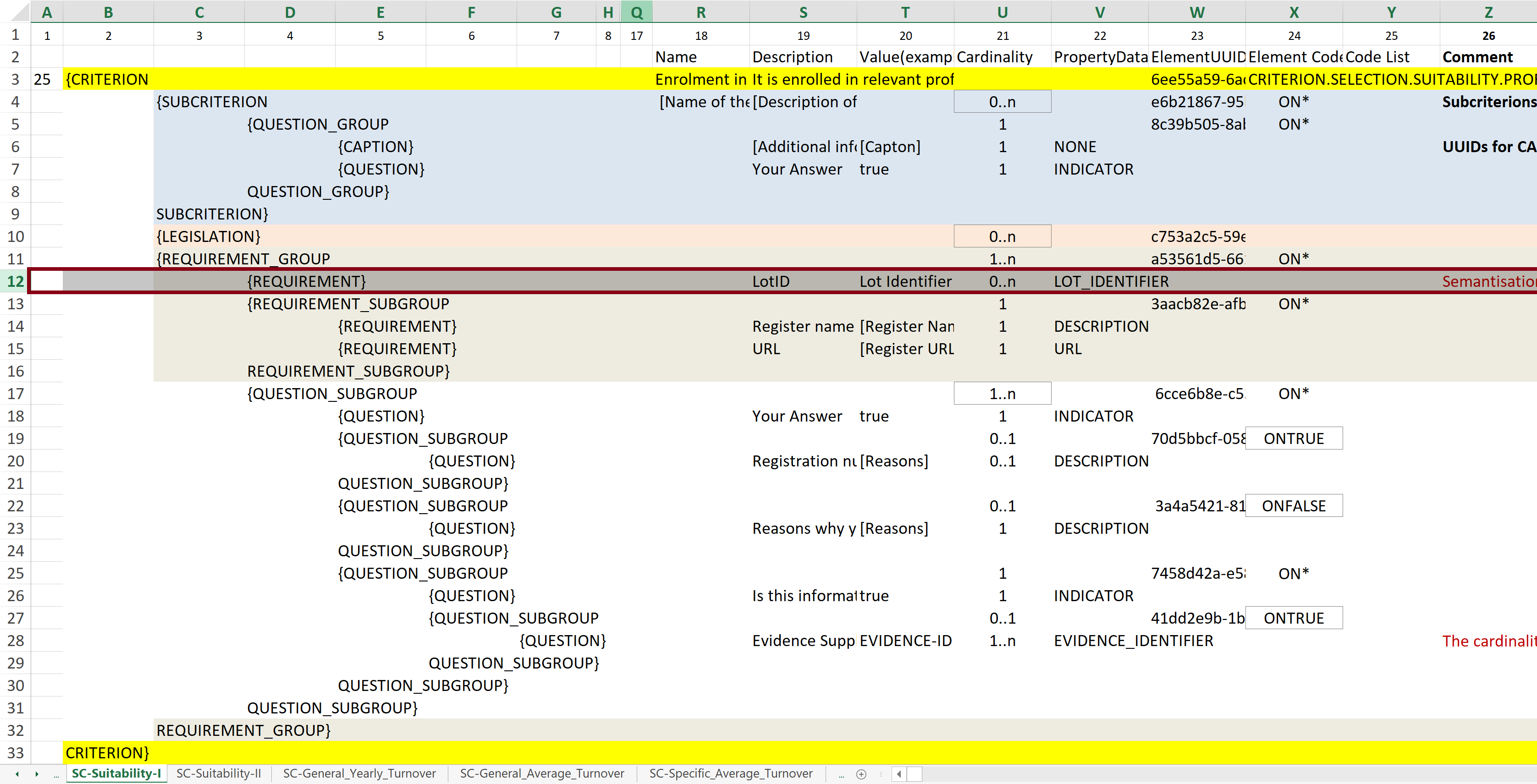
The fragment of XML code shows how this list of lot identifiers ends up implemented as multiple REQUIREMENTs.
    <!-- Lot1 is affected by the REQUIREMENT(s)  -->
    <cac:TenderingCriterionProperty>
        <cbc:ID schemeID="CriteriaTaxonomy" schemeAgencyID="EU-COM-GROW" schemeVersionID="2.1.1">47d211d9-e933-4d93-b4d7-f45d46a6e83e</cbc:ID>
        <cbc:Description>Lot ID</cbc:Description>
        <cbc:TypeCode listID="CriterionElementType" listAgencyID="EU-COM-GROW" listVersionID="2.1.1">REQUIREMENT</cbc:TypeCode>
        <cbc:ValueDataTypeCode listID="ResponseDataType" listAgencyID="EU-COM-GROW" listVersionID="2.1.1">LOT_IDENTIFIER</cbc:ValueDataTypeCode>
        <cbc:ExpectedID schemeAgencyID="EU-COM-GROW">Lot1</cbc:ExpectedID>
    </cac:TenderingCriterionProperty>
    <!-- Lot2 is affected by the REQUIREMENT(s)  -->
    <cac:TenderingCriterionProperty>
        <cbc:ID schemeID="CriteriaTaxonomy" schemeAgencyID="EU-COM-GROW" schemeVersionID="2.1.1">47d211d9-e933-4d93-b4d7-f45d46a6e83e</cbc:ID>
        <cbc:Description>LotIDs</cbc:Description>
        <cbc:TypeCode listID="CriterionElementType" listAgencyID="EU-COM-GROW" listVersionID="2.1.1">REQUIREMENT</cbc:TypeCode>
        <cbc:ValueDataTypeCode listID="ResponseDataType" listAgencyID="EU-COM-GROW" listVersionID="2.1.1">LOT_IDENTIFIER</cbc:ValueDataTypeCode>
        <cbc:ExpectedID schemeAgencyID="EU-COM-GROW">Lot2</cbc:ExpectedID>
    </cac:TenderingCriterionProperty>
    <!-- Lot4 is affected by the REQUIREMENT(s)  -->
    <cac:TenderingCriterionProperty>
        <cbc:ID schemeID="CriteriaTaxonomy" schemeAgencyID="EU-COM-GROW" schemeVersionID="2.1.1">6f7c51c2-c2ac-47f2-9c7d-af9be815404a</cbc:ID>
        <cbc:Description>LotIDs</cbc:Description>
        <cbc:TypeCode listID="CriterionElementType" listAgencyID="EU-COM-GROW" listVersionID="2.1.1">REQUIREMENT</cbc:TypeCode>
        <cbc:ValueDataTypeCode listID="ResponseDataType" listAgencyID="EU-COM-GROW" listVersionID="2.1.1">LOT_IDENTIFIER</cbc:ValueDataTypeCode>
        <cbc:ExpectedID schemeAgencyID="EU-COM-GROW">Lot4</cbc:ExpectedID>
    </cac:TenderingCriterionProperty>
    <!-- Lot5 is affected by the REQUIREMENT(s)  -->
    <cac:TenderingCriterionProperty>
        <cbc:ID schemeID="CriteriaTaxonomy" schemeAgencyID="EU-COM-GROW" schemeVersionID="2.1.1">69433c3f-0277-4a8d-a41e-3aeb8ac6257a</cbc:ID>
        <cbc:Description>LotIDs</cbc:Description>
        <cbc:TypeCode listID="CriterionElementType" listAgencyID="EU-COM-GROW" listVersionID="2.1.1">REQUIREMENT</cbc:TypeCode>
        <cbc:ValueDataTypeCode listID="ResponseDataType" listAgencyID="EU-COM-GROW" listVersionID="2.1.1">LOT_IDENTIFIER</cbc:ValueDataTypeCode>
        <cbc:ExpectedID schemeAgencyID="EU-COM-GROW">Lot5</cbc:ExpectedID>
    </cac:TenderingCriterionProperty>
This issue is currently being discussed in the UBL-2.3 TC and a solution will be soon provided. Once solved, the sequence of 5 properties below would be reduced to only one (of type REQUIREMENT):
IX.2 All about weights
The Extended ESPD caters for two methods of evaluating criteria (the Basic ESP does not covers this aspect). These two methods are identified in the code list EvaluationMethodType as 1) PASSFAIL (Pass or fail), and 2) WEIGHTED (the criterion is assigned a weight).
The ''pass or fail'' method is used in open procedures and in the first stage of multi-staged procedures. In multi-staged procedures, once the list of candidates meeting the criteria have been selected, it makes sense to evaluate their tenders based on weighted selection criteria.
Hence the following general rule should be applied by software applications dealing with the ESPD-EDM:
-
If the procedure is open 1) no reduction of candidates is possible, and 2) criteria will not be weighted (the value of the element cbc:EvaluationMethodTypeCode is to be set to
PASSFAIL); -
Otherwise 1) the contracting authority should have the possibility of specifying the criteria and rules to be applied in order to limit the number of candidates, and 2) it should have the possibility of assigning a weight to any selection criterion (the value of the element cbc:EvaluationMethodTypeCode is to be set to
WEIGHTED);
Information requirement check-list
-
Only in Extended ESPD-Request and ESDP-Response documents
-
Only in multi-staged procedures
-
The need for weighting was identified only for these Selection criteria (although the data model caters for weighing any criterion):
-
Abilities I (Persons)
-
Criterion #40 - Technicians or technical bodies for quality control
-
Criterion #41 - For works contracts: technicians or technical bodies to carry out the work
-
-
Abilities II (Facilities, etc.)
-
Criterion #42 - Technical facilities and measures for ensuring quality
-
Criterion #43 - Study and research facilities
-
Criterion #44 - Supply chain management
-
Criterion #45 - Environmental management measures
-
Criterion #46 - Tools, plant or technical equipment
-
-
Abilities III (Education)
-
Criterion #47 - Educational and professional qualifications
-
-
|
A complete ESPD-Response document with the examples provided in this section can be found in the file Weights-Extended-Request_V2.1.1.xml |
Nº |
Data Element |
Description |
Location |
Rules |
1 |
The weighting methodology |
Method that will be used to select those selection criteria that will be weighted (used for transparency purposes) |
Element |
The economic operators should be informed in detail about how the selection will be performed |
2 |
The numeric weighting type |
The expression method for the weighting of the selection criteria (numeric, percentage). |
Element |
The numeric can also be used to express percentages (in the form of ''0.x''). See also the code list EvaluationMethodType |
3 |
The criterion weight value |
The concrete value assigned by the CA to the criterion for its weighting at evaluation time (e.g. 10%) |
Element |
None |
4 |
The criterion evaluation method type |
To inform that the criterion will be weighted (WEIGHTED vs PASSFAIL). See code list EvaluationMethodType |
Element |
The weight is used in second (or subsequent) stages of the evaluation. The first stage is always a PASSFAIL selection, even if the code WEIGHTED is assigned to this element |
5 |
Criterion-specific evaluation approach |
Explanation about how this specific criterion is weighted and will be evaluated (for transparency purposes) |
Element |
|
6 |
REQUIREMENT(s) in the criterion |
Criteria that are weighted carry a specific REQUIREMENT stating that ''This criterion will be weighted'' |
Elements |
BEWARE that the REQUIREMENT ''This criterion will be weighted'' is redundant with the element
|
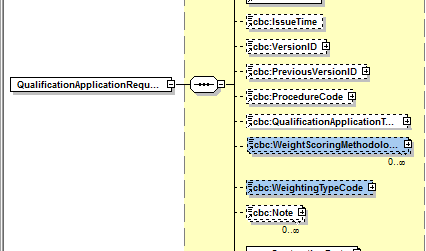
The figure below shows elements 1 and 2 in the UBL-2.2 XSD Schema:
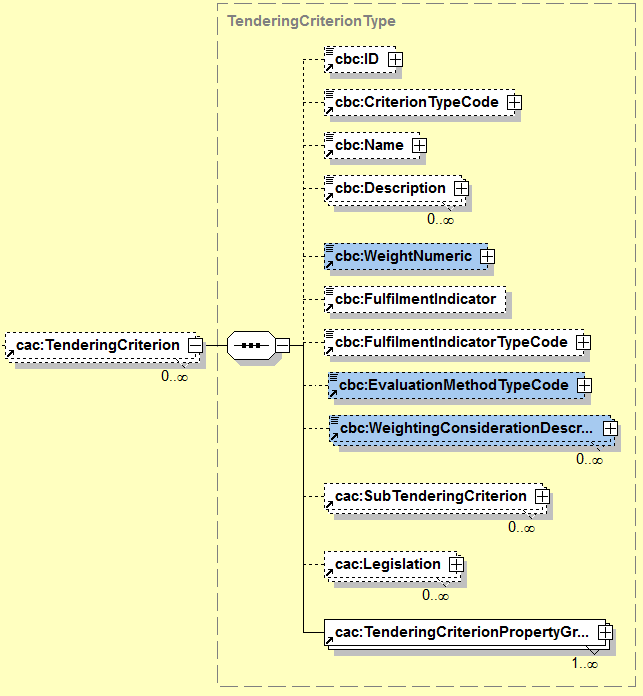
This other figure shows the elements inside the class Criterion:
Mock-up - contracting authority perspective
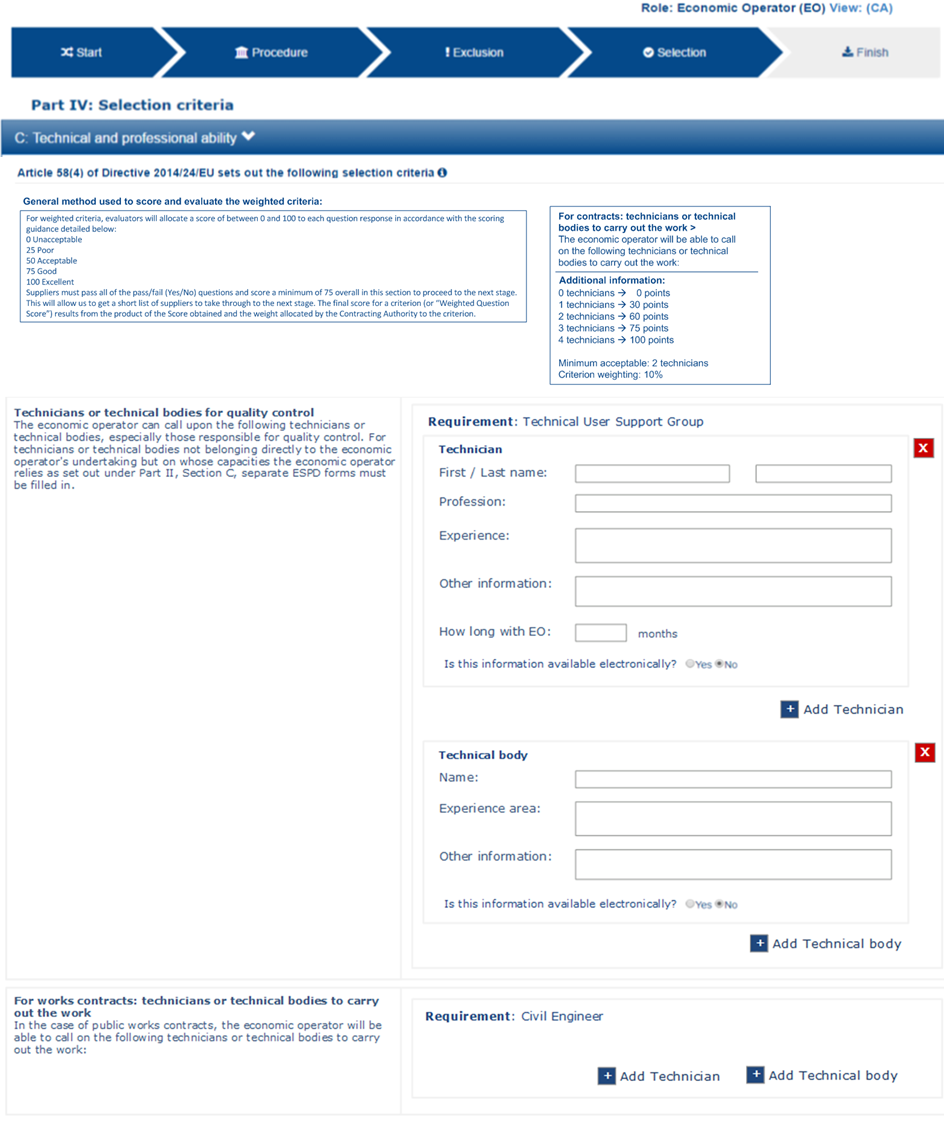
The mock-up below illustrates how the contracting authority may specify weighted criteria.
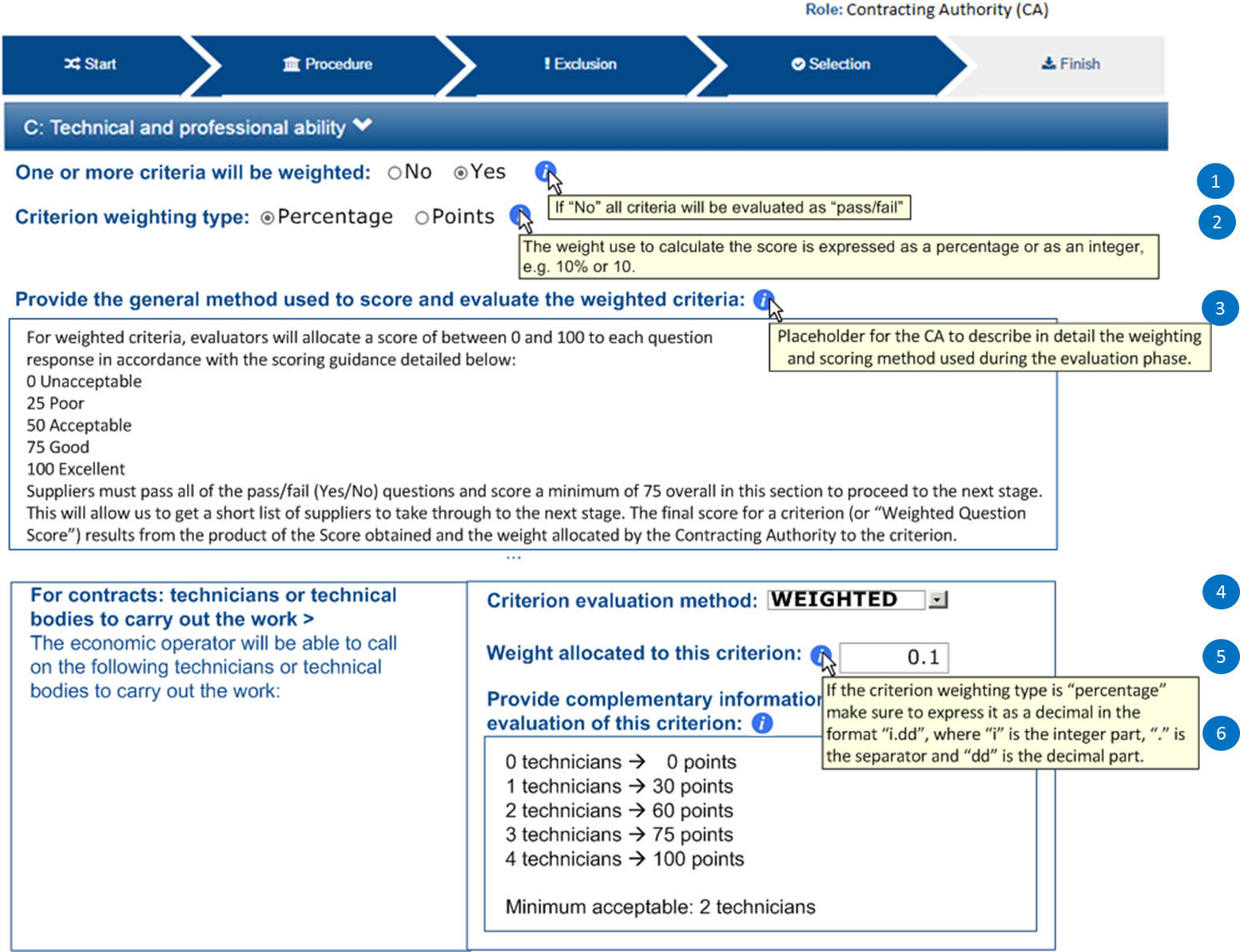
Notice that:
-
The field ''One or more criteria will be weighted'' is not stored in the data model;
-
The field ''Criterion weighting type'' is generic to all the criteria and is placed in the element
cbc:WeightingTypeCode(element #2 in the table above); -
The field ''Provide the general method used to score and evaluate the weighted criteria" is hold in the element
cbc:WeightScoringMethodologyNote; and is also generic for all the weighted criteria (element #1 in the table above); -
The CA has chosen ''WEIGHTED'' as the value for the combo box labeled 'Criterion evaluation method' and for the specific criterion ''For contracts: technicians or technical bodies to carry out the work'' (element #4 in the table above);
-
The weight assigned by the contracting authority (CA) to this criterion is
0.1. This value will be placed in the the elementcbc:WeightNumeric(element #3 in the table above); -
The additional information about how this specific criterion will be evaluated will be place in the element
cbc:WeightingConsiderationDescription(element #5 in the table above).
Mock-up - economic operator perspective
This mock-up illustrates how all the information specified by the contracting authority (CA), concerning 1) the generic information about weights, and 2) the information specific of the criterion may be presented to the economic operator (EO):
Criterion data structure
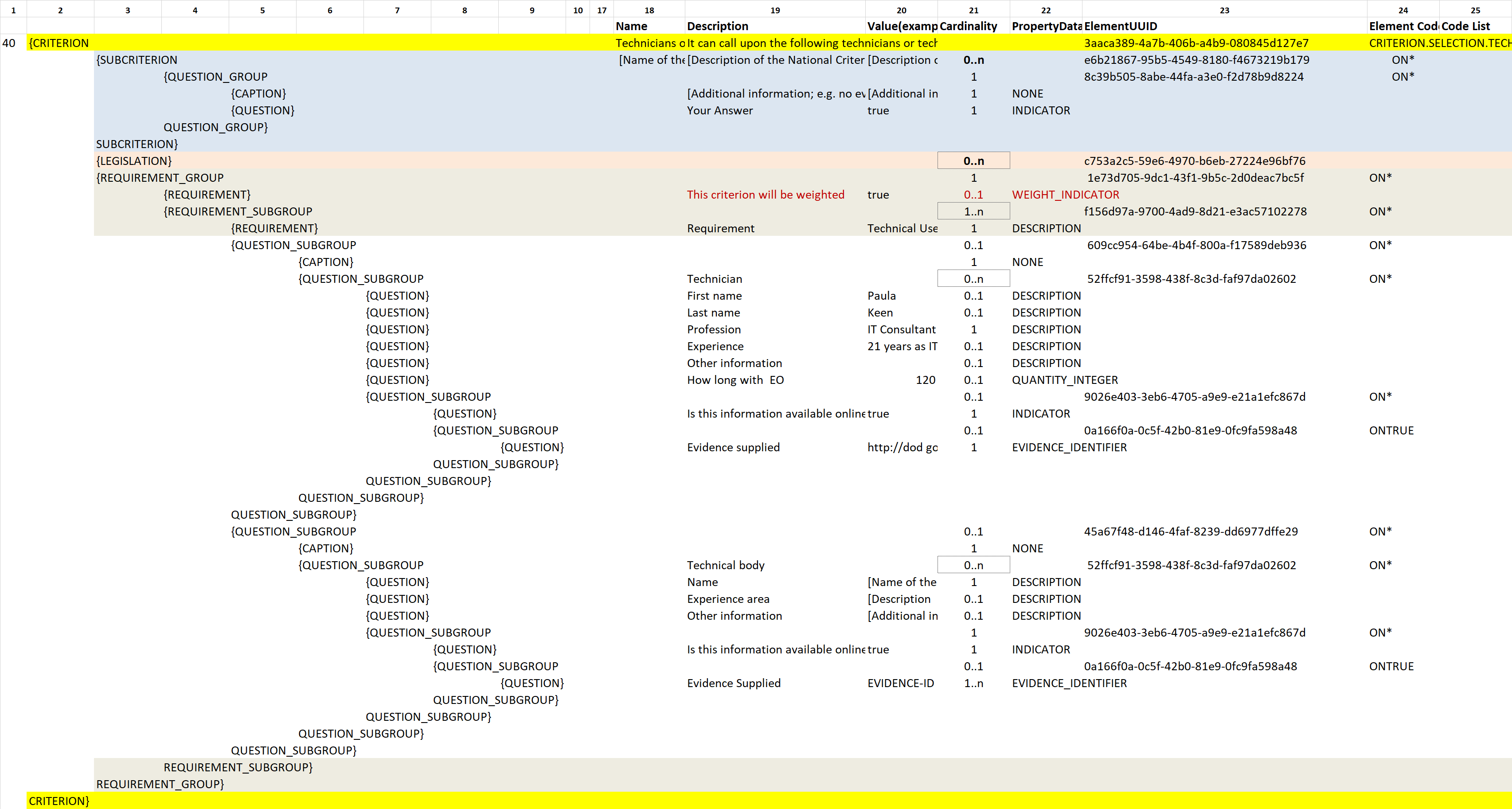
The following data structure represents the structure of one of the selection criteria that may be weighted in multi-stage procedures (''Technicians or technical bodies for quality control'').
Beware that:
-
The fact that the criterion will be weighted is indicated by the REQUIREMENT ''This criterion will be weighted'';
-
This REQUIREMENT can be replaced by a CAPTION
-
The purpose of this REQUIREMENT can be fulfilled using the element
cbc:EvaluationMethodTypeCode
XML example
The fragment of XML code below illustrates how the elements related to the weighting are specified in an Extended ESPD Request document.
|
Many compulsory elements and attributes of the XML example below that are not related to the subject covered in this section have been removed to gain clarity and brevity. For complete XML samples download the files under folder dist/xml. |
<?xml version="1.0" encoding="UTF-8" standalone="yes"?>
<QualificationApplicationRequest xmlns="urn:oasis:names:specification:ubl:schema:xsd:QualificationApplicationRequest-2"
xmlns:ext="urn:oasis:names:specification:ubl:schema:xsd:CommonExtensionComponents-2"
xmlns:cac="urn:oasis:names:specification:ubl:schema:xsd:CommonAggregateComponents-2"
xmlns:cbc="urn:oasis:names:specification:ubl:schema:xsd:CommonBasicComponents-2" >
<!-- Some root elements remove for brevity -->
<cbc:ID schemeID="ISO/IEC 9834-8:2008 - 4UUID" schemeAgencyID="EU-COM-GROW" schemeAgencyName="DG GROW (European Commission)" schemeVersionID="1.1">576ae724-f8e8-4b51-ae9c-2c2f4c90f433</cbc:ID>
<cbc:ContractFolderID schemeAgencyID="TeD">__ProcurementProcedureFileRefNumber</cbc:ContractFolderID>
<cbc:IssueDate>2019-01-23</cbc:IssueDate>
<cbc:ProcedureCode listID="ProcedureType" listAgencyID="EU-COM-OP" listVersionID="1.0">OPEN</cbc:ProcedureCode>
<cbc:QualificationApplicationTypeCode listID="QualificationApplicationType" listAgencyID="EU-COM-GROW" listVersionID="2.1.1">Extended</cbc:QualificationApplicationTypeCode>

<!--
    *DATA ELEMENTS #1 and #2!* General information about all the weighted selection criteria.
-->
<cbc:WeightScoringMethodologyNote>For weighted criteria, evaluators will allocate a score between 0 and 100 to each question reponse in accordance with the scoring guidance below:</cbc:WeightScoringMethodologyNote>(3)
<cbc:WeightScoringMethodologyNote>0 Unnaceptable</cbc:WeightScoringMethodologyNote>
<cbc:WeightScoringMethodologyNote>25 Poor</cbc:WeightScoringMethodologyNote>
<cbc:WeightScoringMethodologyNote>50 Acceptable</cbc:WeightScoringMethodologyNote>
<cbc:WeightScoringMethodologyNote>75 Good</cbc:WeightScoringMethodologyNote>
<cbc:WeightScoringMethodologyNote>100 Excellent</cbc:WeightScoringMethodologyNote>
<cbc:WeightScoringMethodologyNote>Suppliers must pass all of the pass/fail (Yes/No) questions and score a minimum of 75 overall in this section to proceed to the next stage. This will allows us to get a short list of suppliers to take through to the next stage. The final score for a criterion (or "Weighted Question Score") results from the product of the Score obtained and the weight allocated by the Contracting Authority to the criterion.</cbc:WeightScoringMethodologyNote>
<cbc:WeightingTypeCode listID="WeightingType" listAgencyID="EU-COM-GROW" listVersionID="2.1.1">PERCENTAGE</cbc:WeightingTypeCode>(2)

<!-- Data About the CA -->
<cac:ContractingParty>
    <cac:Party><!-- elements removed for brevity --></cac:Party>
</cac:ContractingParty>
<!-- Data About the Procedure -->
<cac:ProcurementProject><!-- elements removed for brevity --></cac:ProcurementProject>
<!-- Procedure divided into three Lots. Not relevant for this example about weighting. -->
<cac:ProcurementProjectLot>
    <cbc:ID schemeAgencyID="EU-COM-GROW">Lot1</cbc:ID>
</cac:ProcurementProjectLot>
<cac:ProcurementProjectLot>
    <cbc:ID schemeAgencyID="EU-COM-GROW">Lot2</cbc:ID>
</cac:ProcurementProjectLot>
<cac:ProcurementProjectLot>
    <cbc:ID schemeAgencyID="EU-COM-GROW">Lot3</cbc:ID>
</cac:ProcurementProjectLot>
<!-- Requirements about Lots addressed to EOs. Not relevant for this example about weighting. See other examples with lots. -->
<cac:TenderingCriterion><!-- elements removed for brevity --></cac:TenderingCriterion>

<!--
        *THE REST OF THE DATA ELEMENTS RELATED TO WEIGHTING (elements #3 to #5 in the table above)
        GO INSIDE THE CRITERIA THAT ARE WEIGHTED. E.g. Selection Criteria about ''Abilities I (Persons),
        II (Facilities, etc.) and 'III (Education)': Technicians or technical bodies for quality control,
        For works contracts: technicians or technical bodies to carry out the work, Technical facilities and
        measures for ensuring quality, Study and research facilities, Supply chain management, Environmental
        management measures, Tools, plant or technical equipment, and Educational and professional qualifications.
 -->
<cac:TenderingCriterion>
<cbc:ID schemeID="CriteriaTaxonomy" schemeAgencyID="EU-COM-GROW" schemeVersionID="2.1.1">3aaca389-4a7b-406b-a4b9-080845d127e7</cbc:ID>
<cbc:CriterionTypeCode listID="CriteriaTypeCode" listAgencyID="EU-COM-GROW" listVersionID="2.1.1">CRITERION.SELECTION.TECHNICAL_PROFESSIONAL_ABILITY.TECHNICAL.TECHNICIANS_FOR_QUALITY_CONTROL</cbc:CriterionTypeCode>
<cbc:Name>Technicians or technical bodies for quality control</cbc:Name>
<cbc:Description>It can call upon the following technicians or technical bodies, especially those responsible for quality control. For technicians or technical bodies not belonging directly to the economic operator's undertaking but on whose capacities the economic operator relies as set out under Part II, Section C, separate ESPD forms must be filled in.</cbc:Description>
<cbc:WeightNumeric>0.1</cbc:WeightNumeric>(5)
<cbc:EvaluationMethodTypeCode listID="EvaluationMethodType" listAgencyID="EU-COM-GROW" listVersionID="2.1.1">WEIGHTED</cbc:EvaluationMethodTypeCode>(4)
<cbc:WeightingConsiderationDescription>0 technicians ->   0 points</cbc:WeightingConsiderationDescription>(6)
<cbc:WeightingConsiderationDescription>1 technician ->   30 points</cbc:WeightingConsiderationDescription>(6)
<cbc:WeightingConsiderationDescription>2 technicians ->  60 points</cbc:WeightingConsiderationDescription>(6)
<cbc:WeightingConsiderationDescription>3 technicians ->  75 points</cbc:WeightingConsiderationDescription>(6)
<cbc:WeightingConsiderationDescription>4 technicians -> 100 points</cbc:WeightingConsiderationDescription>(6)
<cbc:WeightingConsiderationDescription>Minimum acceptable: 2 technicians</cbc:WeightingConsiderationDescription>(6)
<cac:Legislation>
    <cbc:Title>Public Procurement Directive 2014/24/EU</cbc:Title>
    <cbc:Description>Directive 2014/24/EU of the European Parliament and of the Council of 26 February 2014 on public procurement and repealing Directive 2004/18/EC</cbc:Description>
    <cbc:JurisdictionLevel>eu</cbc:JurisdictionLevel>
    <cbc:Article>Article 58(4)</cbc:Article>
    <cbc:URI>http://eur-lex.europa.eu/legal-content/EN/TXT/?uri=uriserv:OJ.L_.2014.094.01.0065.01.ENG</cbc:URI>
</cac:Legislation>
<cac:TenderingCriterionPropertyGroup>
    <cbc:ID schemeAgencyID="EU-COM-GROW" schemeVersionID="2.1.1">1e73d705-9dc1-43f1-9b5c-2d0deac7bc5f</cbc:ID>
    <cbc:PropertyGroupTypeCode listID="PropertyGroupType" listAgencyID="EU-COM-GROW" listVersionID="2.1.1">ON*</cbc:PropertyGroupTypeCode>
    <cac:TenderingCriterionProperty>
        <cbc:ID schemeID="CriteriaTaxonomy" schemeAgencyID="EU-COM-GROW" schemeVersionID="2.1.1">2a7dcb2a-dc10-4c30-bece-66dfd0a8bc6b</cbc:ID>
        <!--
            NOTICE that this is a CAPTION, not a REQUIREMENT (as suggested in the Criteria Taxonomy). The fact that the criterion is weighted is
            already stated in the data element `cbc:EvaluationMethodTypeCode`, above. The text ''This criterion will be weighted'' could thus
            be ''calculated'' (i.e. automatically provided in the ESPD-Request, by the software application based on the value placed in the
            element `cbc:EvaluationMethodTypeCode`.
        -->
        <cbc:Description>This criterion will be weighted</cbc:Description>(1)
        <cbc:TypeCode listID="CriterionElementType" listAgencyID="EU-COM-GROW" listVersionID="2.1.1">CAPTION</cbc:TypeCode>
        <!-- The type of value provided by the CA is `NONE`, as this is a CAPTION, not a REQUIREMENT. -->
        <cbc:ValueDataTypeCode listID="ResponseDataType" listAgencyID="EU-COM-GROW" listVersionID="2.1.1">NONE</cbc:ValueDataTypeCode>
    </cac:TenderingCriterionProperty>

    <!-- THE REST OF THE CRITERION DOES NOT REFER ANYMORE TO ANY DATA ELEMENT RELATED TO ITS WEIGHTING. -->

    <cac:SubsidiaryTenderingCriterionPropertyGroup>
        <cbc:ID schemeAgencyID="EU-COM-GROW" schemeVersionID="2.1.1">f156d97a-9700-4ad9-8d21-e3ac57102278</cbc:ID>
        <cbc:PropertyGroupTypeCode listID="PropertyGroupType" listAgencyID="EU-COM-GROW" listVersionID="2.1.1">ON*</cbc:PropertyGroupTypeCode>
        <cac:TenderingCriterionProperty>
            <cbc:ID schemeID="CriteriaTaxonomy" schemeAgencyID="EU-COM-GROW" schemeVersionID="2.1.1">d1936fa0-4a8a-4016-8349-9e389c80fff4</cbc:ID>
            <cbc:Description>Requirement</cbc:Description>
            <cbc:TypeCode listID="CriterionElementType" listAgencyID="EU-COM-GROW" listVersionID="2.1.1">REQUIREMENT</cbc:TypeCode>
            <cbc:ValueDataTypeCode listID="ResponseDataType" listAgencyID="EU-COM-GROW" listVersionID="2.1.1">DESCRIPTION</cbc:ValueDataTypeCode>
            <cbc:ExpectedDescription>__TechniciansRequirement</cbc:ExpectedDescription>
        </cac:TenderingCriterionProperty>
        <cac:SubsidiaryTenderingCriterionPropertyGroup>
            <cbc:ID schemeAgencyID="EU-COM-GROW" schemeVersionID="2.1.1">609cc954-64be-4b4f-800a-f17589deb936</cbc:ID>
            <cbc:PropertyGroupTypeCode listID="PropertyGroupType" listAgencyID="EU-COM-GROW" listVersionID="2.1.1">ON*</cbc:PropertyGroupTypeCode>
            <cac:TenderingCriterionProperty>
                <cbc:ID schemeID="CriteriaTaxonomy" schemeAgencyID="EU-COM-GROW" schemeVersionID="2.1.1">5b878bbe-b575-43e4-a40c-6bf3ede91641</cbc:ID>
                <cbc:Description> </cbc:Description>
                <cbc:TypeCode listID="CriterionElementType" listAgencyID="EU-COM-GROW" listVersionID="2.1.1">CAPTION</cbc:TypeCode>
                <cbc:ValueDataTypeCode listID="ResponseDataType" listAgencyID="EU-COM-GROW" listVersionID="2.1.1">NONE</cbc:ValueDataTypeCode>
            </cac:TenderingCriterionProperty>
            <cac:SubsidiaryTenderingCriterionPropertyGroup>
                <cbc:ID schemeAgencyID="EU-COM-GROW" schemeVersionID="2.1.1">52ffcf91-3598-438f-8c3d-faf97da02602</cbc:ID>
                <cbc:PropertyGroupTypeCode listID="PropertyGroupType" listAgencyID="EU-COM-GROW" listVersionID="2.1.1">ON*</cbc:PropertyGroupTypeCode>
                <cac:TenderingCriterionProperty>
                    <cbc:ID schemeID="CriteriaTaxonomy" schemeAgencyID="EU-COM-GROW" schemeVersionID="2.1.1">acf762a6-0087-4ad3-9f95-a8b624be81b0</cbc:ID>
                    <cbc:Description>First name</cbc:Description>
                    <cbc:TypeCode listID="CriterionElementType" listAgencyID="EU-COM-GROW" listVersionID="2.1.1">QUESTION</cbc:TypeCode>
                    <cbc:ValueDataTypeCode listID="ResponseDataType" listAgencyID="EU-COM-GROW" listVersionID="2.1.1">DESCRIPTION</cbc:ValueDataTypeCode>
                </cac:TenderingCriterionProperty>
                <cac:TenderingCriterionProperty>
                    <cbc:ID schemeID="CriteriaTaxonomy" schemeAgencyID="EU-COM-GROW" schemeVersionID="2.1.1">3b4b838b-1c41-42a3-a21b-a1cac72d2971</cbc:ID>
                    <cbc:Description>Last name</cbc:Description>
                    <cbc:TypeCode listID="CriterionElementType" listAgencyID="EU-COM-GROW" listVersionID="2.1.1">QUESTION</cbc:TypeCode>
                    <cbc:ValueDataTypeCode listID="ResponseDataType" listAgencyID="EU-COM-GROW" listVersionID="2.1.1">DESCRIPTION</cbc:ValueDataTypeCode>
                </cac:TenderingCriterionProperty>
                <cac:TenderingCriterionProperty>
                    <cbc:ID schemeID="CriteriaTaxonomy" schemeAgencyID="EU-COM-GROW" schemeVersionID="2.1.1">95912db9-df33-44b1-97fd-63f5e0202d84</cbc:ID>
                    <cbc:Description>Profession</cbc:Description>
                    <cbc:TypeCode listID="CriterionElementType" listAgencyID="EU-COM-GROW" listVersionID="2.1.1">QUESTION</cbc:TypeCode>
                    <cbc:ValueDataTypeCode listID="ResponseDataType" listAgencyID="EU-COM-GROW" listVersionID="2.1.1">DESCRIPTION</cbc:ValueDataTypeCode>
                </cac:TenderingCriterionProperty>
                <cac:TenderingCriterionProperty>
                    <cbc:ID schemeID="CriteriaTaxonomy" schemeAgencyID="EU-COM-GROW" schemeVersionID="2.1.1">9ddd05be-6194-4ad8-9f68-7ac549dff64e</cbc:ID>
                    <cbc:Description>Experience</cbc:Description>
                    <cbc:TypeCode listID="CriterionElementType" listAgencyID="EU-COM-GROW" listVersionID="2.1.1">QUESTION</cbc:TypeCode>
                    <cbc:ValueDataTypeCode listID="ResponseDataType" listAgencyID="EU-COM-GROW" listVersionID="2.1.1">DESCRIPTION</cbc:ValueDataTypeCode>
                </cac:TenderingCriterionProperty>
                <cac:TenderingCriterionProperty>
                    <cbc:ID schemeID="CriteriaTaxonomy" schemeAgencyID="EU-COM-GROW" schemeVersionID="2.1.1">f4351f24-d1f7-4039-893c-e2947ba3afac</cbc:ID>
                    <cbc:Description>Other information</cbc:Description>
                    <cbc:TypeCode listID="CriterionElementType" listAgencyID="EU-COM-GROW" listVersionID="2.1.1">QUESTION</cbc:TypeCode>
                    <cbc:ValueDataTypeCode listID="ResponseDataType" listAgencyID="EU-COM-GROW" listVersionID="2.1.1">DESCRIPTION</cbc:ValueDataTypeCode>
                </cac:TenderingCriterionProperty>
                <cac:TenderingCriterionProperty>
                    <cbc:ID schemeID="CriteriaTaxonomy" schemeAgencyID="EU-COM-GROW" schemeVersionID="2.1.1">7a348140-4d0c-421b-8142-2053835272a3</cbc:ID>
                    <cbc:Description>How long with  EO</cbc:Description>
                    <cbc:TypeCode listID="CriterionElementType" listAgencyID="EU-COM-GROW" listVersionID="2.1.1">QUESTION</cbc:TypeCode>
                    <cbc:ValueDataTypeCode listID="ResponseDataType" listAgencyID="EU-COM-GROW" listVersionID="2.1.1">QUANTITY_INTEGER</cbc:ValueDataTypeCode>
                </cac:TenderingCriterionProperty>
                <cac:SubsidiaryTenderingCriterionPropertyGroup>
                    <cbc:ID schemeAgencyID="EU-COM-GROW" schemeVersionID="2.1.1">9026e403-3eb6-4705-a9e9-e21a1efc867d</cbc:ID>
                    <cbc:PropertyGroupTypeCode listID="PropertyGroupType" listAgencyID="EU-COM-GROW" listVersionID="2.1.1">ON*</cbc:PropertyGroupTypeCode>
                    <cac:TenderingCriterionProperty>
                        <cbc:ID schemeID="CriteriaTaxonomy" schemeAgencyID="EU-COM-GROW" schemeVersionID="2.1.1">0de6079a-3f13-4391-a8a6-1b4b350f8b2f</cbc:ID>
                        <cbc:Description>Is this information available online?</cbc:Description>
                        <cbc:TypeCode listID="CriterionElementType" listAgencyID="EU-COM-GROW" listVersionID="2.1.1">QUESTION</cbc:TypeCode>
                        <cbc:ValueDataTypeCode listID="ResponseDataType" listAgencyID="EU-COM-GROW" listVersionID="2.1.1">INDICATOR</cbc:ValueDataTypeCode>
                    </cac:TenderingCriterionProperty>
                    <cac:SubsidiaryTenderingCriterionPropertyGroup>
                        <cbc:ID schemeAgencyID="EU-COM-GROW" schemeVersionID="2.1.1">0a166f0a-0c5f-42b0-81e9-0fc9fa598a48</cbc:ID>
                        <cbc:PropertyGroupTypeCode listID="PropertyGroupType" listAgencyID="EU-COM-GROW" listVersionID="2.1.1">ONTRUE</cbc:PropertyGroupTypeCode>
                        <cac:TenderingCriterionProperty>
                            <cbc:ID schemeID="CriteriaTaxonomy" schemeAgencyID="EU-COM-GROW" schemeVersionID="2.1.1">c4d4dec1-ea76-4d1c-bcf2-2d4f265982fb</cbc:ID>
                            <cbc:Description>Evidence supplied</cbc:Description>
                            <cbc:TypeCode listID="CriterionElementType" listAgencyID="EU-COM-GROW" listVersionID="2.1.1">QUESTION</cbc:TypeCode>
                            <cbc:ValueDataTypeCode listID="ResponseDataType" listAgencyID="EU-COM-GROW" listVersionID="2.1.1">EVIDENCE_IDENTIFIER</cbc:ValueDataTypeCode>
                        </cac:TenderingCriterionProperty>
                    </cac:SubsidiaryTenderingCriterionPropertyGroup>
                </cac:SubsidiaryTenderingCriterionPropertyGroup>
            </cac:SubsidiaryTenderingCriterionPropertyGroup>
        </cac:SubsidiaryTenderingCriterionPropertyGroup>
        <cac:SubsidiaryTenderingCriterionPropertyGroup>
            <cbc:ID schemeAgencyID="EU-COM-GROW" schemeVersionID="2.1.1">45a67f48-d146-4faf-8239-dd6977dffe29</cbc:ID>
            <cbc:PropertyGroupTypeCode listID="PropertyGroupType" listAgencyID="EU-COM-GROW" listVersionID="2.1.1">ON*</cbc:PropertyGroupTypeCode>
            <cac:TenderingCriterionProperty>
                <cbc:ID schemeID="CriteriaTaxonomy" schemeAgencyID="EU-COM-GROW" schemeVersionID="2.1.1">c1806c05-3589-4af4-9bea-7061b30e3f4f</cbc:ID>
                <cbc:Description> </cbc:Description>
                <cbc:TypeCode listID="CriterionElementType" listAgencyID="EU-COM-GROW" listVersionID="2.1.1">CAPTION</cbc:TypeCode>
                <cbc:ValueDataTypeCode listID="ResponseDataType" listAgencyID="EU-COM-GROW" listVersionID="2.1.1">NONE</cbc:ValueDataTypeCode>
            </cac:TenderingCriterionProperty>
            <cac:SubsidiaryTenderingCriterionPropertyGroup>
                <cbc:ID schemeAgencyID="EU-COM-GROW" schemeVersionID="2.1.1">52ffcf91-3598-438f-8c3d-faf97da02602</cbc:ID>
                <cbc:PropertyGroupTypeCode listID="PropertyGroupType" listAgencyID="EU-COM-GROW" listVersionID="2.1.1">ON*</cbc:PropertyGroupTypeCode>
                <cac:TenderingCriterionProperty>
                    <cbc:ID schemeID="CriteriaTaxonomy" schemeAgencyID="EU-COM-GROW" schemeVersionID="2.1.1">1d07b02b-cfce-4143-8743-79943b6265a0</cbc:ID>
                    <cbc:Description>Name</cbc:Description>
                    <cbc:TypeCode listID="CriterionElementType" listAgencyID="EU-COM-GROW" listVersionID="2.1.1">QUESTION</cbc:TypeCode>
                    <cbc:ValueDataTypeCode listID="ResponseDataType" listAgencyID="EU-COM-GROW" listVersionID="2.1.1">DESCRIPTION</cbc:ValueDataTypeCode>
                </cac:TenderingCriterionProperty>
                <cac:TenderingCriterionProperty>
                    <cbc:ID schemeID="CriteriaTaxonomy" schemeAgencyID="EU-COM-GROW" schemeVersionID="2.1.1">ef2281fc-3505-4d3b-9fbc-e7655e534b28</cbc:ID>
                    <cbc:Description>Experience area</cbc:Description>
                    <cbc:TypeCode listID="CriterionElementType" listAgencyID="EU-COM-GROW" listVersionID="2.1.1">QUESTION</cbc:TypeCode>
                    <cbc:ValueDataTypeCode listID="ResponseDataType" listAgencyID="EU-COM-GROW" listVersionID="2.1.1">DESCRIPTION</cbc:ValueDataTypeCode>
                </cac:TenderingCriterionProperty>
                <cac:TenderingCriterionProperty>
                    <cbc:ID schemeID="CriteriaTaxonomy" schemeAgencyID="EU-COM-GROW" schemeVersionID="2.1.1">9e8f3516-50fa-45d3-83cd-fa005705d4fa</cbc:ID>
                    <cbc:Description>Other information</cbc:Description>
                    <cbc:TypeCode listID="CriterionElementType" listAgencyID="EU-COM-GROW" listVersionID="2.1.1">QUESTION</cbc:TypeCode>
                    <cbc:ValueDataTypeCode listID="ResponseDataType" listAgencyID="EU-COM-GROW" listVersionID="2.1.1">DESCRIPTION</cbc:ValueDataTypeCode>
                </cac:TenderingCriterionProperty>
                <cac:SubsidiaryTenderingCriterionPropertyGroup>
                    <cbc:ID schemeAgencyID="EU-COM-GROW" schemeVersionID="2.1.1">9026e403-3eb6-4705-a9e9-e21a1efc867d</cbc:ID>
                    <cbc:PropertyGroupTypeCode listID="PropertyGroupType" listAgencyID="EU-COM-GROW" listVersionID="2.1.1">ON*</cbc:PropertyGroupTypeCode>
                    <cac:TenderingCriterionProperty>
                        <cbc:ID schemeID="CriteriaTaxonomy" schemeAgencyID="EU-COM-GROW" schemeVersionID="2.1.1">89ae7f89-e17c-492c-a529-d137d7a5e22d</cbc:ID>
                        <cbc:Description>Is this information available online?</cbc:Description>
                        <cbc:TypeCode listID="CriterionElementType" listAgencyID="EU-COM-GROW" listVersionID="2.1.1">QUESTION</cbc:TypeCode>
                        <cbc:ValueDataTypeCode listID="ResponseDataType" listAgencyID="EU-COM-GROW" listVersionID="2.1.1">INDICATOR</cbc:ValueDataTypeCode>
                    </cac:TenderingCriterionProperty>
                    <cac:SubsidiaryTenderingCriterionPropertyGroup>
                        <cbc:ID schemeAgencyID="EU-COM-GROW" schemeVersionID="2.1.1">0a166f0a-0c5f-42b0-81e9-0fc9fa598a48</cbc:ID>
                        <cbc:PropertyGroupTypeCode listID="PropertyGroupType" listAgencyID="EU-COM-GROW" listVersionID="2.1.1">ONTRUE</cbc:PropertyGroupTypeCode>
                        <cac:TenderingCriterionProperty>
                            <cbc:ID schemeID="CriteriaTaxonomy" schemeAgencyID="EU-COM-GROW" schemeVersionID="2.1.1">f977a875-2889-4415-920f-256c1c1a06ed</cbc:ID>
                            <cbc:Description>Evidence supplied</cbc:Description>
                            <cbc:TypeCode listID="CriterionElementType" listAgencyID="EU-COM-GROW" listVersionID="2.1.1">QUESTION</cbc:TypeCode>
                            <cbc:ValueDataTypeCode listID="ResponseDataType" listAgencyID="EU-COM-GROW" listVersionID="2.1.1">EVIDENCE_IDENTIFIER</cbc:ValueDataTypeCode>
                        </cac:TenderingCriterionProperty>
                    </cac:SubsidiaryTenderingCriterionPropertyGroup>
                </cac:SubsidiaryTenderingCriterionPropertyGroup>
            </cac:SubsidiaryTenderingCriterionPropertyGroup>
        </cac:SubsidiaryTenderingCriterionPropertyGroup>
    </cac:SubsidiaryTenderingCriterionPropertyGroup>
</cac:TenderingCriterionPropertyGroup>
</cac:TenderingCriterion>
</QualificationApplicationRequest>| 1 | The contracting authority has selected that this criterion will be weighted. |
| 2 | Method that will be used to select those selection criteria that will be weighted (used for transparency purposes). |
| 3 | The expression method for the weighting of the selection criteria (numeric, percentage). |
| 4 | To inform that the criterion will be weighted (WEIGHTED vs PASSFAIL). See code list. EvaluationMethodType. |
| 5 | The concrete value assigned by the CA to the criterion for its weighting at second-stage evaluation time. |
| 6 | Explanation about how this specific criterion is weighted and will be evaluated (for transparency purposes). |
IX.3 All about UUIDs
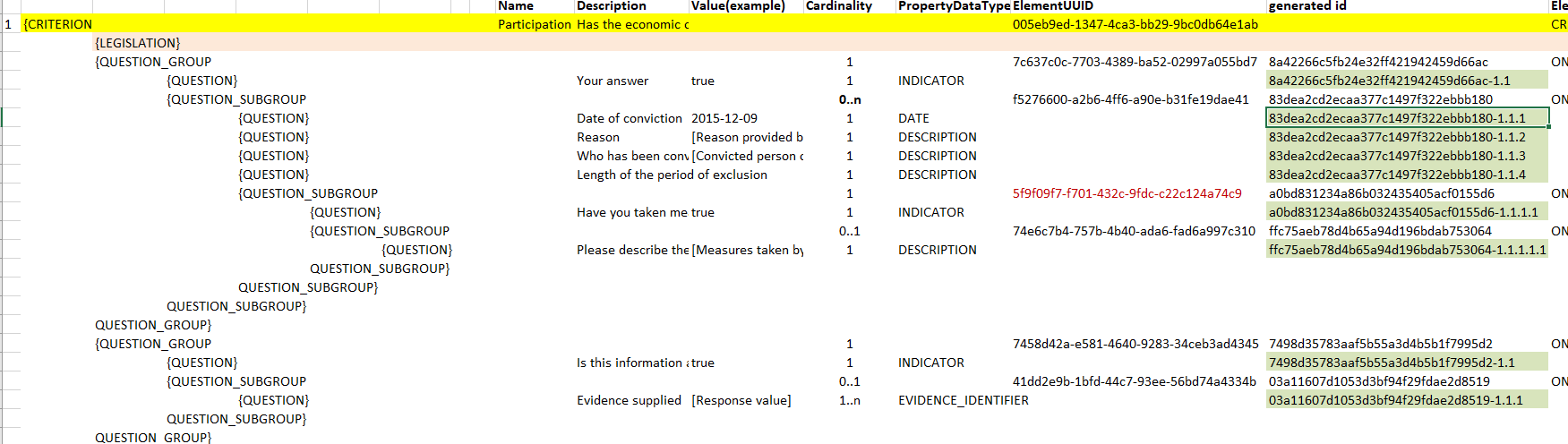
In the Basic and Extended ESPD-EDM Criteria Taxonomies every element of the criterion data structures has an UUID assigned, except for the CAPTIONs, REQUIREMENT(s) and QUESTION(s).
This UUID is necessary to identify unambiguously a particular "data structure" (or "data shape"). One data structure identified with a unique identifier has always the same elements and in the same order. This allows the reuse of the same structure multiple times in the same criterion or in different criteria. These UUIDs map the ones maintained in e-Certis for each criterion.
Examples of data structure reuse
-
Example 1: There is a data structure that is reused by practically all the criteria, the one asking whether the information is available electronically. You will notice that all criteria where it is used the UUIDs of the groups and subgroups are identical, but also the cardinalities, the PropertyDataType and the Element Code.
-
Example 2: If you look into the "Convictions" data structures you will notice a data structure (a QUESTION_SUBGROUP) identified with the UUID "f4978772-3126-4ded-bc30-f50da8c3a038". This subgroup contains one QUESTION ("Have you taken measures to demonstrate your reliability (Self-Cleaning)?" and a sub-group with another QUESTION ("Please describe them"). If you search into the spread-sheet book you will observe that this very structure is also reused by other criteria (e.g. CRITERION.EXCLUSION.SOCIAL.*, CRITERION.EXCLUSION.MISCONDUCT.\*, etc.), but the UUID of the main subgroup is different in all those cases from the one used for Convictions. This is because the Element Code in the case of Convictions (and for this subgroup) is "ONTRUE" whilst in the rest of criteria it is "ON*".
As mentioned above, CAPTIONs, REQUIREMENT(s) and QUESTION(s) cannot have a reusable UUID pre-allocated. The reason for this is that each response by the economic operator (in the ESPD Response document) MUST refer to one, and only one, QUESTION of the ESPD Request. See other details on criterion properties in sections IV.4 Properties and VIII.7 Answering QUESTION(s).
Implementation challenge
The fact that Criterion Properties are to be generated dynamically may pose a challenge to developers in certain situations. One of these situations could be when the QUESTIONs are repositoried and answered in a Pre-Qualification System (PQS) that is used to pre-fill ESPD-Responses to ESPD-Request instances that are kept in another system unknown to the PQS (e.g. a Service Provider acting on behalf of one or more Contracting Authorities).
One possible solution may be based on the fact that each REQUIREMENT and QUESTION occurs always in the same position inside a group or a sub-group. If the order of the REQUIREMENTs and QUESTIONs is altered the Schematron-based validation would trigger a fatal exception.
The proposal consists in identifying each REQUIREMENT and QUESTION by concatenating the UUIDs of the CRITERION and the "parent" groups and sub-groups, as described in the Criteria Taxonomy spread-sheets, produce a short hash of the concatenated string and add to it the position of the element in the group or subgroup. This casts a constant UUID for each REQUIREMENT and QUESTION that would be known by any stakeholder, thus enabling the decoupling of systems producing ESPD-Requests and systems keeping particular QUESTIONS and RESPONSES.
Let’s take one Basic criterion as an example to illustrate this proposal (this works also for Extended ESPD criteria):
Example: Convictions Criterion
User Story
I, as a PQS, need to provide the information about an EO’s convictions, so the EO can produce a pre-filled ESPD-Response.
Algorithm
The algorithm to generate the first subgroup of QUESTIONs (in convictions) would be:
-
Question_UUID = "" ;
-
Question_UUID += Criterion_UUID + "." ;
-
Question_UUID += Group_UUID + "." ;
-
Question_UUID += Subgroup_UUID + "." ;
-
Question_UUID = hash_md5(Question_UUID) ;
-
Question_UUID += Question_UUID + "." + Group_Position() + "." + Subgroup_Position() + "." + Question_Position() ;
Apply repeatedly this algorithm to the subsequent sub-subgroups.
The objective of hashing the concatenation of UUIDs is to produce a non-too-verbose UUID for the QUESTION.
This algorithm produces a unique digital print per each data element of the data shape. If this hash were added to an IRI, the data element could be described in a very specific namespace and its de-referencing could provide back a machine-readable description of the element (name, description, examples, etc.).