I.1 ESPD Introduction
The purpose of this document is to introduce the European Single Procurement Document (ESPD) from a business perspective and to provide high-level information about the two ESPD documents (the Request and the Response documents) and their related users, business processes and contents, as well as to highlight the main goals and benefits of using ESPD. For implementation purposes, please see the ESPD Technical HandBook , which is focused on providing technical guidance for the implementation of the ESPD Exchange Data Model (henceforth ESPD-EDM).
I.1.1 Legal framework and context
Article 59 of the Public Procurement Directive 2014/24/EC (henceforth ''the Directive'') introduced a new concept, the European Single Procurement Document (ESPD), which is a self-declaration document intended for preliminary evidence in a public procurement procedure. By mapping out equivalent certificates between Member States, the ESPD replaces certificates issued by public authorities or a third party involved in a procedure. It is thus a valuable facilitator for cross-border participation of a greater number of potential operators in public procurement procedures and a valuable tool for integrating the European Single Market.
In order to make use of the ESPD concept, the European Commission established an on-line service available for both Buyers and Economic Operators.
The ESPD Service tool allows Buyers and Economic Operators to create, edit, export and import electronic documents in XML format (eESPD) for the exchange of criteria, requirements, statements and references to evidences. Article 4 of the Directive regulates in detail those public procurement procedures in which the value of the contract exceeds a certain amount. These amounts, also known as 'thresholds', vary depending on the type of the contract and the administration level of the Buyer. Those contracts that fall under article 4 of the Directive are called contracts 'above the threshold', and the rest are known as contracts 'below the threshold'. The ESPD Service is rich and flexible enough so as to provide coverage to procurement procedures both above and below the threshold.
The main objective of the ESPD is to reduce the administrative burden and lead to considerable simplification of participation in public procurement procedures for Economic Operators and Buyers by removing the need to produce a substantial number of certificates and documentation related to exclusion and selection criteria. This will answer to obstacles reported by many suppliers and especially small and medium-sized enterprises (SMEs). As shown in the image below, the first version of the digital ESPD was set up in 2016 (version 1.0.1). Since then, a number of new developments and enhancements have been implemented in order to produce a more efficient ESPD Service, taking into account Member States' requirements and needs and in compliance with the Directive. Major releases (from 1.0.2 to 2.0.1, in 2018, and the from 2.1.1 to 3.0.0, in 2021) have implied relevant changes to the ESPD-EDM.
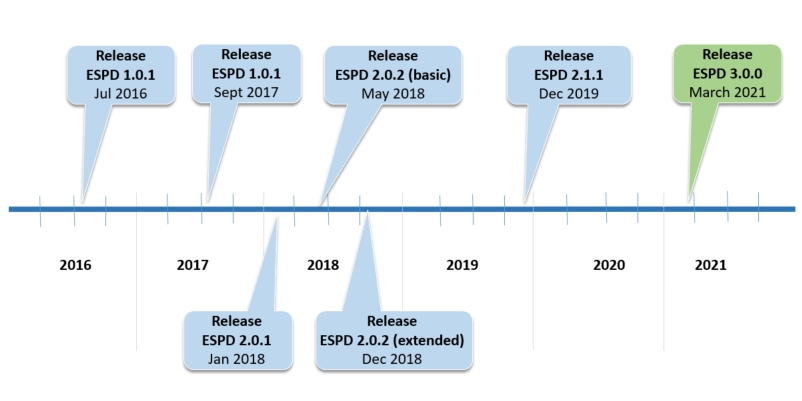
Figure 1: ESPD-EDM Roadmap
Focusing on the last evolution of the ESPD, it is worth to note that it has been developed emphasizing the alignment with eForms . This alignment has followed three main principles: (1) ensure the interoperability between models; (2) the simplification of data processing and (3) to ease the fulfilment of the ESPD in both sides (Buyers and Economic Operators). Currently, the European Commission is no longer maintaining the ESPD service , and it is on Member States to implement the last version available.