IV. Criteria, common aspects
REQUIREMENT _br41-002 |
The contracting body shall provide the exclusion grounds and selection criteria for its tendering process as structured information – via ESPD template or structured list of criteria set out in a call for tender. |
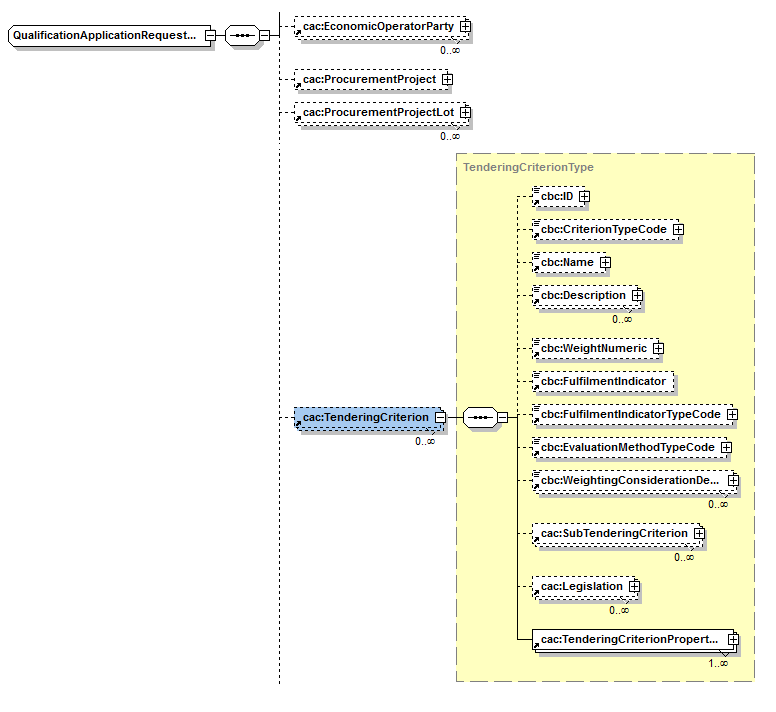
The ESPD-EDM defined a flexible structure to express data about criteria. Based on this structure UBL-2.2 defined in turn the component cac:TenderingCriterion, which is used in ESPD-EDM V2.0.2 to implement the XML objects for exclusion and selection criteria.
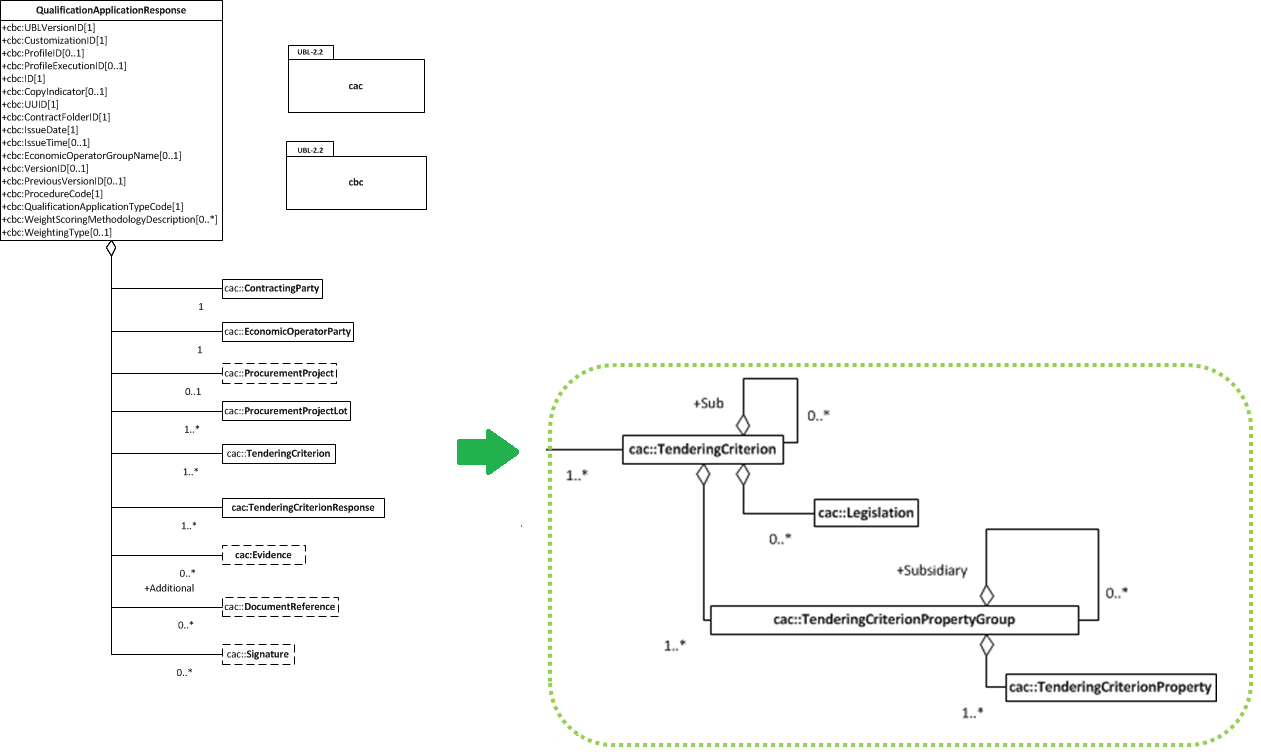
The UML diagram below provides a graphic view of the QualificationApplicationRequest document with the complete structure for the cac:TenderingCriterion component (cf. section on the ESPD Response, furhter on this guide, to understand how the QualificationApplicationResponse deals with Criteria).
IV.1 General behavior
Notice that:
-
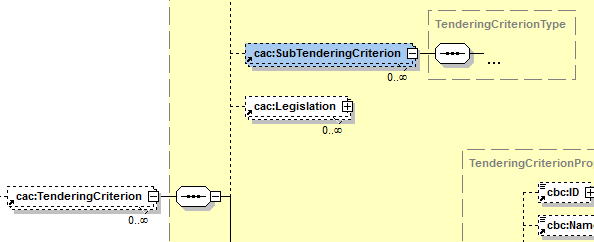
One criterion may have descendent 'sub-criteria'. This is very useful to, for example, define national exclusion criteria that specialise the EU criteria defined in the Directive;
-
One criterion may refer to one or several pieces of legislation (EU, national, other);
-
One criterion must always contain at least one group of 'properties'. Properties may be informative captions; general requirements issued by the Member State or procedure-specific requirements specified by the contracting authority; and questions addressed to the economic operator;
-
One group of properties must always specify at least one 'property';
-
One group of properties may contain one or several 'sub-groups' of properties.
XSD Schema
This XSD Schema diagram shows a global view of the UBL-2.2 cac:TenderingCriterion component:
Expected elements
Class name: |
cac:TenderingCriterion |
Definition: |
A tendering criterion describes a fact or a condition that is used by the contracting body to evaluate and compare tenders by economic operators and which will be used for the exclusion and the selection of candidate tenderers to the award decision. |
Business rule(s): |
SELF-CONTAINED (BR-LOT-20, BR-LOT-30, BR-LOT-30-S20), Common (BR-TC-01) |
File: |
dist/common/xsdrt/UBL-CommonAggregateComponents-Pre-award.xsd |
Path: |
/QualificationApplicationRequest/cac:TenderingCriterion |
| Components | Type | Card | Description | Requirements |
|---|---|---|---|---|
cbc:ID |
Identifier |
1 |
A language-independent token, e.g., a number, that allows to identify a criterion uniquely as well as allows to reference the criterion in other documents. |
Information Requirement: tbr070-010. Rule: Each Criterion is defined in e-Certis and must use the UUID supplied by e-Certis. See also the spreadsheets Criteria Taxonomy (Regulated ESPD) and Criteria Taxonomy (Self-contained ESPD). Rule scope: Common (BR-TC-02, BR-TC-12, BR-TC-13, BR-OTH-02) |
cbc:CriterionTypeCode |
Code |
1 |
A classification code defined by the ESPD-EDM to represent the criterion in the ESPD taxonomy of criteria. |
Information Requirement: tbr070-013 Rule: Compulsory use of codes coming from e-Certis, which are also used in the spreadsheets Criteria Taxonomy (Regulated ESPD) and Criteria Taxonomy (Self-contained ESPD), e.g. CRITERION.EXCLUSION.CONVICTIONS.PARTICIPATION_IN_CRIMINAL_ORGANISATION, CRITERION.EXCLUSION.SOCIAL.ENVIRONMENTAL_LAW, CRITERION.SELECTION.ECONOMIC_FINANCIAL_STANDING.FINANCIAL_RATIO, etc.). Rule scope: Common (BR-REQ-30, BR-REQ-30-S10, BR-REQ-30-S20, BR-REQ-40, BR-TC-03, BR-TC-04, BR-OTH-01, BR-OTH-01#7, BR-OTH-03) |
cbc:Name |
Text |
1 |
A short and descriptive name for a criterion. |
Information Requirement: tbr70-010 Rule: The name should match the one from e-Certis, which should be the same as in the in the spreadsheets Criteria Taxonomy (Regulated ESPD) and Criteria Taxonomy (Self-contained ESPD), e.g. 'Convictions', 'Corruption', 'Fraud', 'Financial ratio', 'Subcontracting proportion', 'Allowance of checks', etc.). Rule scope: Common (BR-TC-05) |
cbc:Description |
Text |
1..n |
An extended description of the criterion. |
Information Requirement: tbr70-010 Rule: The description should match the one from e-Certis, which should be the same as in the in the spreadsheets Criteria Taxonomy (Regulated ESPD) and Criteria Taxonomy (Self-contained ESPD), e.g. 'Has the economic operator itself or any person who is a member of its administrative, management or supervisory body or has powers of representation, decision or control therein been the subject of a conviction by final judgment for participation in a criminal organisation, by a conviction rendered at the most five years ago or in which an exclusion period set out directly in the conviction continues to be applicable? As defined in Article 2 of Council Framework Decision 2008/841/JHA of 24 October 2008 on the fight against organised crime (OJ L 300, 11.11.2008, p. 42).'. Rule scope: Common (BR-TC-06, BR-TC-19) Note: The UBL specification allows always multiple lines of text for the component |
cbc:WeightNumeric |
Numeric |
0..1 |
A weighting to provide for automatic scoring of the Criterion (normally a percentage, e.g. 0.1, 0.5) |
Information Requirement: tbr70-016 Rule: Used only in Self-contained ESPDs namely for ability and professional selection criteria in procedures organised in two stages. Rule scope: SELF-CONTAINED (BR-2P-10, BR-2P-10-S10, BR-2P-10-S10#1, BR-2P-10-S20#1) |
cbc:EvaluationMethodTypeCode |
Code |
0..1 |
A code to inform about the type of Evaluation, namely for transparency purposes (e.g. PASSFAIL, WEIGHTED) |
Information Requirement: tbr70-016 Rule: Compulsory use of the Code List “EvaluationMethodType”. Rule scope: SELF-CONTAINED (BR-2P-10-S10#2, BR-2P-10-S20, BR-OTH-01, BR-OTH-03, BR-OTH-01#8, BR-OTH-03) |
cbc:WeightingConsiderationDescription |
Numeric |
0..n |
Additional information, comments or considerations about the weighting and the evaluation method, namely for transparency purposes; e.g. '0 Points 0 IT specialists, 30 Points 1 IT specialists, 60 Points 2 IT specialists'. See section about Selection Criteria and sub-section on 'Weighting', for more details. |
Information Requirement: tbr70-016 Rule: Used only in Self-contained ESPDs namely for ability and professional selection criteria in procedures organised in two stages. |
cbc:SubTenderingCriterion |
Class |
0..n |
One or more descendant criteria used namely to define a national exclusion criterion that specialises a more generic criterion like a EU exclusion criterion defined in the Directive. |
Information Requirement: tbr70-013 Rule: None. Beware that a sub-criterion 'is a' criterion, therefore no need to list these elements at new. See XML examples in the section about exclusion criteria about how to define a sub-criterion. |
cbc:Legislation |
Class |
0..n |
A reference to the legislation related to the Criterion. |
Information Requirement: tbr070-013 Rule: None. See table below with the elements of this class. |
cbc:TenderingCriterionPropertyGroup |
Class |
1..n |
The first level group of properties and sub-groups of properties in the structure of a criterion. |
Information Requirement: tbr070-013 Rule: None. Beware that in previous versions of the ESPD-EDM this was termed “RequirementGroup”. |
IV.2 Legislation
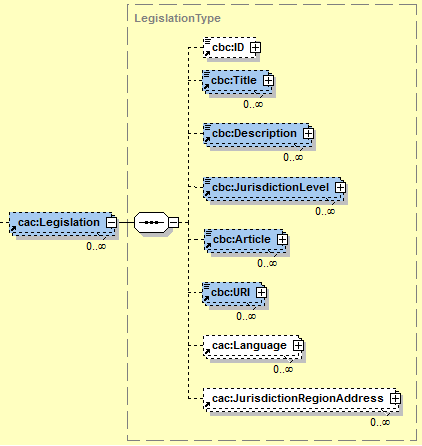
The XSD schema below shows, in blue, the elements of the component cac:Legislation used to point at the legislation related to the criterion.
Expected elements
Class name: |
cac:Legislation |
Definition: |
A class to make reference to the legislation related to the criterion. |
Business rule(s): |
Common (BR-TC-08, 2. BR-OTH-01, BR-OTH-01#9, BR-OTH-03) |
File: |
dist/common/xsdrt/UBL-CommonAggregateComponents-Pre-award.xsd |
Path: |
/QualificationApplicationRequest/cac:TenderingCriterion/cac:Legislation |
| Components | Type | Card | Description | Requirements |
|---|---|---|---|---|
cbc:LegislationTitle |
Text |
1..n |
Title of the legislation. |
Information Requirement: tbr070-013. Rule: The complete title of the legislation provided as in the original legal text. At a later stage it might be provided by e-CERTIS (e.g.'DIRECTIVE 2014/24/EU OF THE EUROPEAN PARLIAMENT AND OF THE COUNCIL of 26 February 2014
on public procurement and repealing Directive 2004/18/EC'). Can be provided in several languages, but if Rule scope: Common (BR-TC-09) |
cbc:Description |
Code |
0..n |
Textual short description of the legislation. |
Information Requirement: tbr070-013 Rule: The description of the legislation provided in the original legal text SHOULD be provided. At a later stage they might be provided by e-CERTIS. Can be provided in several languages, but if Rule scope: Common (BR-TC-10) |
cbc:JurisdictionLevel |
Text |
0..n |
Jurisdictional level of a particular legislation. |
Information Requirement: tbr070-013 Rule: Although this is a text, use the description in Code List Rule scope: Common (BR-OTH-03, BR-OTH-01#10, BR-OTH-03) |
cbc:Article |
Text |
0..n |
Textual description of the article of the legislation. |
Information Requirement: tbr070-013 Rule: Other articles where the Criterion is referred to SHOULD also be provided. At a later stage they might be provided by eCERTIS. Can be provided in several languages, but if Rule scope: Common (BR-TC-11) |
cbc:URI |
Identifier |
0..1 |
URI that points to a legislation related to this criterion. |
Information Requirement: tbr070-013 Rule: In the case of European legislation, the URL MUST point at the multilingual EUR-LEX web-page; e.g. Directive 2014/24/EU. |
XML Example
Snippet of XML to illustrate how to use the cac:Legislation component inside a criterion:
<cac:TenderingCriterion>

 <!-- ... elements omitted for brevity -->

	<cac:Legislation>
		<cbc:ID schemeID="CriteriaTaxonomy" schemeAgencyID="EU-COM-GROW" schemeVersionID="2.0.2">4ea7a10a-643e-4022-b67e-e06573b28ff5</cbc:ID>(1)
		<cbc:Title>DIRECTIVE 2014/24/EU OF THE EUROPEAN PARLIAMENT AND OF THE COUNCIL of 26 February 2014 on public procurement and repealing Directive 2004/18/EC</cbc:Title> (2)
		<cbc:Description>DIRECTIVE 2014/24/EU OF THE EUROPEAN PARLIAMENT AND OF THE COUNCIL of 26 February 2014 on public procurement and repealing Directive 2004/18/EC</cbc:Description> (3)
		<cbc:JurisdictionLevel languageID="en">EU Directive</cbc:JurisdictionLevel> (4)
		<cbc:Article>57(1)</cbc:Article> (5)
		<cbc:URI>http://eur-lex.europa.eu/legal-content/ES/TXT/?uri=celex%3A32014L0024</cbc:URI> (6)
		</cac:Legislation>

 <!-- ... elements omitted for brevity -->

</cac:TenderingCriterion>| 1 | Use the UUID provided by GROW. |
| 2 | The official long title of the legislation is expected in the Title. |
| 3 | The short name that is commonly used to refer to the legislation is expected in the Description. |
| 4 | Use the textual values (descriptions) listed in the Code List LegislationType ESPD-CodeLists-V2.0.2.ods |
IV.3 Groups of properties
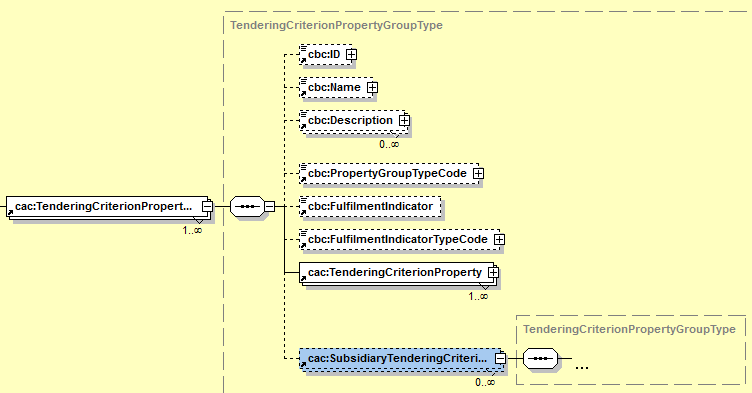
This XSD diagram shows the sub-components of a group of criteria:
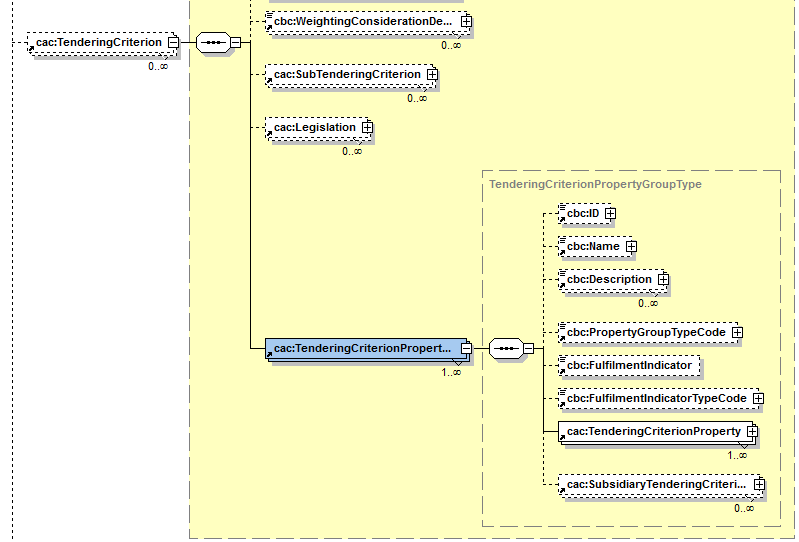
One group of properties may include one or more 'sub-groups' of properties (class cac:SubsidiaryTenderingCriterionGroup).
Notice that: One sub-group of properties 'is a' group of criteria:
Expected elements
Class name: |
cac:TenderingCriterionPropertyGroup |
Definition: |
The first level group of properties and sub-groups of properties in the structure of a criterion. |
Business rule(s): |
Common (BR-TC-07, BR-TC-16) |
File: |
dist/common/xsdrt/UBL-CommonAggregateComponents-Pre-award.xsd |
Path: |
/QualificationApplicationRequest/cac:TenderingCriterion/cac:TenderingCriterionPropertyGroup |
| Components | Type | Card | Description | Requirements |
|---|---|---|---|---|
cbc:ID |
Identifier |
1 |
Identifies a group of requirements uniquely. |
Information Requirement: tbr070-013. Rule: Compulsory use of the UUIDs supplied by e-Certis. See also the spreadsheets Criteria Taxonomy (Regulated ESPD) and Criteria Taxonomy (Self-contained ESPD). Rule scope: Common (BR-TC-12, BR-OTH-02, BR-OTH-02#01) |
cbc:PropertyGroupTypeCode |
Code |
1 |
Code addressed to control the behavior of the group of criteria. |
Information Requirement: tbr070-013. Rule: Compulsory use of the Code List Rule scope: Common (BR-TC-14, BR-TC-15, BR-OTH-01, BR-OTH-01#11, BR-OTH-03) |
cac:TenderingCriterionProperty |
Class |
1..n |
Caption (i.e. a 'label'), specific MS or contracting authority requirement (e.g. 'Number of references expected: 5' or a question addressed to the economic operator (e.g. 'Your average yearly turnover for the past three years?'. |
Information Requirement: tbr070-013. Rule: See the rules for the class in the tables below to see the rules related to criterion properties. See also the XML examples provided in sections about exclusion and selection criteria. |
cac:SubsidiaryTenderingCriterionPropertyGroup |
Class |
0..n |
A second, third or n-level group inside a first level group of properties. |
Information Requirement: tbr070-013. Rule: subsidiary property groups 'are' property groups (i.e. its the same component but qualified as 'subsidary'). Therefore all the rules applicable to property groups are also applicable to sub-groups: Compulsory use of the Code List |
XML Examples
-
See examples in sections about exclusion and selection criteria.
-
You will notice in the examples that the elements
cbc:Nameandcbc:Descriptionof groups and subgroups of properties are never used. As a common practice the ESPD documents use instead a firstcac:TenderingCriterionPropertyof type CAPTION (i.e. an informative property that act as a 'label').
IV.4 Properties
REQUIREMENT |
The contracting authority needs to be able to specify the type of the value it expects from the economic operator in a response; e.g. DESCRIPTION, INDICATOR, QUANTITY, URL, etc.). The economic operator must provide a value for the response that is consistent with the type specified by the contracting authority. |
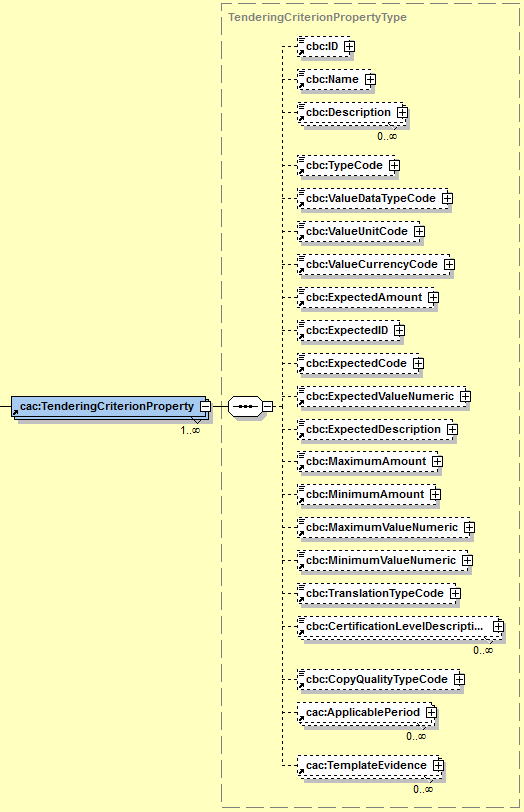
This other XSD diagram shows the elements of the properties of a criterion :
Notice that: One sub-criterion 'is a' criterion:
Expected elements
The following table lists the elements of a criterion property. Beware that the majority of the elements are the possible types of responses that the contracting authority can specify. The economic operator, in the ESPDResponse, must provide values that are consistent with the type specified by the contracting authority.
Class name: |
cac:TenderingCriterionProperty |
Definition: |
Caption (i.e. a 'label'), specific MS or contracting authority requirement (e.g. 'Number of references expected: 5' or a question addressed to the economic operator (e.g. 'Your average yearly turnover for the past three years?'. Information Requirement: tbr070-013 |
Business rule(s): |
SELF-CONTAINED (BR-SC-20) |
File: |
dist/common/xsdrt/UBL-CommonAggregateComponents-Pre-award.xsd |
Path: |
/QualificationApplicationRequest/cac:TenderingCriterion/cac:TenderingCriterionProperty |
| Components | Type | Card | Description | Requirements |
|---|---|---|---|---|
cbc:ID |
Identifier |
1 |
Identifies one specific property. |
Information Requirement: tbr070-013. Rule: Property identifiers must use UUID numbers (version 4) automatically generated. The responses of the economic operator (in the ESPD Response document) will refer to this UUID to link the response with one, and only one, criterion property. See the section about the ESPD Response for examples. Rule scope: Common (BR-TC-18, BR-OTH-02) |
cbc:Description |
Text |
1 |
The text of the caption, requirement or question. |
Information Requirement: tbr070-013. Rule: None. Rule scope: Common (BR-TC-19) |
cbc:TypeCode |
Code |
1 |
The type of property. Used to verify that structure of the property is correct. |
Information Requirement: tbr070-013. Rule: Compulsory use of the Code List 'CriterionElementType'. Possible types are 'CAPTION, REQUIREMENT and QUESTION'. If the type is Rule scope: SELF-CONTAINED (BR-TC-20, BR-OTH-01, BR-OTH-01#14, BR-OTH-03) |
cbc:ValueDataTypeCode |
Code |
1 |
The type of answer expected by the contracting authority in the case of a poperty of type QUESTION. |
Information Requirement: tbr070-013. Rule: Compulsory use of the Code List Rule scope: Common (BR-TC-21, BR-OTH-01, BR-OTH-03, BR-OTH-01#12, BR-OTH-03) |
cbc:ValueUnitCode |
Code |
0..1 |
The unit of measure of the numeric value as a quantity or measure in the expected response from the economic operator. |
Information Requirement: *Rule*: Verify that the value of `+cac:TypeCode`" class="bare">http://wiki.ds.unipi.gr/display/ESPDInt/BIS+41+-ESPD+V2.0#BIS41-ESPDV2.0-tbr070-013[_tbr070-013_]. *Rule*: Verify that the value of `+cac:TypeCode` is set to`QUESTION`and that the Rule scope: SELF-CONTAINED (BR-OTH-01) |
cbc:ValueCurrencyCode |
Code |
0..1 |
The currency of the numeric value as an amount in the expected response from the economic operator. |
Information Requirement: *Rule*: Verify that the value of `+cac:TypeCode`" class="bare">http://wiki.ds.unipi.gr/display/ESPDInt/BIS+41+-ESPD+V2.0#BIS41-ESPDV2.0-tbr070-013[_tbr070-013_]. *Rule*: Verify that the value of `+cac:TypeCode` is set to`QUESTION`and that the Rule scope: SELF-CONTAINED (BR-OTH-01) |
cbc:ExpectedID |
Identifier |
0..1 |
The expected identifier that the economic operator has to provide in the criterion response. |
Information Requirement: *Rule*: Verify that the value of `+cac:TypeCode`" class="bare">http://wiki.ds.unipi.gr/display/ESPDInt/BIS+41+-ESPD+V2.0#BIS41-ESPDV2.0-tbr070-013[_tbr070-013_]. *Rule*: Verify that the value of `+cac:TypeCode` is set to`QUESTION`and that the Rule scope: SELF-CONTAINED (BR-LOT-40) |
cbc:ExpectedCode |
Code |
0..1 |
The expected code that the economic operator has to provide in the Criterion response. |
Information Requirement: *Rule*: Verify that the value of `+cac:TypeCode`" class="bare">http://wiki.ds.unipi.gr/display/ESPDInt/BIS+41+-ESPD+V2.0#BIS41-ESPDV2.0-tbr070-013[_tbr070-013_]. *Rule*: Verify that the value of `+cac:TypeCode` is set to`QUESTION`and that the Rule scope: SELF-CONTAINED (BR-OTH-01) |
cbc:ExpectedValueNumeric |
Numeric |
0..1 |
The expected value that the economic operator has to provide in the Criterion response. |
Information Requirement: *Rule*: Verify that the value of `+cac:TypeCode`" class="bare">http://wiki.ds.unipi.gr/display/ESPDInt/BIS+41+-ESPD+V2.0#BIS41-ESPDV2.0-tbr070-013[_tbr070-013_]. *Rule*: Verify that the value of `+cac:TypeCode` is set to`QUESTION`and that the |
cbc:MaximumValueNumeric |
Numeric |
0..1 |
The maximum value the response must have. |
Information Requirement: *Rule*: Verify that the value of `+cac:TypeCode`" class="bare">http://wiki.ds.unipi.gr/display/ESPDInt/BIS+41+-ESPD+V2.0#BIS41-ESPDV2.0-tbr070-013[_tbr070-013_]. *Rule*: Verify that the value of `+cac:TypeCode` is set to`QUESTION`and that the |
cbc:MinimumValueNumeric |
Numeric |
0..1 |
The minimum value the response must have. |
Information Requirement: *Rule*: Verify that the value of `+cac:TypeCode`" class="bare">http://wiki.ds.unipi.gr/display/ESPDInt/BIS+41+-ESPD+V2.0#BIS41-ESPDV2.0-tbr070-013[_tbr070-013_]. *Rule*: Verify that the value of `+cac:TypeCode` is set to`QUESTION`and that the |
cbc:CertificationLevelDescription |
Text |
0..1 |
The description of the level of the expected certification. |
Information Requirement: *Rule*: Verify that the value of `+cac:TypeCode`" class="bare">http://wiki.ds.unipi.gr/display/ESPDInt/BIS+41+-ESPD+V2.0#BIS41-ESPDV2.0-tbr070-013[_tbr070-013_]. *Rule*: Verify that the value of `+cac:TypeCode` is set to`QUESTION`and that the |
cac:ApplicablePeriod |
Class |
0..1 |
The period to which this criterion property shall apply. |
Information Requirement: tbr070-013. Rule: The ESPD-EDM does only expect start date and end date. |
cac:TemplateEvidence |
Class |
0..n |
A pointer to one or more evidences that support the veracity of this criterion. |
Information Requirement: tbr070-013. Rule: None. |